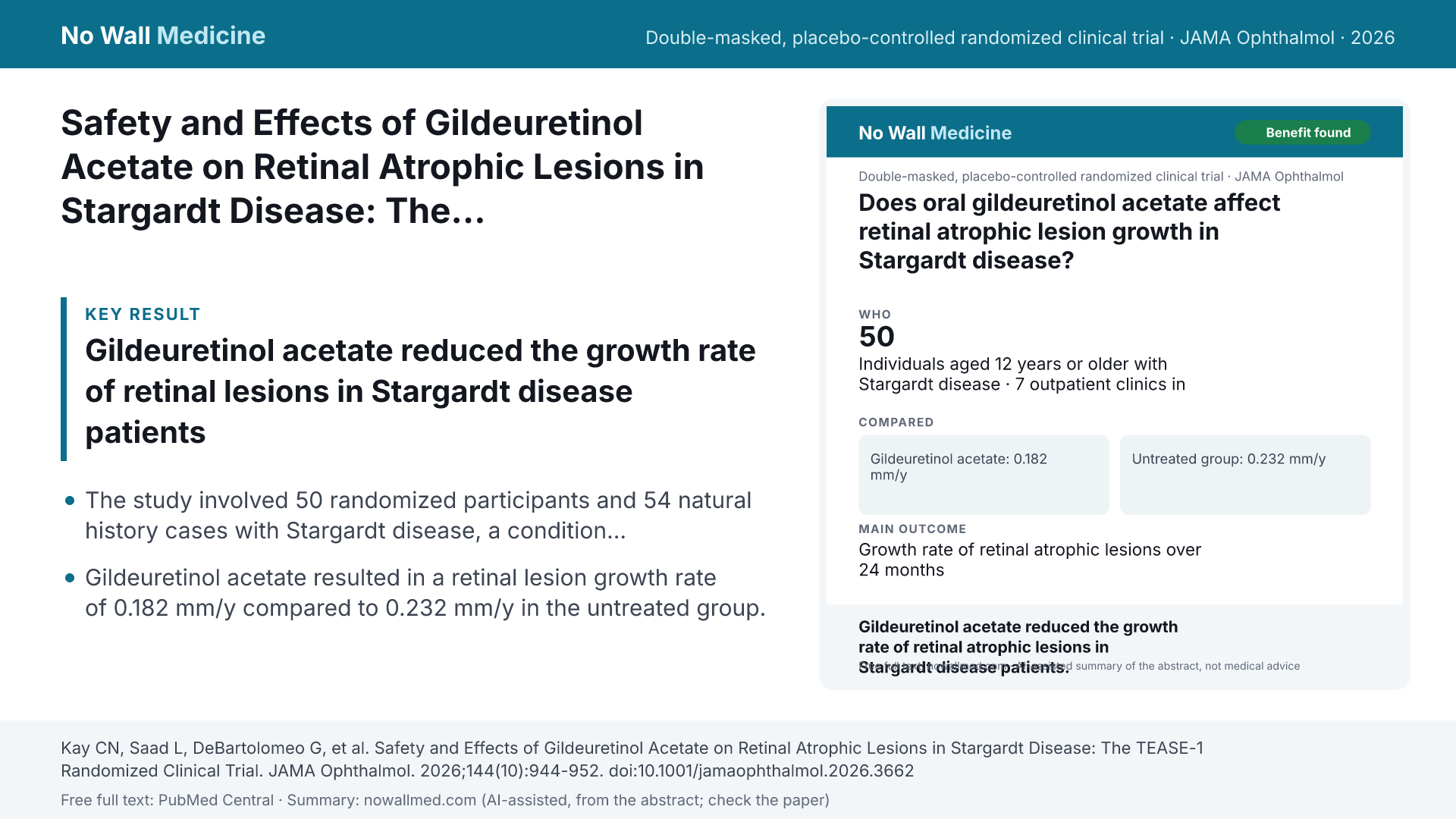
Gildeuretinol acetate reduced the growth rate of retinal lesions in Stargardt disease patients
Safety and Effects of Gildeuretinol Acetate on Retinal Atrophic Lesions in Stargardt Disease: The TEASE-1 Randomized Clinical Trial
OphthalmologyAdult and pediatric
Double-masked, placebo-controlled randomized clinical trialBenefit found
Does oral gildeuretinol acetate affect retinal atrophic lesion growth in Stargardt disease?
Who
50
Individuals aged 12 years or older with Stargardt disease · 7 outpatient clinics in the US
Compared
Gildeuretinol acetate: 0.182 mm/y
Untreated group: 0.232 mm/y
Main outcome
Growth rate of retinal atrophic lesions over 24 months
Result: mean difference -0.050 mm/y (95% CI, -0.072 to -0.027)
Bottom line: Gildeuretinol acetate reduced the growth rate of retinal atrophic lesions in Stargardt disease patients.
JAMA Ophthalmol · 2026-09-03 · Save PNG
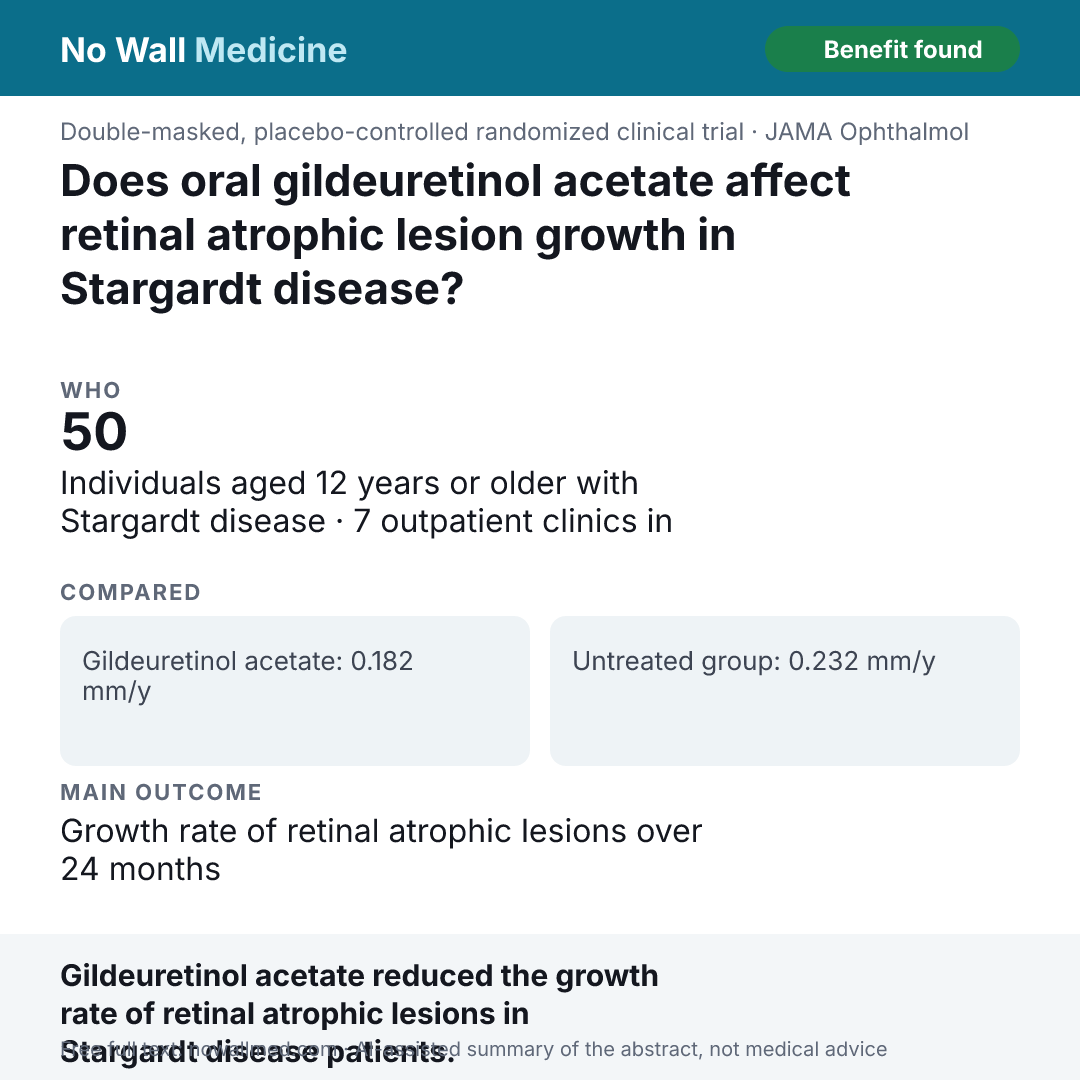
Clinical question: Does oral gildeuretinol acetate affect retinal atrophic lesion growth in Stargardt disease?
Why it matters: There is currently no approved treatment for Stargardt disease, which is the most common macular dystrophy.
Key points
- The study involved 50 randomized participants and 54 natural history cases with Stargardt disease, a condition causing vision loss.
- Gildeuretinol acetate resulted in a retinal lesion growth rate of 0.182 mm/y compared to 0.232 mm/y in the untreated group.
- Most adverse events were mild or moderate, and no treatment-related serious adverse events or liver function abnormalities were reported.
Headline and key points written with AI from the paper’s abstract, with every number checked against it. Read the paper before relying on them.
Was this summary helpful?
Subject terms
Headline, design, result, key points, caveat and citation as plain text.
Cite this article
Kay CN, Saad L, DeBartolomeo G, et al. Safety and Effects of Gildeuretinol Acetate on Retinal Atrophic Lesions in Stargardt Disease: The TEASE-1 Randomized Clinical Trial. JAMA Ophthalmol. 2026;144(10):944-952. doi:10.1001/jamaophthalmol.2026.3662
Spotted a mistake? Suggest a correction