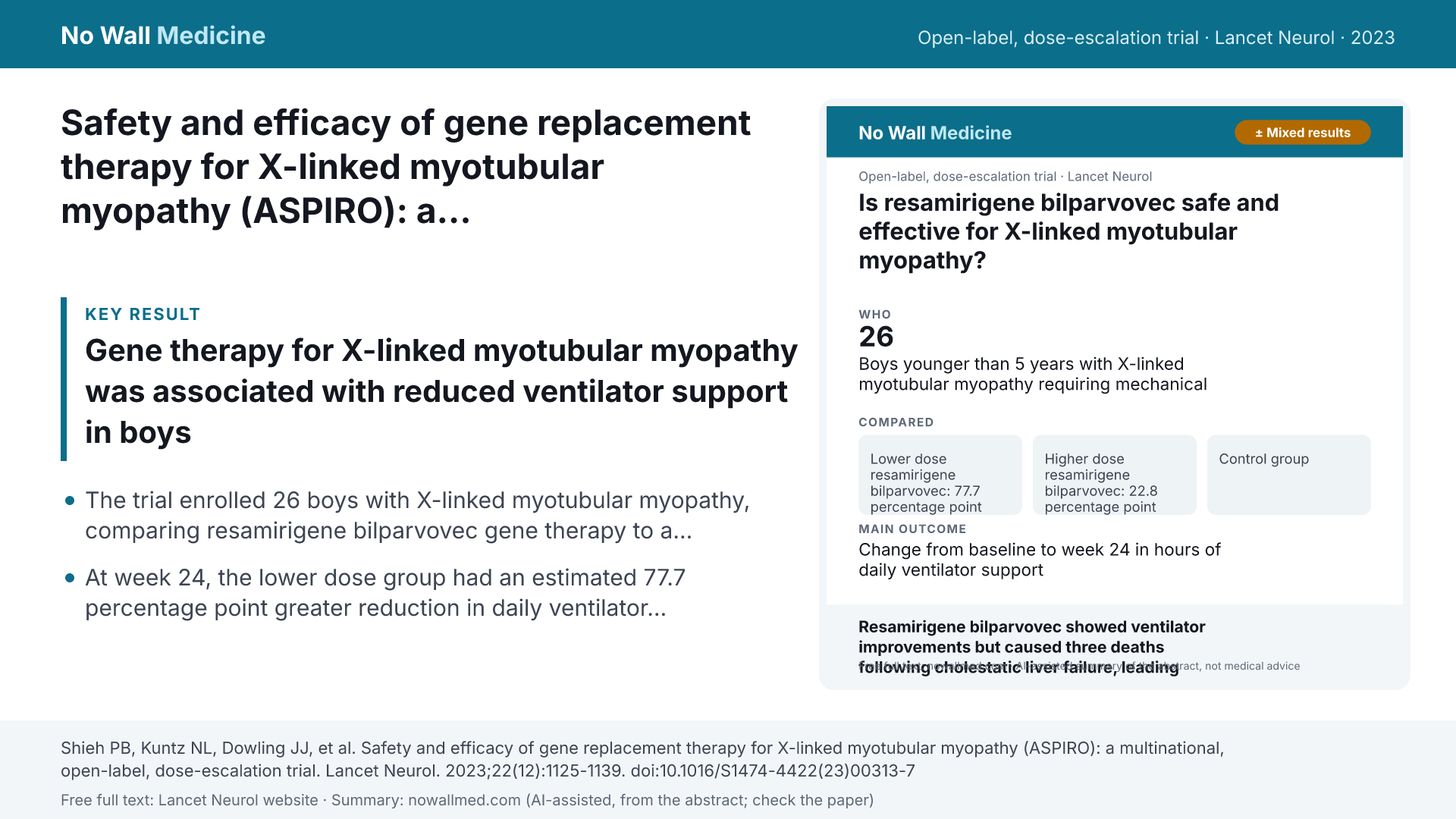
Gene therapy for X-linked myotubular myopathy was associated with reduced ventilator support in boys
Safety and efficacy of gene replacement therapy for X-linked myotubular myopathy (ASPIRO): a multinational, open-label, dose-escalation trial
Open-label, dose-escalation trialMixed results
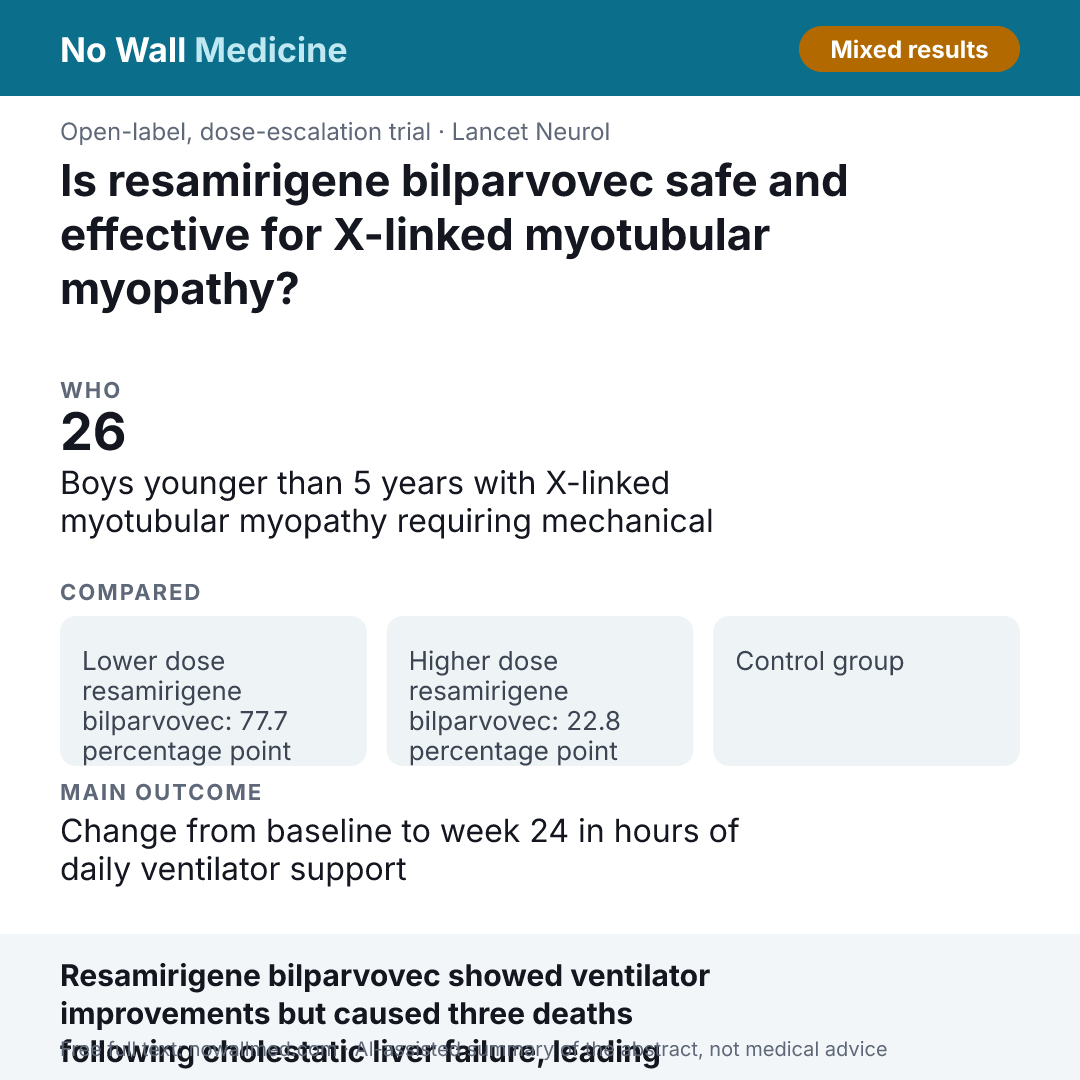
Is resamirigene bilparvovec safe and effective for X-linked myotubular myopathy?
Who
26
Boys younger than 5 years with X-linked myotubular myopathy requiring mechanical ventilator support · Seven academic medical centres in Canada, France, Germany, and USA
Compared
Lower dose resamirigene bilparvovec: 77.7 percentage point greater reduction in ventilator support
Higher dose resamirigene bilparvovec: 22.8 percentage point greater reduction in ventilator support
Control group
Main outcome
Change from baseline to week 24 in hours of daily ventilator support
Result: 77.7 percentage point (95% CI 40.22 to 115.24) greater reduction (lower dose)
Bottom line: Resamirigene bilparvovec showed ventilator improvements but caused three deaths following cholestatic liver failure, leading to a study pause.
Lancet Neurol · 2023-11-18 · Save PNG
Clinical question: Is resamirigene bilparvovec safe and effective for X-linked myotubular myopathy?
Why it matters: No approved therapies exist for X-linked myotubular myopathy, a rare and life-threatening muscle disease caused by MTM1 mutations.
Key points
- The trial enrolled 26 boys with X-linked myotubular myopathy, comparing resamirigene bilparvovec gene therapy to a control group.
- At week 24, the lower dose group had an estimated 77.7 percentage point greater reduction in daily ventilator support hours compared to controls.
- Four deaths occurred in the treated groups, including one in the lower dose cohort and three in the higher dose cohort, following cholestatic liver failure.
Headline and key points written with AI from the paper’s abstract, with every number checked against it. Read the paper before relying on them.
Was this summary helpful?
Abstract
Background
X-linked myotubular myopathy is a rare, life-threatening, congenital muscle disease observed mostly in males, which is caused by mutations in MTM1. No therapies are approved for this disease. We aimed to assess the safety and efficacy of resamirigene bilparvovec, which is an adeno-associated viral vector serotype 8 delivering human MTM1. Methods
ASPIRO is an open-label, dose-escalation trial at seven academic medical centres in Canada, France, Germany, and the USA. We included boys younger than 5 years with X-linked myotubular myopathy who required mechanical ventilator support. The trial was initially in two parts. Part 1 was planned as a safety and dose-escalation phase in which participants were randomly allocated (2:1) to either the first dose level (1·3 × 1014 vector genomes [vg]/kg bodyweight) of resamirigene bilparvovec or delayed treatment, then, for later participants, to either a higher dose (3·5 × 1014 vg/kg bodyweight) of resamirigene bilparvovec or delayed treatment. Part 2 was intended to confirm the dose selected in part 1. Resamirigene bilparvovec was administered as a single intravenous infusion. An untreated control group comprised boys who participated in a run-in study (INCEPTUS; NCT02704273) or those in the delayed treatment cohort who did not receive any dose. The primary efficacy outcome was the change from baseline to week 24 in hours of daily ventilator support. After three unexpected deaths, dosing at the higher dose was stopped and the two-part feature of the study design was eliminated. Because of changes to the study design during its implementation, analyses were done on an as-treated basis and are deemed exploratory. All treated and control participants were included in the safety analysis. The trial is registered with ClinicalTrials.gov, NCT03199469. Outcomes are reported as of Feb 28, 2022. ASPIRO is currently paused while deaths in dosed participants are investigated. Findings
Between Aug 3, 2017 and June 1, 2021, 30 participants were screened for eligibility, of whom 26 were enrolled; six were allocated to the lower dose, 13 to the higher dose, and seven to delayed treatment. Of the seven children whose treatment was delayed, four later received the higher dose (n=17 total in the higher dose cohort), one received the lower dose (n=7 total in the lower dose cohort), and two received no dose and joined the control group (n=14 total, including 12 children from INCEPTUS). Median age at dosing or enrolment was 12·1 months (IQR 10·0-30·9; range 9·5-49·7) in the lower dose cohort, 31·1 months (16·0-64·7; 6·8-72·7) in the higher dose cohort, and 18·7 months (10·1-31·5; 5·9-39·3) in the control cohort. Median follow-up was 46·1 months (IQR 41·0-49·5; range 2·1-54·7) for lower dose participants, 27·6 months (24·6-29·1; 3·4-41·0) for higher dose participants, and 28·3 months (9·7-46·9; 5·7-32·7) for control participants. At week 24, lower dose participants had an estimated 77·7 percentage point (95% CI 40·22 to 115·24) greater reduction in least squares mean hours per day of ventilator support from baseline versus controls (p=0·0002), and higher dose participants had a 22·8 percentage point (6·15 to 39·37) greater reduction from baseline versus controls (p=0·0077). One participant in the lower dose cohort and three in the higher dose cohort died; at the time of death, all children had cholestatic liver failure following gene therapy (immediate causes of death were sepsis; hepatopathy, severe immune dysfunction, and pseudomonal sepsis; gastrointestinal haemorrhage; and septic shock). Three individuals in the control group died (haemorrhage presumed related to hepatic peliosis; aspiration pneumonia; and cardiopulmonary failure). Interpretation
Most children with X-linked myotubular myopathy who received MTM1 gene replacement therapy had important improvements in ventilator dependence and motor function, with more than half of dosed participants achieving ventilator independence and some attaining the ability to walk independently. Investigations into the risk for underlying hepatobiliary disease in X-linked myotubular myopathy, and the need for monitoring of liver function before gene replacement therapy, are ongoing. Funding
Astellas Gene Therapies.
Abstract reproduced under the article’s CC BY NC ND licence.
Subject terms
Headline, design, result, key points, caveat and citation as plain text.
Cite this article
Shieh PB, Kuntz NL, Dowling JJ, et al. Safety and efficacy of gene replacement therapy for X-linked myotubular myopathy (ASPIRO): a multinational, open-label, dose-escalation trial. Lancet Neurol. 2023;22(12):1125-1139. doi:10.1016/S1474-4422(23)00313-7
Spotted a mistake? Suggest a correction