Intensive task-specific training did not improve motor recovery in people with recent spinal cord injury
Safety and efficacy of intensive task-specific training in people with recent spinal cord injury: a phase 3, pragmatic, randomised, assessor-blinded, superiority trial
Phase 3, pragmatic, randomised, assessor-blinded, superiority trialNo clear difference
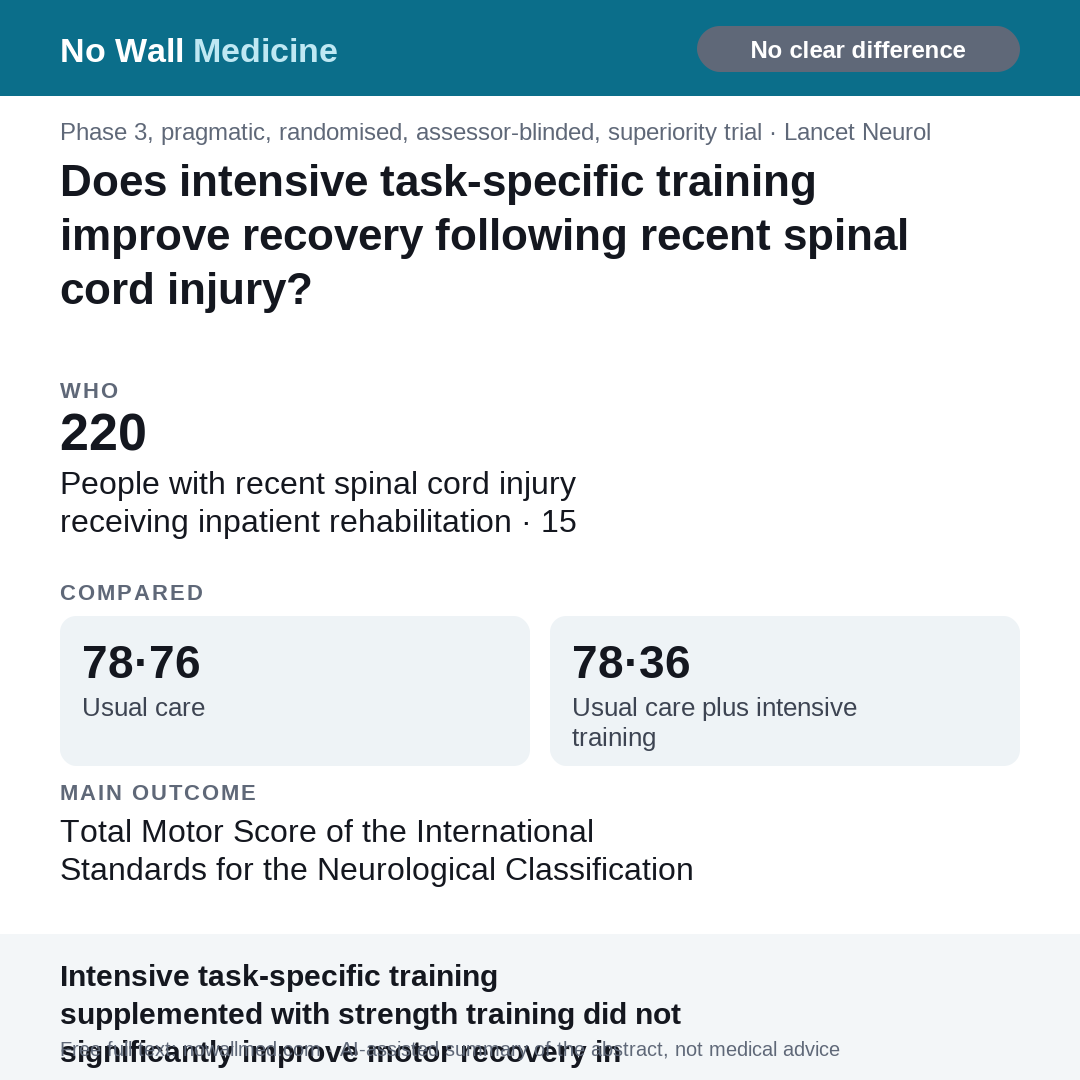
Does intensive task-specific training improve recovery following recent spinal cord injury?
Who
220
People with recent spinal cord injury receiving inpatient rehabilitation · 15 hospitals in six countries
Compared
78·76Usual care (SD 17·34)
78·36Usual care plus intensive training (SD 17·00)
Main outcome
Total Motor Score of the International Standards for the Neurological Classification of SCI
Result: mean between-group difference 0·93 (95% CI -1·63 to 3·48)
Bottom line: Intensive task-specific training supplemented with strength training did not significantly improve motor recovery in people with recent spinal cord injury.
Funded by: New South Wales Ministry of Health, University of Sydney, and Wings for Life
Lancet Neurol · 2026-02-22Download image
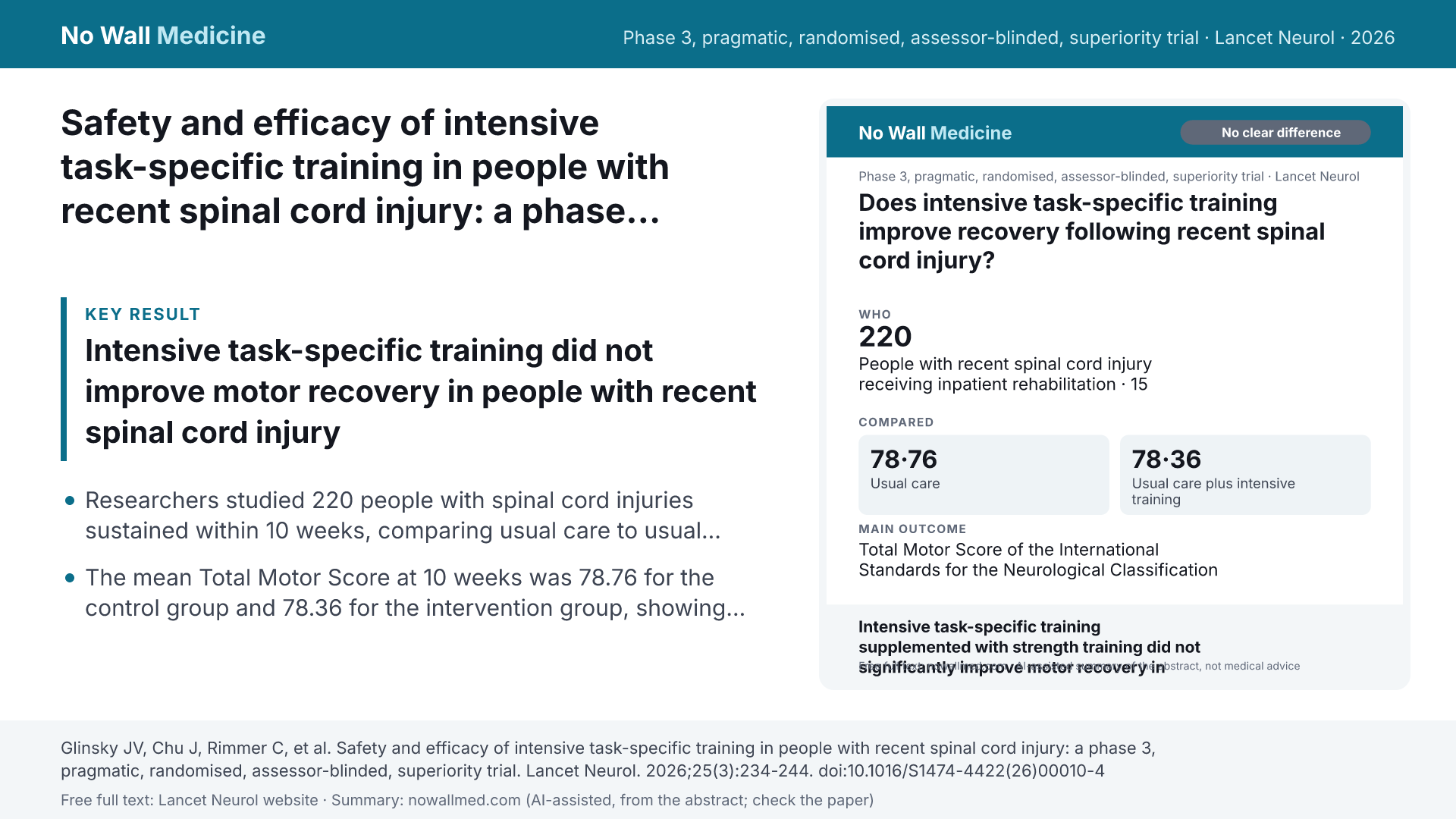
Clinical question: Does intensive task-specific training improve recovery following recent spinal cord injury?
Why it matters: It is widely believed that intensive task-specific training improves neurological recovery by exploiting spinal plasticity in people with recent spinal cord injury.
Key points
- Researchers studied 220 people with spinal cord injuries sustained within 10 weeks, comparing usual care to usual care plus 12 hours of weekly intensive training.
- The mean Total Motor Score at 10 weeks was 78.76 for the control group and 78.36 for the intervention group, showing no significant difference.
- Four serious adverse events occurred, including two deaths in the intervention group and one in the control group.
Headline and key points written with AI from the paper’s abstract, with every number checked against it. Read the paper before relying on them.
Was this summary helpful?
Abstract
Background
It is widely believed that intensive task-specific training enhances neurological recovery in people with spinal cord injury (SCI) by exploiting activity-dependent spinal plasticity. We aimed to determine whether 10 weeks of intensive task-specific training supplemented with strength training that targets motor function at and below the level of the lesion improves recovery following recent SCI. Methods
We conducted a pragmatic phase 3 superiority randomised controlled trial at 15 hospitals in Australia, Belgium, Italy, the Netherlands, Norway, and the UK (England and Scotland). People who sustained a SCI in the preceding 10 weeks, had some motor function below the level of injury, and were receiving inpatient rehabilitation were randomly assigned to usual care (control group) or usual care plus 12 h per week for 10 weeks of intensive task-specific training targeting voluntary motor function below the level of the lesion supplemented with strength training (intervention group). Randomisation was computer generated, concealed, and stratified by site and level of injury. The primary outcome was Total Motor Score of the International Standards for the Neurological Classification of SCI (0-100 points) at 10 weeks. The outcome assessors were blinded to group assignment. Serious adverse events were defined as those resulting in death, life-threatening conditions, prolongation of hospitalisation, or substantial disability. All analyses were conducted by intention to treat. The trial is registered with the Australian New Zealand Clinical Trials Registry (ACTRN12621000091808; universal trial number: U1111-1264-1689). Findings
Between June 7, 2021, and Feb 5, 2025, 220 participants were randomly assigned to the control (n=111; 23 female and 88 male) or intervention (n=109; 28 female and 81 male) group. Data were available for 216 (98%) of 220 participants at 10 weeks (107 in the intervention group and 109 in the control group). The mean Total Motor Scores at 10 weeks were 78·76 (SD 17·34) for the control group and 78·36 (SD 17·00) for the intervention group. The mean between-group difference was 0·93 (95% CI -1·63 to 3·48; p=0·48). There were four serious adverse events (three in the intervention group and one in the control group) including two deaths in participants from the intervention group. Interpretation
Intensive task-specific training supplemented with strength training provided in people with recent SCI did not result in significant benefits on our primary and secondary clinical outcomes. The evidence does not support any beneficial effect of additional training for those receiving usual inpatient rehabilitation care from a multi-disciplinary team. Funding
New South Wales Ministry of Health, University of Sydney, and Wings for Life.
Abstract reproduced under the article’s CC BY licence.
Subject terms
Cite this article
Glinsky JV, Chu J, Rimmer C, et al. Safety and efficacy of intensive task-specific training in people with recent spinal cord injury: a phase 3, pragmatic, randomised, assessor-blinded, superiority trial. Lancet Neurol. 2026. doi:10.1016/S1474-4422(26)00010-4
Spotted a mistake? Suggest a correction