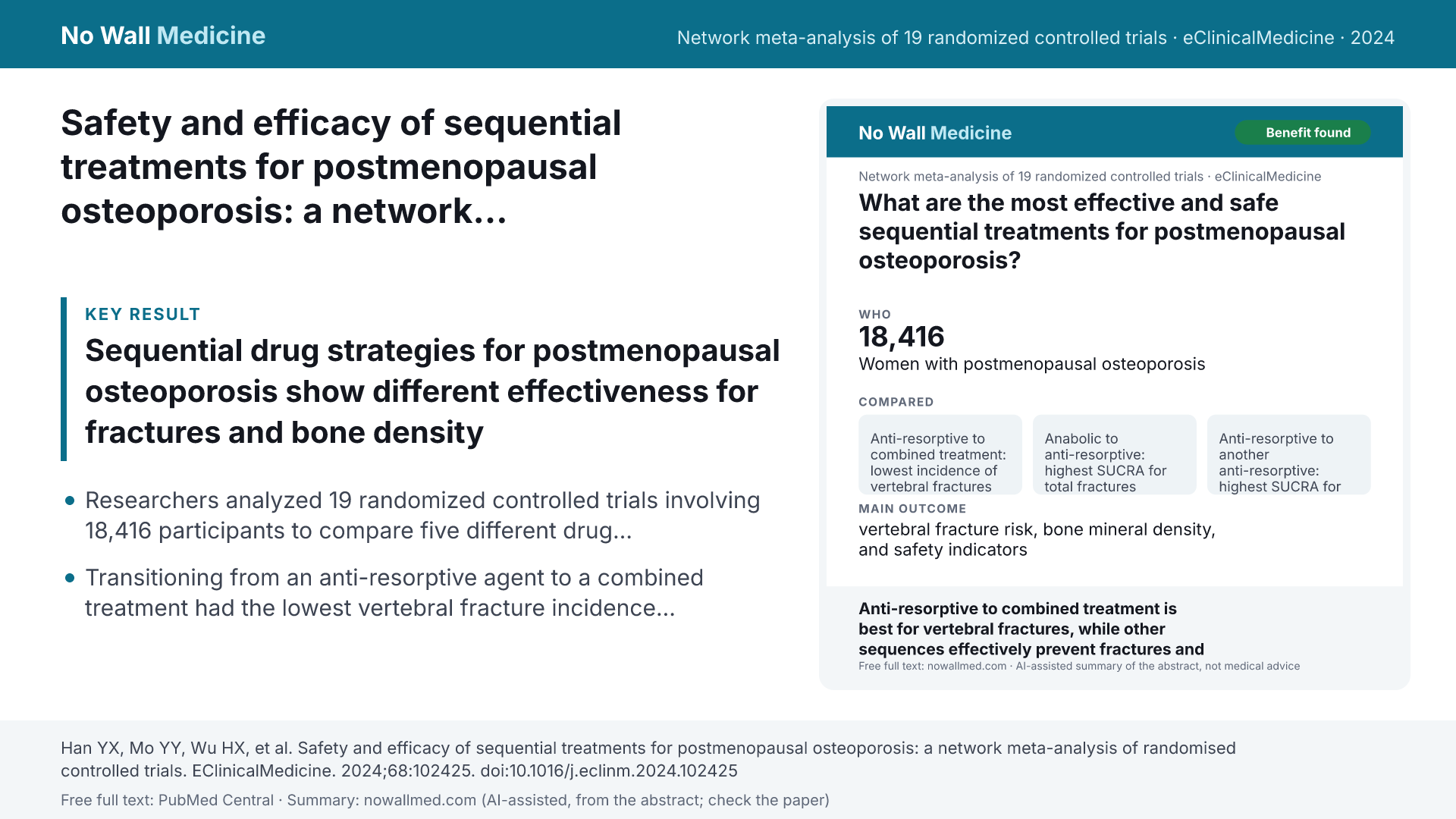
Sequential drug strategies for postmenopausal osteoporosis show different effectiveness for fractures and bone density
Safety and efficacy of sequential treatments for postmenopausal osteoporosis: a network meta-analysis of randomised controlled trials
Network meta-analysis of 19 randomized controlled trialsBenefit found
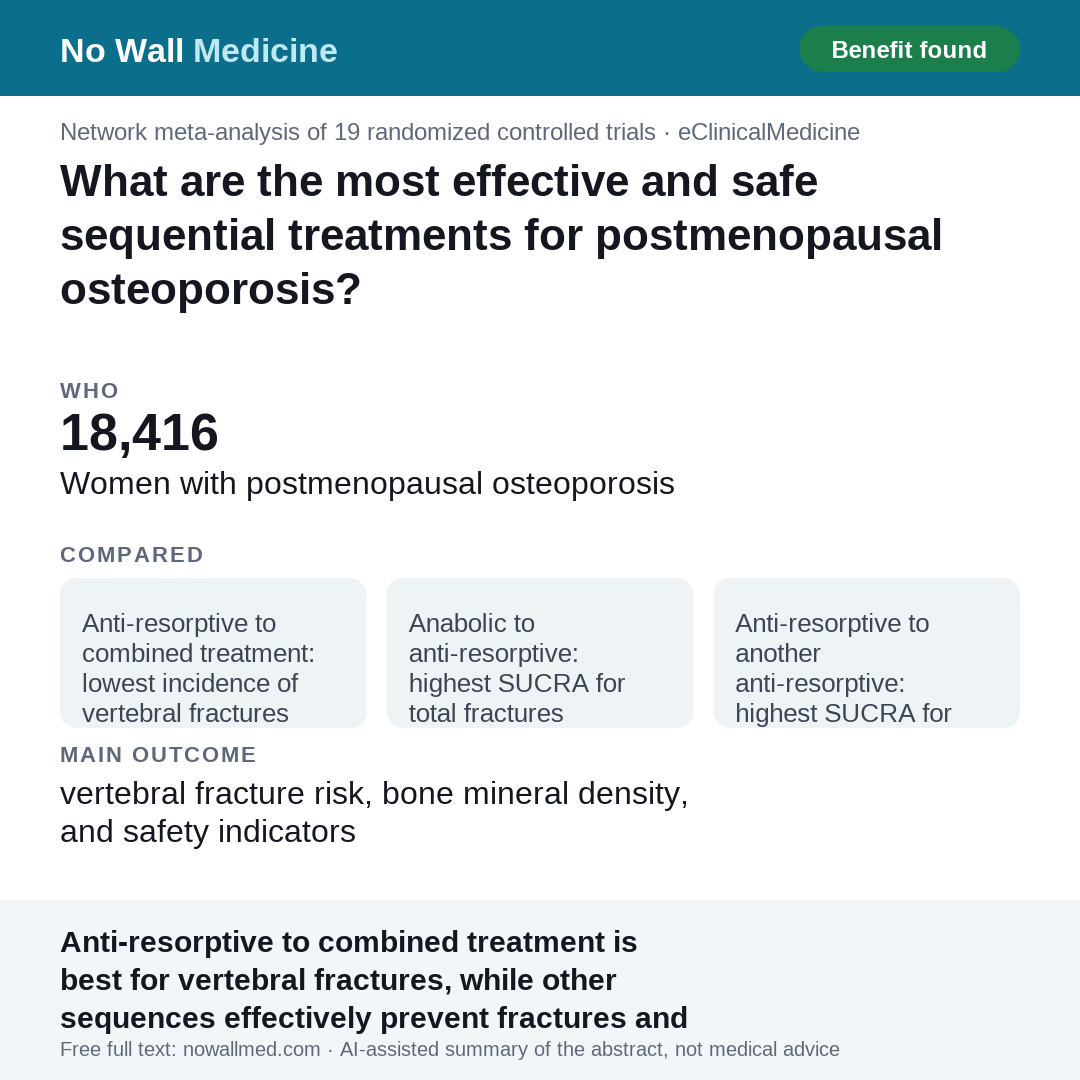
What are the most effective and safe sequential treatments for postmenopausal osteoporosis?
Who
18,416
Women with postmenopausal osteoporosis
Compared
Anti-resorptive to combined treatment: lowest incidence of vertebral fractures
Anabolic to anti-resorptive: highest SUCRA for total fractures 94.3%
Anti-resorptive to another anti-resorptive: highest SUCRA for total hip bone mineral density 96.1%
Main outcome
vertebral fracture risk, bone mineral density, and safety indicators
Bottom line: Anti-resorptive to combined treatment is best for vertebral fractures, while other sequences effectively prevent fractures and improve bone density.
Funded by: National Natural Science Foundation of China and others
eClinicalMedicine · 2024-01-23Download image
Clinical question: What are the most effective and safe sequential treatments for postmenopausal osteoporosis?
Why it matters: The order in which different types of osteoporosis drugs are used is confusing and controversial for long-term management.
Key points
- Researchers analyzed 19 randomized controlled trials involving 18,416 participants to compare five different drug switching protocols for postmenopausal osteoporosis.
- Transitioning from an anti-resorptive agent to a combined treatment had the lowest vertebral fracture incidence with 81.5% SUCRA.
- Switching from an anti-resorptive agent to another anti-resorptive agent had the highest total hip bone mineral density improvement with 96.1% SUCRA.
Headline and key points written with AI from the paper’s abstract, with every number checked against it. Read the paper before relying on them.
Was this summary helpful?
Cite this article
Han YX, Mo YY, Wu HX, et al. Safety and efficacy of sequential treatments for postmenopausal osteoporosis: a network meta-analysis of randomised controlled trials. eClinicalMedicine. 2024. doi:10.1016/j.eclinm.2024.102425
Spotted a mistake? Suggest a correction