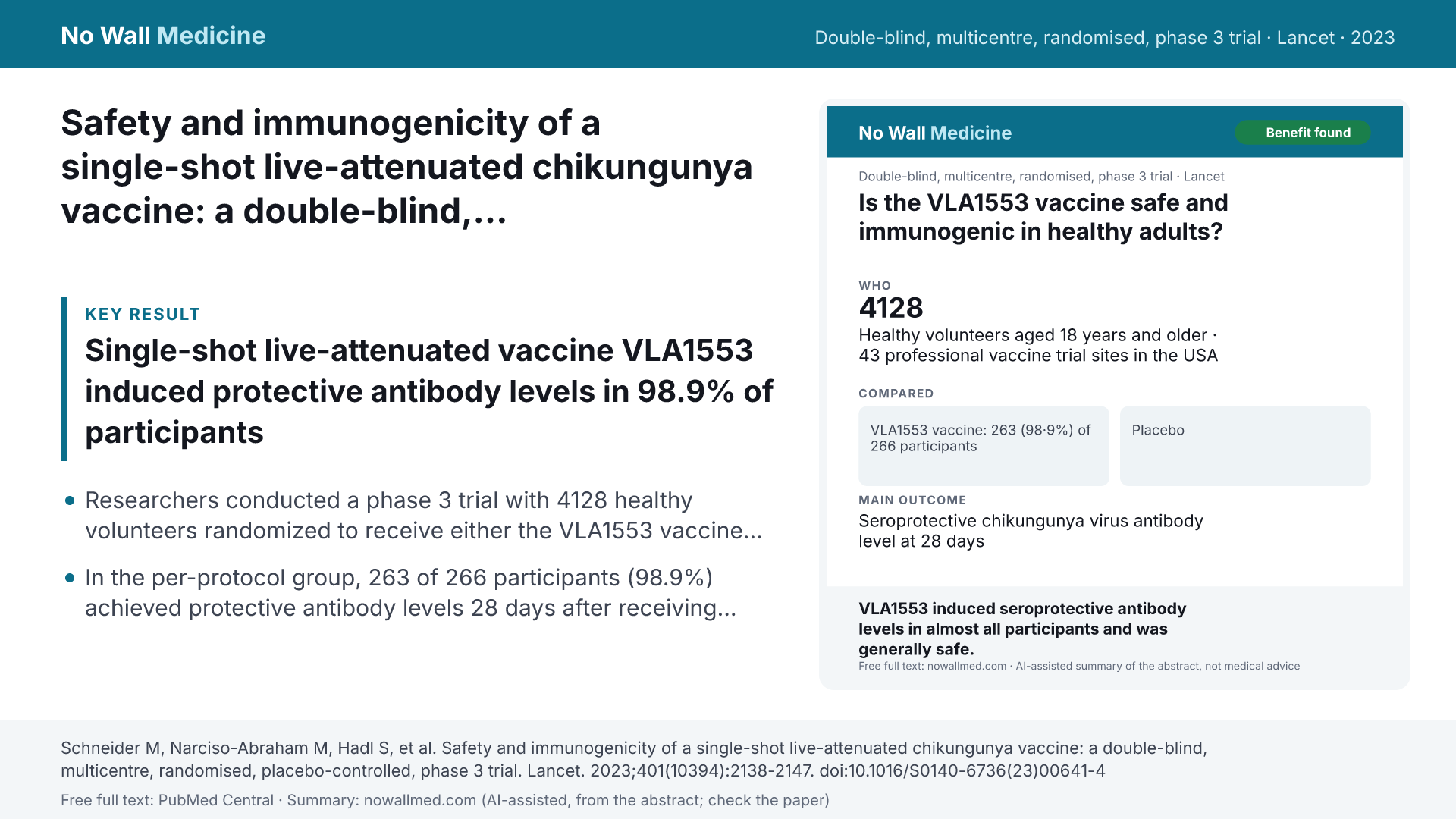
Single-shot live-attenuated vaccine VLA1553 induced protective antibody levels in 98.9% of participants
Safety and immunogenicity of a single-shot live-attenuated chikungunya vaccine: a double-blind, multicentre, randomised, placebo-controlled, phase 3 trial
Double-blind, multicentre, randomised, phase 3 trialBenefit found
Is the VLA1553 vaccine safe and immunogenic in healthy adults?
Who
4128
Healthy volunteers aged 18 years and older · 43 professional vaccine trial sites in the USA
Compared
VLA1553 vaccine: 263 (98·9%) of 266 participants
Placebo
Main outcome
Seroprotective chikungunya virus antibody level at 28 days
Result: 98·9% (95% CI 96·7-99·8)
Bottom line: VLA1553 induced seroprotective antibody levels in almost all participants and was generally safe.
Funded by: Valneva, Coalition for Epidemic Preparedness Innovation, and EU Horizon 2020
Lancet · 2023-06-12 · Save PNG
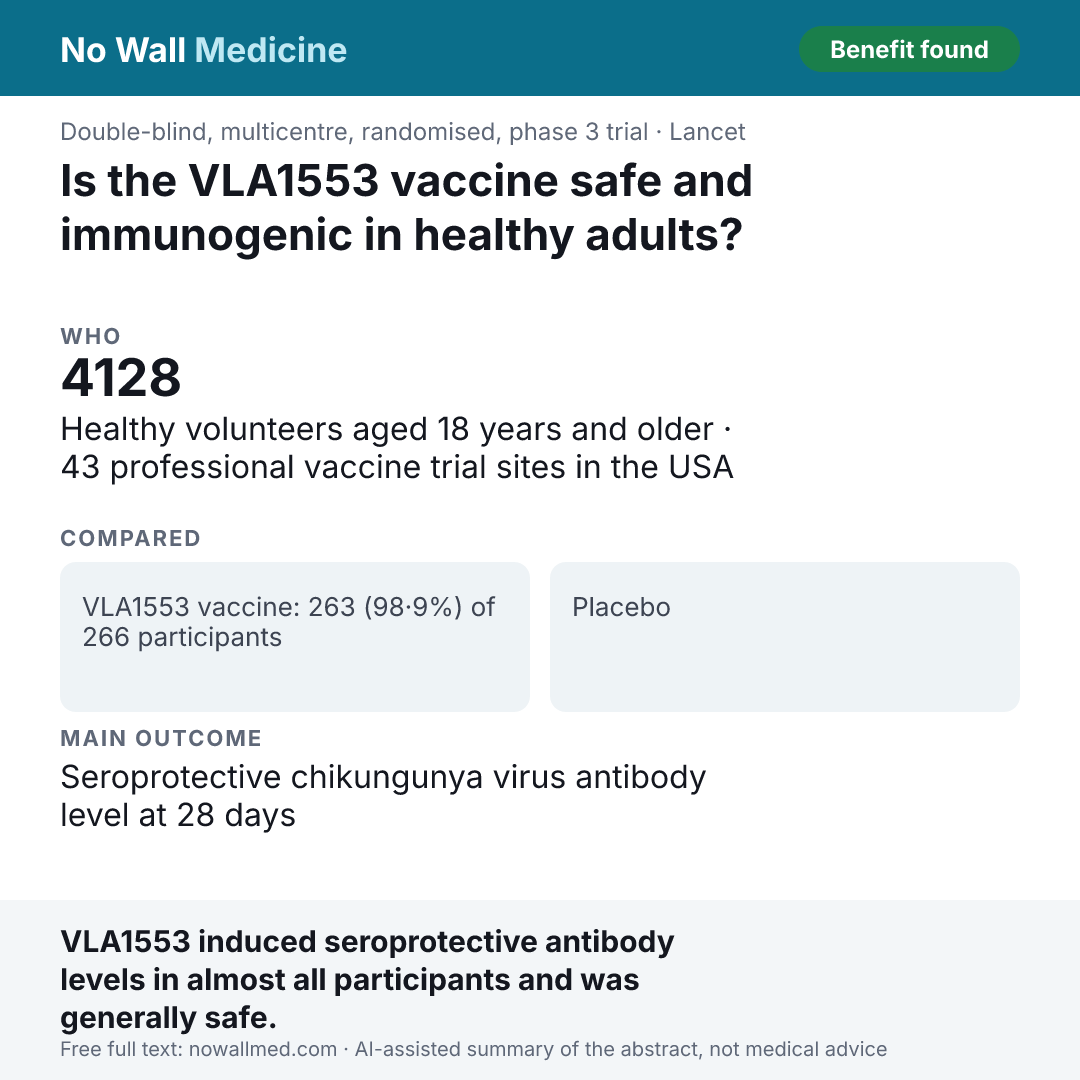
Clinical question: Is the VLA1553 vaccine safe and immunogenic in healthy adults?
Key points
- Researchers conducted a phase 3 trial with 4128 healthy volunteers randomized to receive either the VLA1553 vaccine or a placebo.
- In the per-protocol group, 263 of 266 participants (98.9%) achieved protective antibody levels 28 days after receiving one dose of VLA1553.
- Serious adverse events occurred in 1.5% of those receiving the vaccine compared to 0.8% in the placebo group, with only two events considered related to the treatment.
Headline and key points written with AI from the paper’s abstract, with every number checked against it. Read the paper before relying on them.
Was this summary helpful?
Abstract
Background
VLA1553 is a live-attenuated vaccine candidate for active immunisation and prevention of disease caused by chikungunya virus. We report safety and immunogenicity data up to day 180 after vaccination with VLA1553. Methods
This double-blind, multicentre, randomised, phase 3 trial was done in 43 professional vaccine trial sites in the USA. Eligible participants were healthy volunteers aged 18 years and older. Patients were excluded if they had history of chikungunya virus infection or immune-mediated or chronic arthritis or arthralgia, known or suspected defect of the immune system, any inactivated vaccine received within 2 weeks before vaccination with VLA1553, or any live vaccine received within 4 weeks before vaccination with VLA1553. Participants were randomised (3:1) to receive VLA1553 or placebo. The primary endpoint was the proportion of baseline negative participants with a seroprotective chikungunya virus antibody level defined as 50% plaque reduction in a micro plaque reduction neutralisation test (μPRNT) with a μPRNT50 titre of at least 150, 28 days after vaccination. The safety analysis included all individuals who received vaccination. Immunogenicity analyses were done in a subset of participants at 12 pre-selected study sites. These participants were required to have no major protocol deviations to be included in the per-protocol population for immunogenicity analyses. This trial is registered at ClinicalTrials.gov, NCT04546724. Findings
Between Sept 17, 2020 and April 10, 2021, 6100 people were screened for eligibility. 1972 people were excluded and 4128 participants were enrolled and randomised (3093 to VLA1553 and 1035 to placebo). 358 participants in the VLA1553 group and 133 participants in the placebo group discontinued before trial end. The per-protocol population for immunogenicity analysis comprised 362 participants (266 in the VLA1553 group and 96 in the placebo group). After a single vaccination, VLA1553 induced seroprotective chikungunya virus neutralising antibody levels in 263 (98·9%) of 266 participants in the VLA1553 group (95% CI 96·7-99·8; p<0·0001) 28 days post-vaccination, independent of age. VLA1553 was generally safe with an adverse event profile similar to other licensed vaccines and equally well tolerated in younger and older adults. Serious adverse events were reported in 46 (1·5%) of 3082 participants exposed to VLA1553 and eight (0·8%) of 1033 participants in the placebo arm. Only two serious adverse events were considered related to VLA1553 treatment (one mild myalgia and one syndrome of inappropriate antidiuretic hormone secretion). Both participants recovered fully. Interpretation
The strong immune response and the generation of seroprotective titres in almost all vaccinated participants suggests that VLA1553 is an excellent candidate for the prevention of disease caused by chikungunya virus. Funding
Valneva, Coalition for Epidemic Preparedness Innovation, and EU Horizon 2020.
Abstract reproduced under the article’s CC BY NC ND licence.
Subject terms
Headline, design, result, key points, caveat and citation as plain text.
Cite this article
Schneider M, Narciso-Abraham M, Hadl S, et al. Safety and immunogenicity of a single-shot live-attenuated chikungunya vaccine: a double-blind, multicentre, randomised, placebo-controlled, phase 3 trial. Lancet. 2023;401(10394):2138-2147. doi:10.1016/S0140-6736(23)00641-4
Spotted a mistake? Suggest a correction