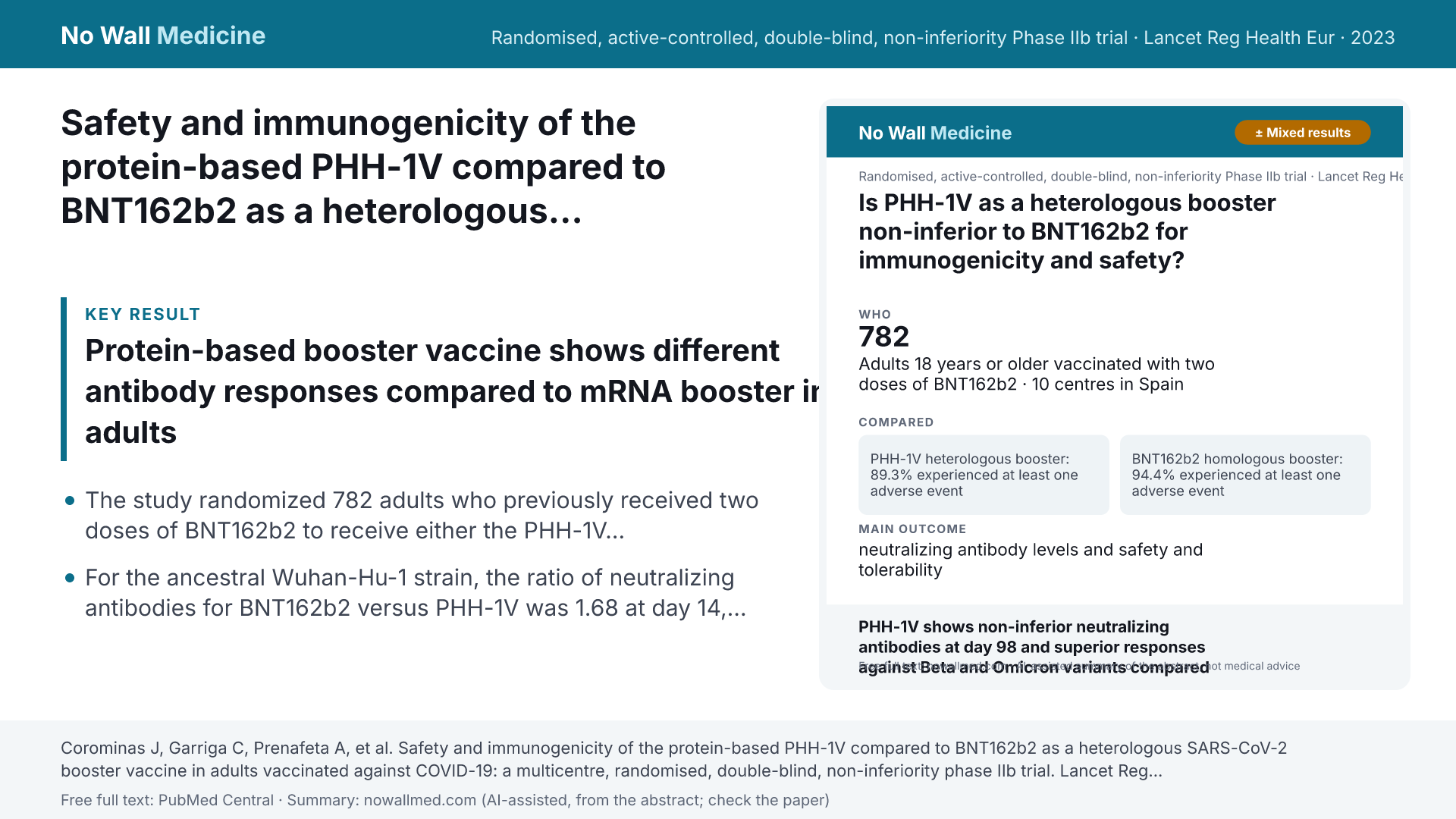
Protein-based booster vaccine shows different antibody responses compared to mRNA booster in adults
Safety and immunogenicity of the protein-based PHH-1V compared to BNT162b2 as a heterologous SARS-CoV-2 booster vaccine in adults vaccinated against COVID-19: a multicentre, randomised, double-blind, non-inferiority phase IIb trial
Randomised, active-controlled, double-blind, non-inferiority Phase IIb trialMixed results
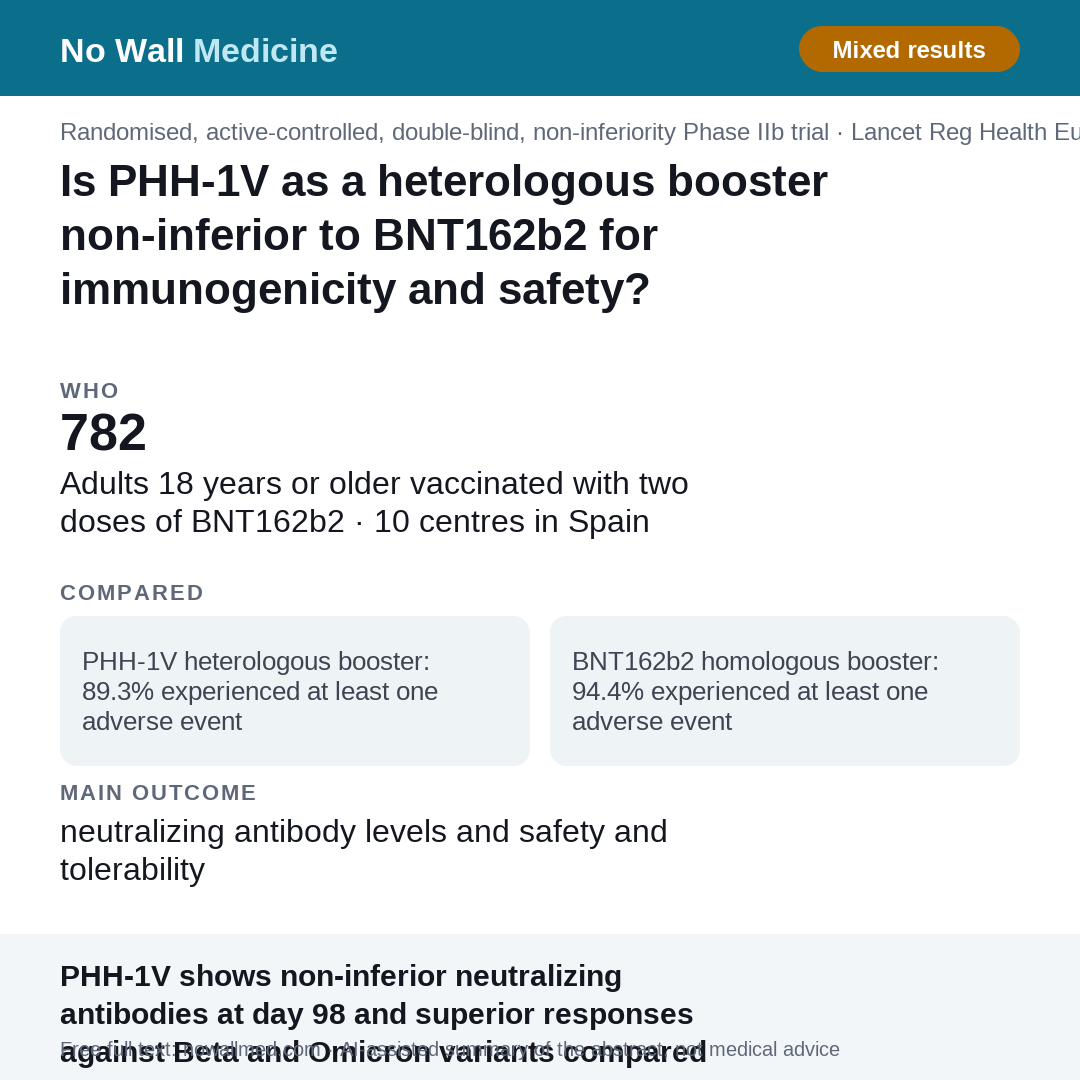
Is PHH-1V as a heterologous booster non-inferior to BNT162b2 for immunogenicity and safety?
Who
782
Adults 18 years or older vaccinated with two doses of BNT162b2 · 10 centres in Spain
Compared
PHH-1V heterologous booster: 89.3% experienced at least one adverse event
BNT162b2 homologous booster: 94.4% experienced at least one adverse event
Main outcome
neutralizing antibody levels and safety and tolerability
Bottom line: PHH-1V shows non-inferior neutralizing antibodies at day 98 and superior responses against Beta and Omicron variants compared to BNT162b2.
Funded by: HIPRA SCIENTIFIC, S.L.U.
Lancet Reg Health Eur · 2023-04-14Download image
Clinical question: Is PHH-1V as a heterologous booster non-inferior to BNT162b2 for immunogenicity and safety?
Key points
- The study randomized 782 adults who previously received two doses of BNT162b2 to receive either the PHH-1V protein-based vaccine or a BNT162b2 booster.
- For the ancestral Wuhan-Hu-1 strain, the ratio of neutralizing antibodies for BNT162b2 versus PHH-1V was 1.68 at day 14, 1.31 at day 28, and 0.86 at day 98.
- Adverse events occurred in 89.3% of the PHH-1V group and 94.4% of the BNT162b2 group, with injection site pain being the most frequent event.
Headline and key points written with AI from the paper’s abstract, with every number checked against it. Read the paper before relying on them.
Was this summary helpful?
Headline, design, result, key points, caveat and citation as plain text.
Cite this article
Corominas J, Garriga C, Prenafeta A, et al. Safety and immunogenicity of the protein-based PHH-1V compared to BNT162b2 as a heterologous SARS-CoV-2 booster vaccine in adults vaccinated against COVID-19: a multicentre, randomised, double-blind, non-inferiority phase IIb trial. Lancet Reg Health Eur. 2023. doi:10.1016/j.lanepe.2023.100613
Spotted a mistake? Suggest a correction