Maximal cardiopulmonary exercise testing appears safe for people with sickle cell disease
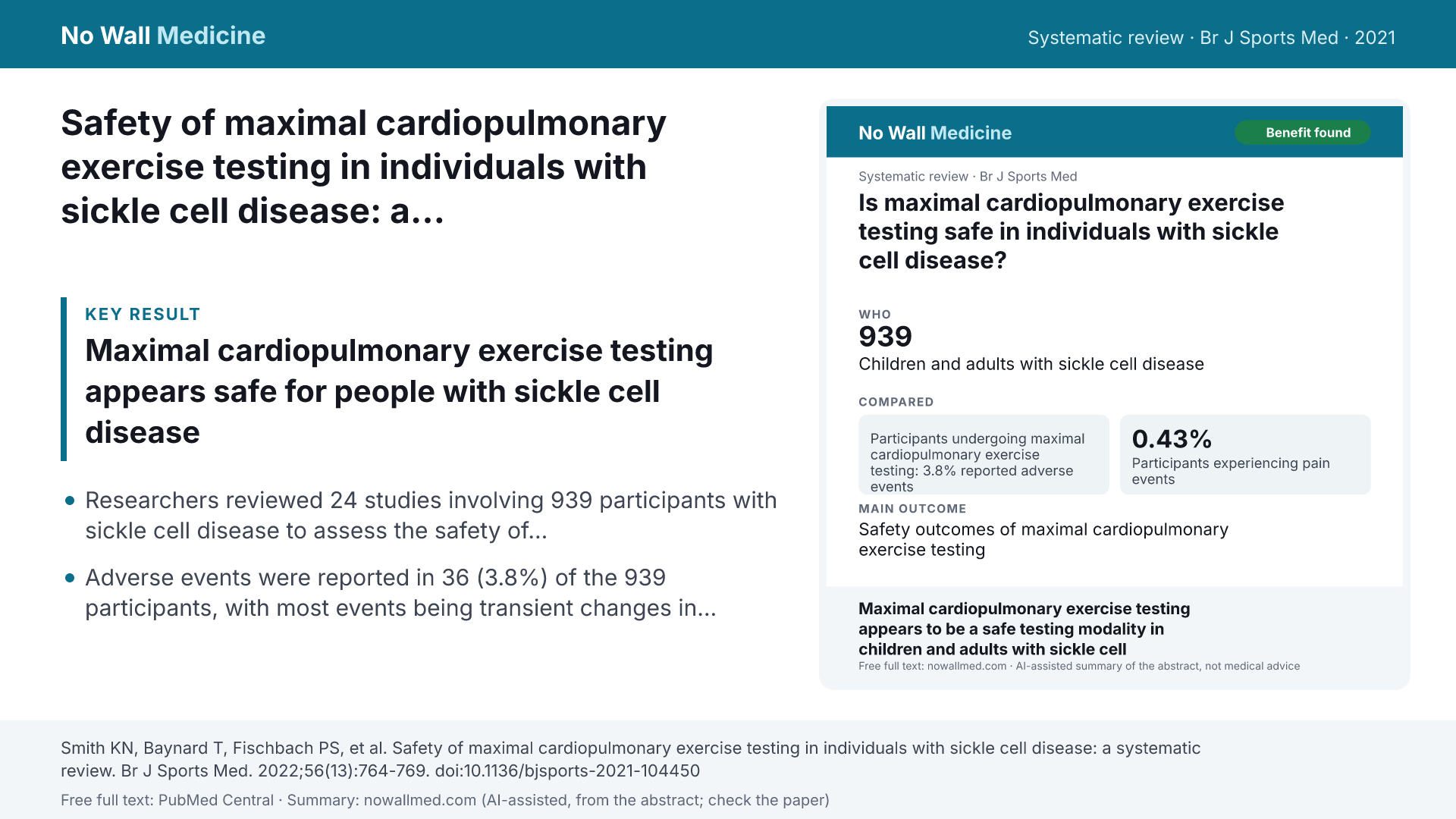
Safety of maximal cardiopulmonary exercise testing in individuals with sickle cell disease: a systematic review
Systematic reviewBenefit found
Is maximal cardiopulmonary exercise testing safe in individuals with sickle cell disease?
Who
939
Children and adults with sickle cell disease
Compared
Participants undergoing maximal cardiopulmonary exercise testing: 3.8% reported adverse events
0.43%Participants experiencing pain events
Main outcome
Safety outcomes of maximal cardiopulmonary exercise testing
Bottom line: Maximal cardiopulmonary exercise testing appears to be a safe testing modality in children and adults with sickle cell disease.
Limitation: Some studies did not focus on reporting adverse events or failed to mention safety monitoring.
Br J Sports Med · 2021-07-20Download image
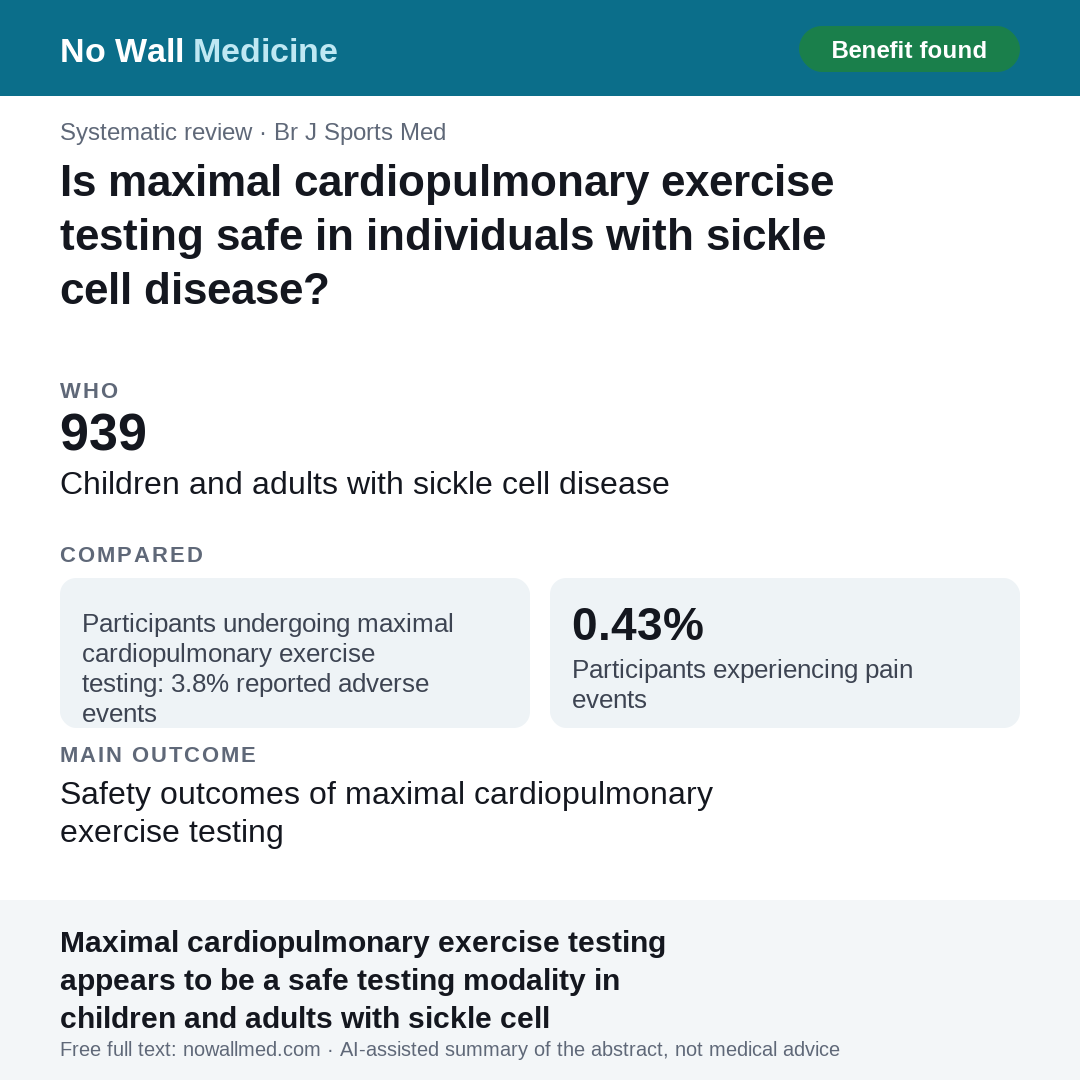
Clinical question: Is maximal cardiopulmonary exercise testing safe in individuals with sickle cell disease?
Why it matters: The safety of using maximal cardiopulmonary exercise testing to measure fitness in people with sickle cell disease is currently unclear.
Key points
- Researchers reviewed 24 studies involving 939 participants with sickle cell disease to assess the safety of maximal cardiopulmonary exercise testing, which measures fitness using gas exchange analysis.
- Adverse events were reported in 36 (3.8%) of the 939 participants, with most events being transient changes in heart rhythm monitoring or oxygen levels that caused no complications.
- Only 4 (0.43%) of the 939 participants experienced pain events during the maximal cardiopulmonary exercise testing.
Limitation the authors note: Some studies did not focus on reporting adverse events related to exercise testing or failed to mention safety monitoring, which contributed to risk of bias.
Headline and key points written with AI from the paper’s abstract, with every number checked against it. Read the paper before relying on them.
Was this summary helpful?
Subject terms
Cite this article
Smith KN, Baynard T, Fischbach PS, et al. Safety of maximal cardiopulmonary exercise testing in individuals with sickle cell disease: a systematic review. Br J Sports Med. 2021. doi:10.1136/bjsports-2021-104450
Spotted a mistake? Suggest a correction