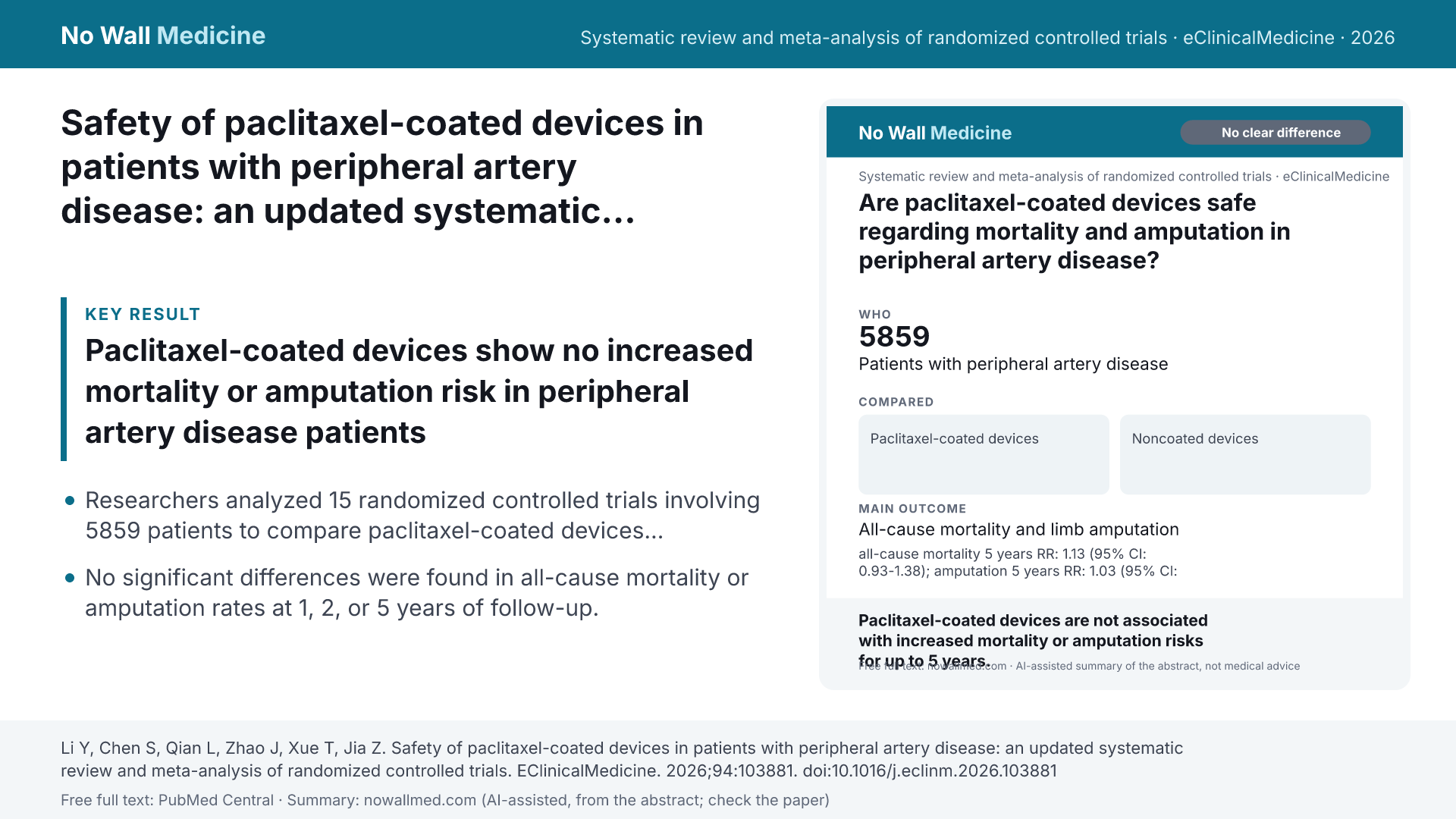
Paclitaxel-coated devices show no increased mortality or amputation risk in peripheral artery disease patients
Safety of paclitaxel-coated devices in patients with peripheral artery disease: an updated systematic review and meta-analysis of randomized controlled trials
Systematic review and meta-analysis of randomized controlled trialsNo clear difference
Are paclitaxel-coated devices safe regarding mortality and amputation in peripheral artery disease?
Who
5859
Patients with peripheral artery disease
Compared
Paclitaxel-coated devices
Noncoated devices
Main outcome
All-cause mortality and limb amputation
Result: all-cause mortality 5 years RR: 1.13 (95% CI: 0.93-1.38); amputation 5 years RR: 1.03 (95% CI: 0.88-1.20)
Bottom line: Paclitaxel-coated devices are not associated with increased mortality or amputation risks for up to 5 years.
eClinicalMedicine · 2026-04-10 · Save PNG

Clinical question: Are paclitaxel-coated devices safe regarding mortality and amputation in peripheral artery disease?
Why it matters: The long-term safety of paclitaxel-coated devices regarding mortality and amputation risks in patients with peripheral artery disease remains controversial.
Key points
- Researchers analyzed 15 randomized controlled trials involving 5859 patients to compare paclitaxel-coated devices with noncoated devices for treating peripheral artery disease.
- No significant differences were found in all-cause mortality or amputation rates at 1, 2, or 5 years of follow-up.
- Paclitaxel-coated devices significantly reduced target lesion revascularization at 1 year (RR: 0.64, 95% CI: 0.48-0.87) and 2 years (RR: 0.45, 95% CI: 0.38-0.54).
Headline and key points written with AI from the paper’s abstract, with every number checked against it. Read the paper before relying on them.
Was this summary helpful?
Headline, design, result, key points, caveat and citation as plain text.
Cite this article
Li Y, Chen S, Qian L, Zhao J, Xue T, Jia Z. Safety of paclitaxel-coated devices in patients with peripheral artery disease: an updated systematic review and meta-analysis of randomized controlled trials. EClinicalMedicine. 2026;94:103881. doi:10.1016/j.eclinm.2026.103881
Spotted a mistake? Suggest a correction