Safety, pharmacodynamics, and exposure-response modeling results from a first-in-human phase 1 study of nedosiran (PHYOX1) in primary hyperoxaluria
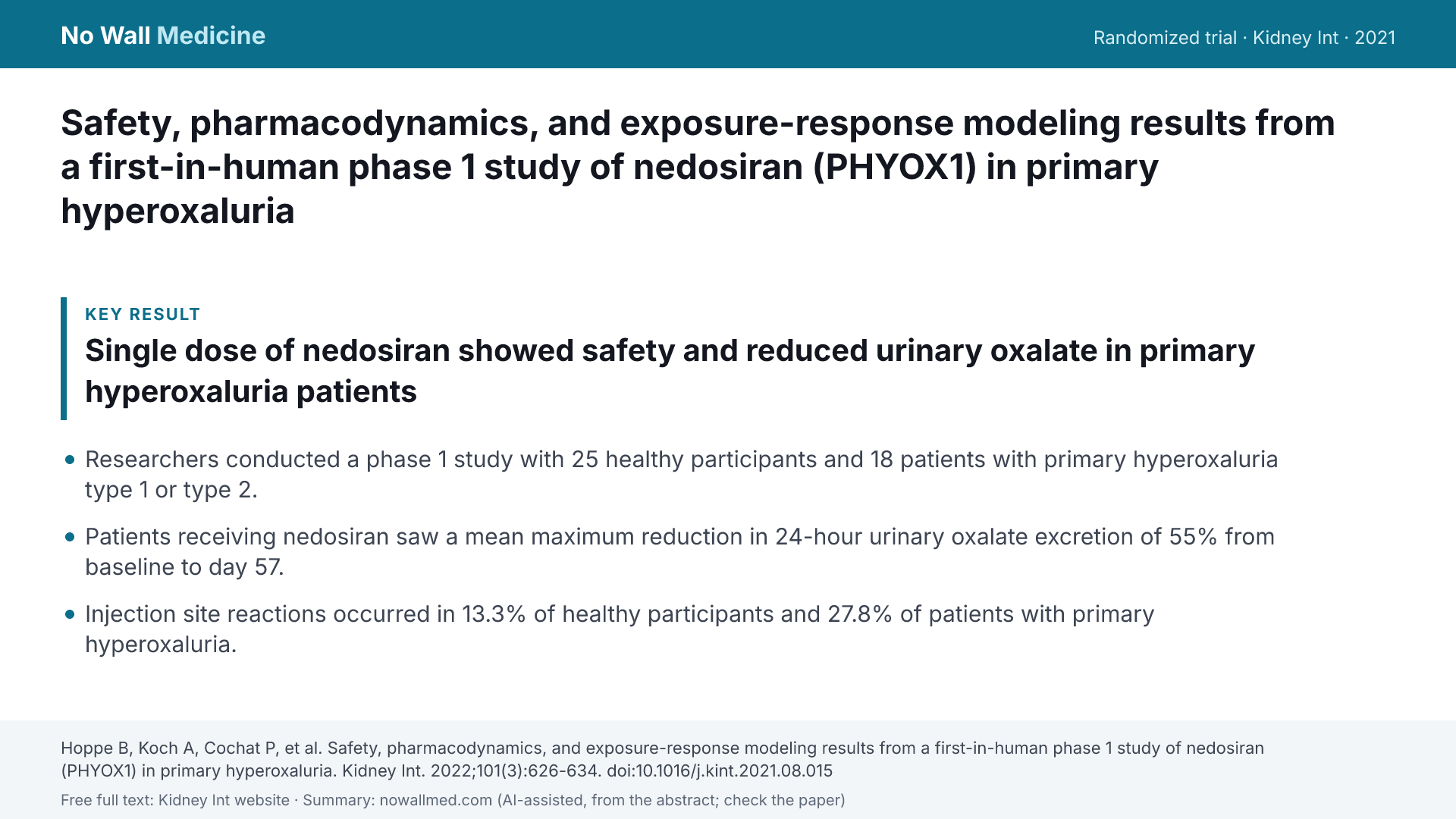
Key result: Single dose of nedosiran showed safety and reduced urinary oxalate in primary hyperoxaluria patients
Key points
- Researchers conducted a phase 1 study with 25 healthy participants and 18 patients with primary hyperoxaluria type 1 or type 2.
- Patients receiving nedosiran saw a mean maximum reduction in 24-hour urinary oxalate excretion of 55% from baseline to day 57.
- Injection site reactions occurred in 13.3% of healthy participants and 27.8% of patients with primary hyperoxaluria.
Why it matters: The safety and effectiveness of nedosiran, an RNA interference agent that inhibits the enzyme responsible for oxalate production, were unknown in humans.
Discussion prompts
- Would these patients look like yours? Who was left out?
- Is the main outcome one that matters to patients?
- Is the difference large enough to change what you do?
Cite: Hoppe B, Koch A, Cochat P, et al. Safety, pharmacodynamics, and exposure-response modeling results from a first-in-human phase 1 study of nedosiran (PHYOX1) in primary hyperoxaluria. Kidney Int. 2021. doi:10.1016/j.kint.2021.08.015
Free full text: Kidney Int website · Summary and visual abstract: nowallmed.com/a/safety-pharmacodynamics-and-exposure-response-modeling-results-from-a-1nuquii/ (AI-assisted from the abstract; check the paper before relying on it).