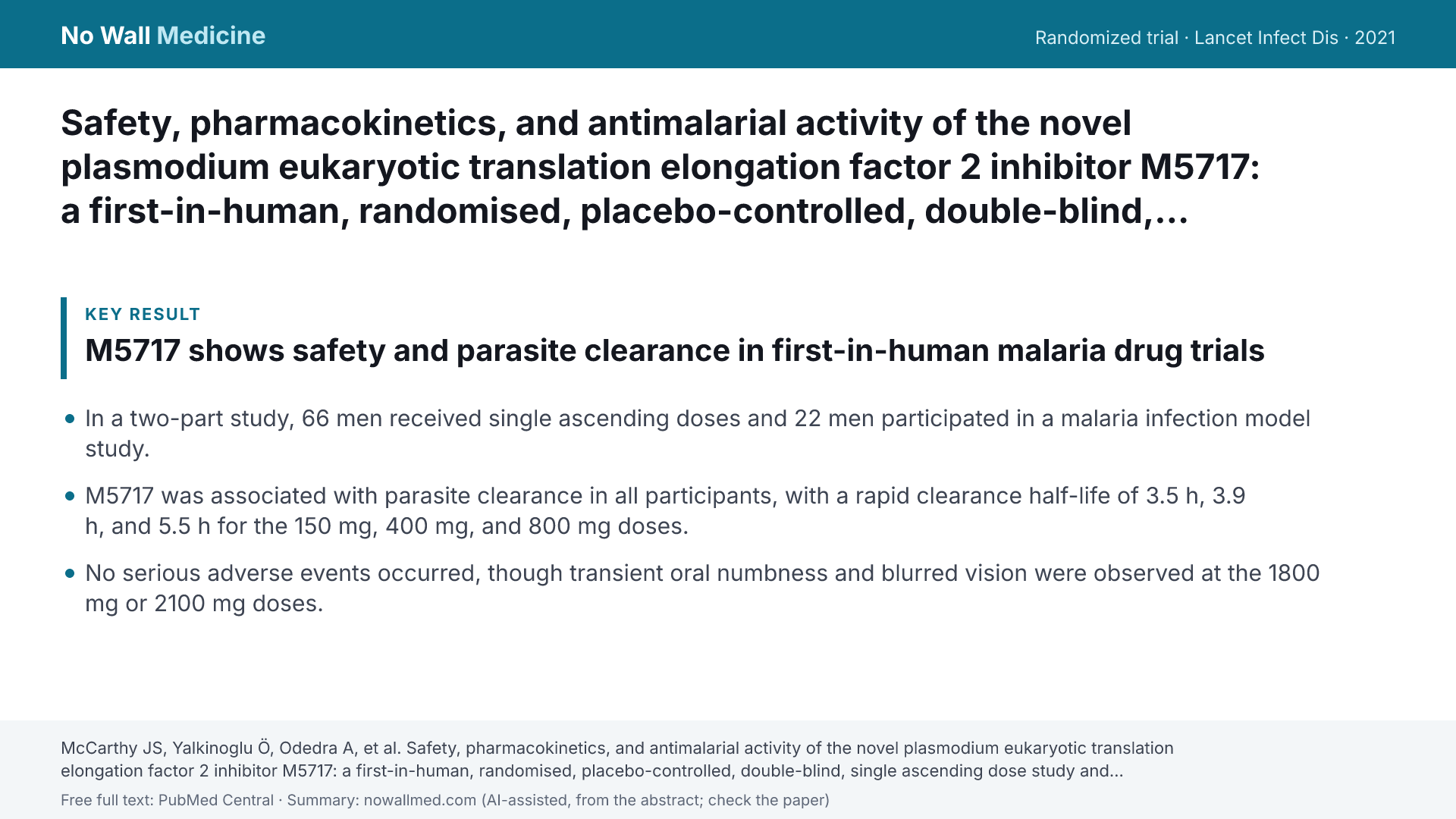
M5717 shows safety and parasite clearance in first-in-human malaria drug trials
Safety, pharmacokinetics, and antimalarial activity of the novel plasmodium eukaryotic translation elongation factor 2 inhibitor M5717: a first-in-human, randomised, placebo-controlled, double-blind, single ascending dose study and volunteer infection study
Why it matters: The safety, how the body processes the drug, and antimalarial activity of the first translation elongation factor 2 inhibitor were unknown in humans.
Key points
- In a two-part study, 66 men received single ascending doses and 22 men participated in a malaria infection model study.
- M5717 was associated with parasite clearance in all participants, with a rapid clearance half-life of 3.5 h, 3.9 h, and 5.5 h for the 150 mg, 400 mg, and 800 mg doses.
- No serious adverse events occurred, though transient oral numbness and blurred vision were observed at the 1800 mg or 2100 mg doses.
Limitation the authors note: The volunteer infection study was an open-label, non-randomised study.
Headline and key points written with AI from the paper’s abstract, with every number checked against it. Read the paper before relying on them.
Was this summary helpful?
Abstract
Background
M5717 is the first plasmodium translation elongation factor 2 inhibitor to reach clinical development as an antimalarial. We aimed to characterise the safety, pharmacokinetics, and antimalarial activity of M5717 in healthy volunteers. Methods
This first-in-human study was a two-part, single-centre clinical trial done in Brisbane, QLD, Australia. Part one was a double-blind, randomised, placebo-controlled, single ascending dose study in which participants were enrolled into one of nine dose cohorts (50, 100, 200, 400, 600, 1000, 1250, 1800, or 2100 mg) and randomly assigned (3:1) to M5717 or placebo. A sentinel dosing strategy was used for each dose cohort whereby two participants (one assigned to M5717 and one assigned to placebo) were initially randomised and dosed. Randomisation schedules were generated electronically by independent, unblinded statisticians. Part two was an open-label, non-randomised volunteer infection study using the Plasmodium falciparum induced blood-stage malaria model in which participants were enrolled into three dose cohorts. Healthy men and women of non-childbearing potential aged 18-55 years were eligible for inclusion; individuals in the volunteer infection study were required to be malaria naive. Safety and tolerability (primary outcome of the single ascending dose study and secondary outcome of the volunteer infection study) were assessed by frequency and severity of adverse events. The pharmacokinetic profile of M5717 was also characterised (primary outcome of the volunteer infection study and secondary outcome of the single ascending dose study). Parasite clearance kinetics (primary outcome of the volunteer infection study) were assessed by the parasite reduction ratio and the corresponding parasite clearance half-life; the incidence of recrudescence up to day 28 was determined (secondary outcome of the volunteer infection study). Recrudescent parasites were tested for genetic mutations (exploratory outcome). The trial is registered with ClinicalTrials.gov (NCT03261401). Findings
Between Aug 28, 2017, and June 14, 2019, 221 individuals were assessed for eligibility, of whom 66 men were enrolled in the single ascending dose study (eight per cohort for 50-1800 mg cohorts, randomised three M5717 to one placebo, and two in the 2100 mg cohort, randomised one M5717 to one placebo) and 22 men were enrolled in the volunteer infection study (six in the 150 mg cohort and eight each in the 400 mg and 800 mg cohorts). No adverse event was serious; all M5717-related adverse events were mild or moderate in severity and transient, with increased frequency observed at doses above 1250 mg. In the single ascending dose study, treatment-related adverse events occurred in three of 17 individuals in the placebo group; no individual in the 50 mg, 100 mg, or 200 mg groups; one of six individuals in each of the 400 mg, 1000 mg, and 1250 mg groups; two of six individuals in the 600 mg group; and in all individuals in the 1800 mg and 2100 mg groups. In the volunteer infection study, M5717-related adverse events occurred in no participants in the 150 mg or 800 mg groups and in one of eight participants in the 400 mg group. Transient oral hypoesthesia (in three participants) and blurred vision (in four participants) were observed in the 1800 mg or 2100 mg groups and constituted an unknown risk; thus, further dosing was suspended after dosing of the two sentinel individuals in the 2100 mg cohort. Maximum blood concentrations occurred 1-7 h after dosing, and a long half-life was observed (146-193 h at doses ≥200 mg). Parasite clearance occurred in all participants and was biphasic, characterised by initial slow clearance lasting 35-55 h (half-life 231·1 h [95% CI 40·9 to not reached] for 150 mg, 60·4 h [38·6 to 138·6] for 400 mg, and 24·7 h [20·4 to 31·3] for 800 mg), followed by rapid clearance (half-life 3·5 h [3·1 to 4·0] for 150 mg, 3·9 h [3·3 to 4·8] for 400 mg, and 5·5 h [4·8 to 6·4] for 800 mg). Recrudescence occurred in three (50%) of six individuals dosed with 150 mg and two (25%) of eight individuals dosed with 400 mg. Genetic mutations associated with resistance were detected in four cases of parasite recrudescence (two individuals dosed with 150 mg and two dosed with 400 mg). Interpretation
The safety, pharmacokinetics, and antimalarial activity of M5717 support its development as a component of a single-dose antimalarial combination therapy or for malaria prophylaxis. Funding
Wellcome Trust and the healthcare business of Merck KGaA, Darmstadt, Germany.
Abstract reproduced under the article’s CC BY licence.
Subject terms
Headline, design, result, key points, caveat and citation as plain text.
Cite this article
McCarthy JS, Yalkinoglu Ö, Odedra A, et al. Safety, pharmacokinetics, and antimalarial activity of the novel plasmodium eukaryotic translation elongation factor 2 inhibitor M5717: a first-in-human, randomised, placebo-controlled, double-blind, single ascending dose study and volunteer infection study. Lancet Infect Dis. 2021;21(12):1713-1724. doi:10.1016/S1473-3099(21)00252-8
Spotted a mistake? Suggest a correction