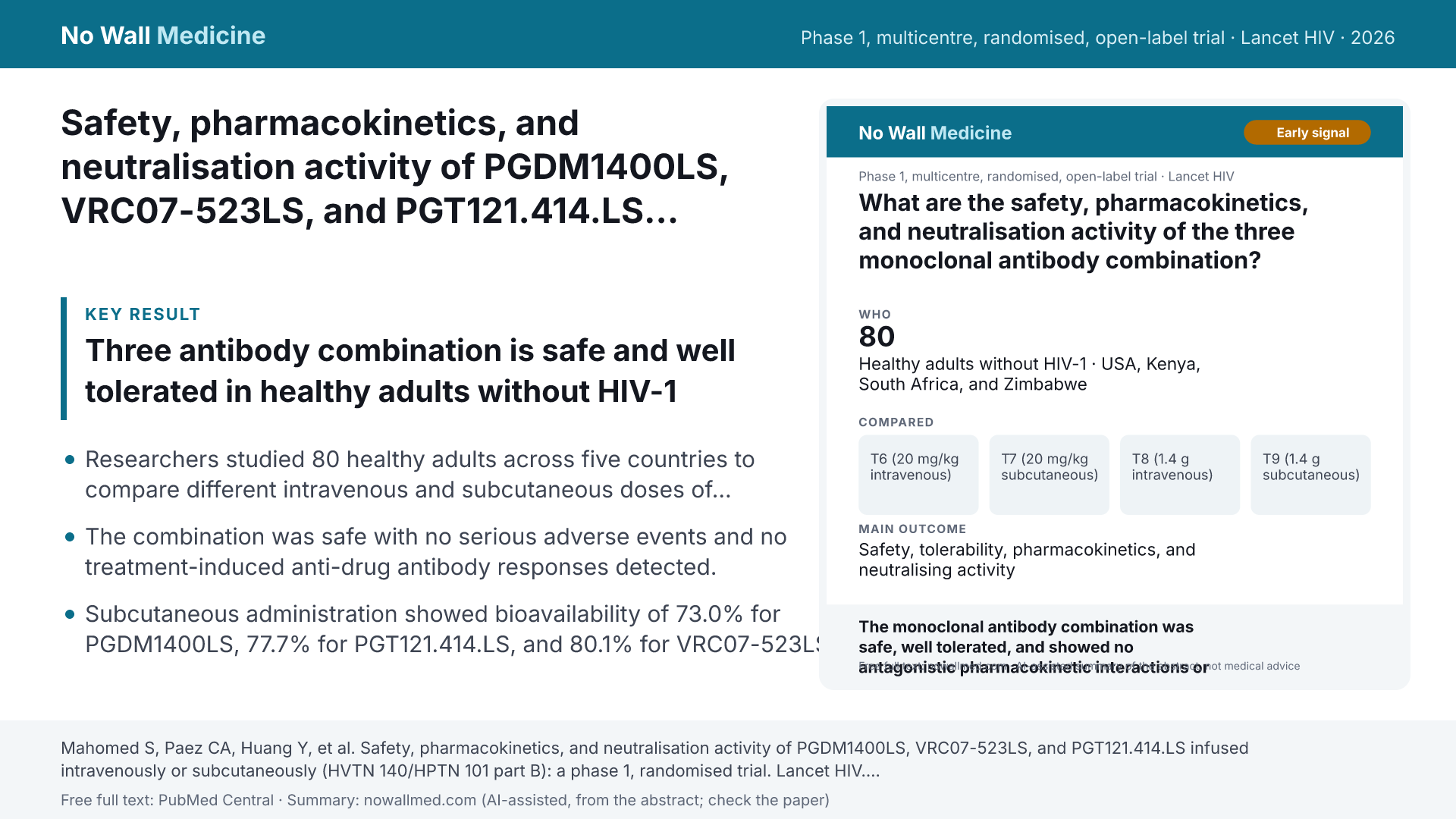
Three antibody combination is safe and well tolerated in healthy adults without HIV-1
Safety, pharmacokinetics, and neutralisation activity of PGDM1400LS, VRC07-523LS, and PGT121.414.LS infused intravenously or subcutaneously (HVTN 140/HPTN 101 part B): a phase 1, randomised trial
Phase 1, multicentre, randomised, open-label trialEarly signal
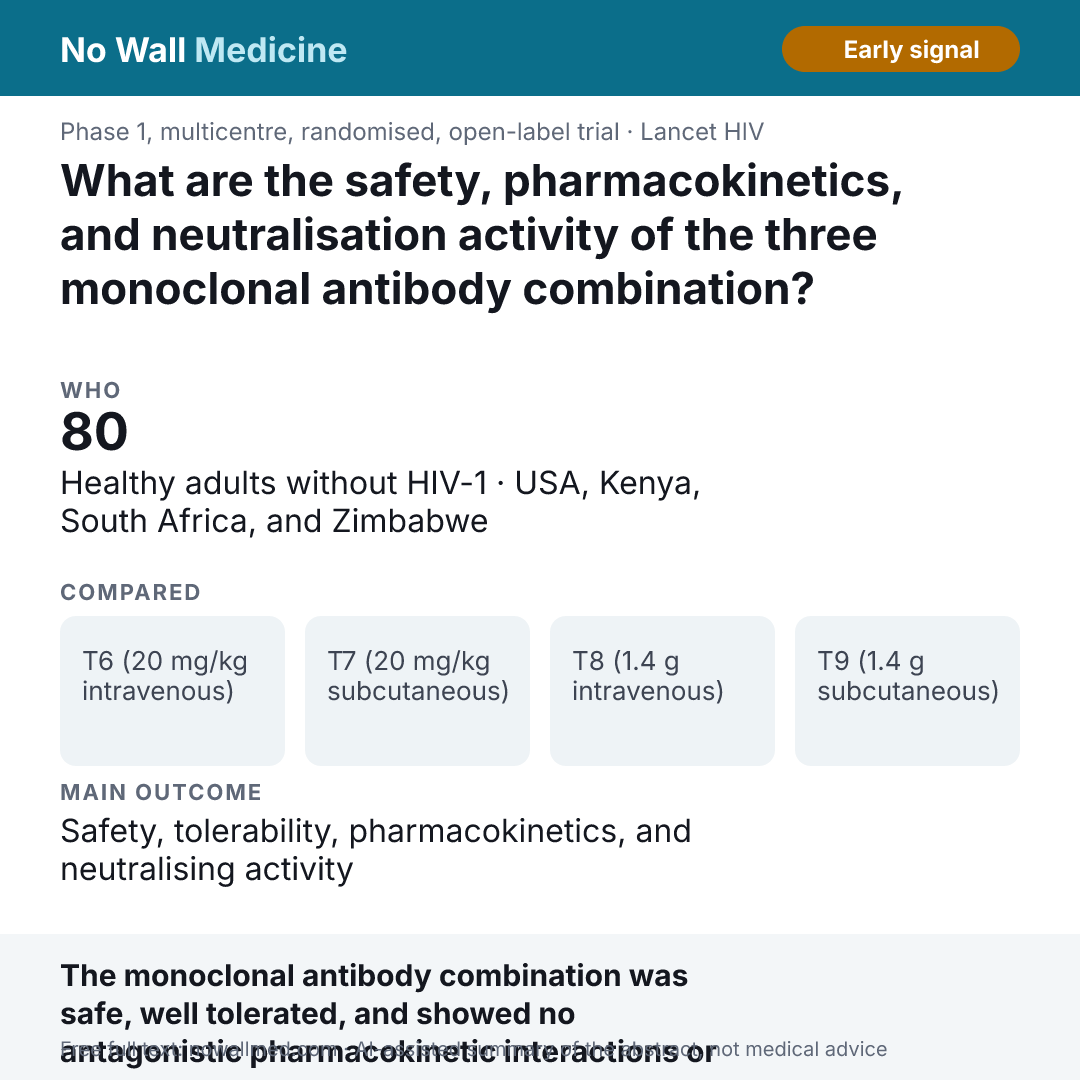
What are the safety, pharmacokinetics, and neutralisation activity of the three monoclonal antibody combination?
Who
80
Healthy adults without HIV-1 · USA, Kenya, South Africa, and Zimbabwe
Compared
T6 (20 mg/kg intravenous)
T7 (20 mg/kg subcutaneous)
T8 (1.4 g intravenous)
T9 (1.4 g subcutaneous)
Main outcome
Safety, tolerability, pharmacokinetics, and neutralising activity
Bottom line: The monoclonal antibody combination was safe, well tolerated, and showed no antagonistic pharmacokinetic interactions or loss of neutralisation activity.
Funded by: National Institute of Allergy and Infectious Diseases-National Institutes of Health
Lancet HIV · 2026-05-11 · Save PNG
Same trial (NCT05184452)
Papers we list that report this registered trial, oldest first. Read a secondary analysis alongside the main results.
- Main results Early signal
PGDM1400LS antibody was safe and showed long half-life in first-in-human phase 1 trial Lancet HIV 2025-05 - Related analysis Early signal
This paper Lancet HIV 2026-05
Clinical question: What are the safety, pharmacokinetics, and neutralisation activity of the three monoclonal antibody combination?
Why it matters: Passive immunization using a combination of broadly neutralizing monoclonal antibodies is being explored as a potential method for HIV-1 prevention.
Key points
- Researchers studied 80 healthy adults across five countries to compare different intravenous and subcutaneous doses of three monoclonal antibodies.
- The combination was safe with no serious adverse events and no treatment-induced anti-drug antibody responses detected.
- Subcutaneous administration showed bioavailability of 73.0% for PGDM1400LS, 77.7% for PGT121.414.LS, and 80.1% for VRC07-523LS.
Headline and key points written with AI from the paper’s abstract, with every number checked against it. Read the paper before relying on them.
Was this summary helpful?
Abstract
Background
Passive immunisation with a combination of broadly neutralising monoclonal antibodies (mAbs) presents a potential HIV-1 prevention modality. This study (HVTN 140/HPTN 101) sought to evaluate PGDM1400LS (targeting V3-glycan) administered alone (part A, previously reported), and in combination (part B) with VRC07-523LS (targeting CD4 binding site) and PGT121.414.LS (targeting V2-apex) in healthy adults without HIV-1. Methods
The study was a phase 1, multicentre, randomised, open-label trial done across the USA (five sites), Kenya (one site), South Africa (four sites), and Zimbabwe (three sites). Part B participants were randomly assigned to five groups (n=16 each), all receiving the three mAbs at months 0 and 4: infusion group T6 (20 mg/kg each mAb intravenously), T7 (20 mg/kg each mAb subcutaneously), T8 (1·4 g each mAb intravenously), T9 (1·4 g each mAb subcutaneously), and T10 (40 mg/kg each mAb intravenously). Primary endpoints were safety and tolerability throughout the study, and pharmacokinetics and neutralising activity on days 0, 3, 6, 28, 56, 112, 168, 224, and 280. Serum mAb concentrations over time were assessed via a validated anti-idiotype binding assay and analysed with two-compartment population pharmacokinetics models. Serum neutralisation titres were assessed by a validated TZM-bl assay. The study is registered at ClinicalTrials.gov (NCT05184452) and is complete. Findings
For the 80 part B participants enrolled from March 21 to Oct 5, 2022, the median age was 27·0 years, with 47·5% females. Most participants had mild-to-moderate solicited local and systemic symptoms. No serious adverse events were reported. On the basis of pharmacokinetics data from part A and part B combined, the estimated elimination half-life of PGDM1400LS was 53 days (51·4-55·3). Subcutaneous administration of PGDM1400LS exhibited bioavailability of 73·0% (67·5-78·5%) relative to intravenous administration of the same dose. PGT121.414.LS had an estimated elimination half-life of 65 days (61·8-68·1) with subcutaneous bioavailability of 77·7% (71·2-84·1), and VRC07-523LS had an estimated elimination half-life of 44 days (41·6-45·7) with a subcutaneous bioavailability of 80·1% (71·4-88·8). Both weight-based and fixed-dose regimens showed similar pharmacokinetic profiles. Observed neutralisation titres were consistent with those predicted on the basis of concentrations and in vitro neutralisation. No treatment-induced anti-drug antibody responses were detected. Interpretation
The mAb combination of PGDM1400LS, PGT121.414.LS, and VRC07-523LS was safe and well tolerated, with no antagonistic pharmacokinetic interactions or loss of neutralisation activity. These findings support further evaluation of this combination in future efficacy trials. Funding
National Institute of Allergy and Infectious Diseases-National Institutes of Health.
Abstract reproduced under the article’s CC BY licence.
Subject terms
Headline, design, result, key points, caveat and citation as plain text.
Cite this article
Mahomed S, Paez CA, Huang Y, et al. Safety, pharmacokinetics, and neutralisation activity of PGDM1400LS, VRC07-523LS, and PGT121.414.LS infused intravenously or subcutaneously (HVTN 140/HPTN 101 part B): a phase 1, randomised trial. Lancet HIV. 2026;13(7):e452-e464. doi:10.1016/S2352-3018(25)00356-X
Spotted a mistake? Suggest a correction