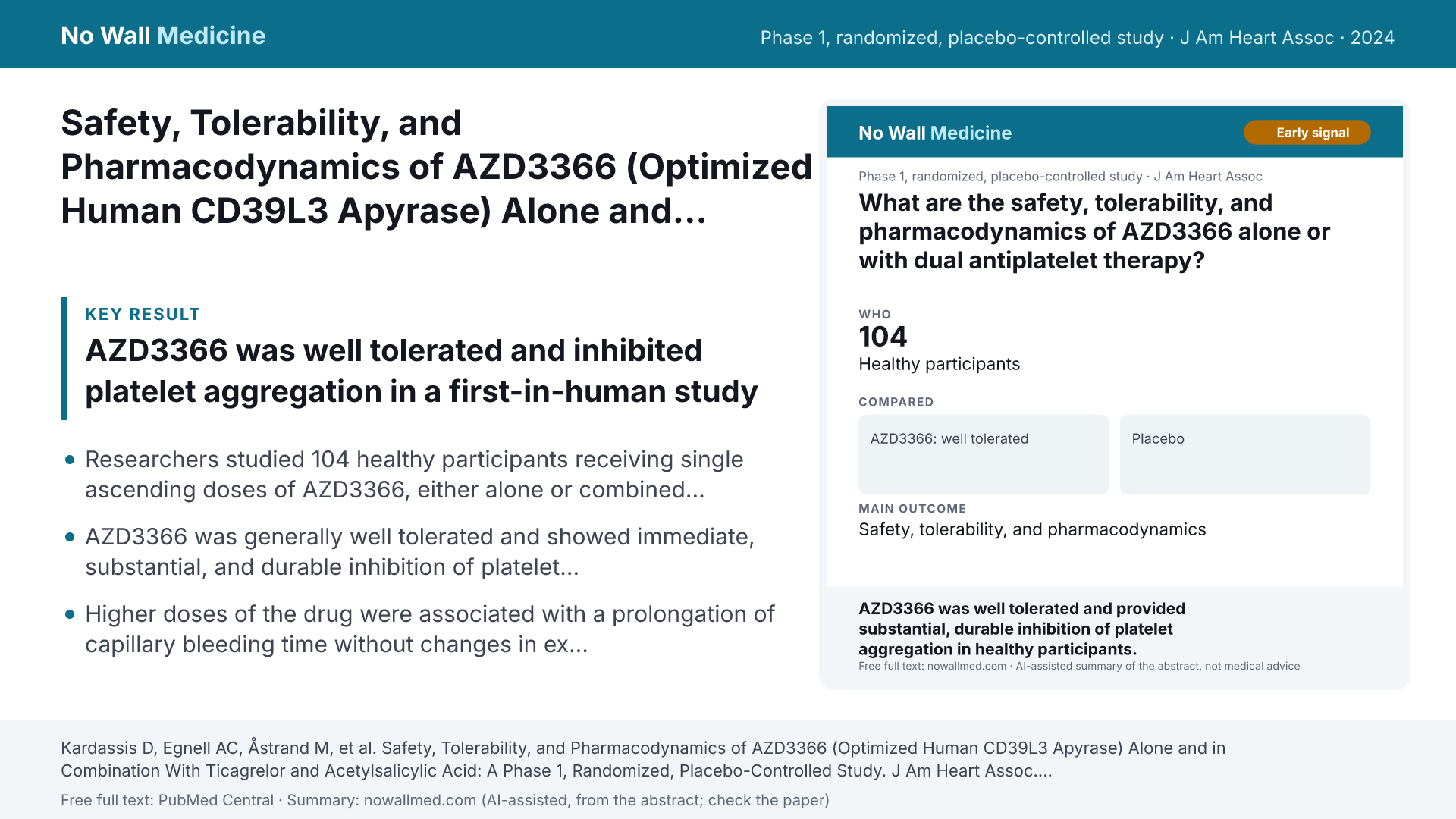
AZD3366 was well tolerated and inhibited platelet aggregation in a first-in-human study
Safety, Tolerability, and Pharmacodynamics of AZD3366 (Optimized Human CD39L3 Apyrase) Alone and in Combination With Ticagrelor and Acetylsalicylic Acid: A Phase 1, Randomized, Placebo-Controlled Study
Phase 1, randomized, placebo-controlled studyBenefit found
What are the safety, tolerability, and pharmacodynamics of AZD3366 alone or with dual antiplatelet therapy?
Who
104
Healthy participants
Compared
AZD3366: well tolerated
Placebo
Main outcome
Safety, tolerability, and pharmacodynamics
Bottom line: AZD3366 was well tolerated and provided substantial, durable inhibition of platelet aggregation in healthy participants.
J Am Heart Assoc · 2024-05-28Download image
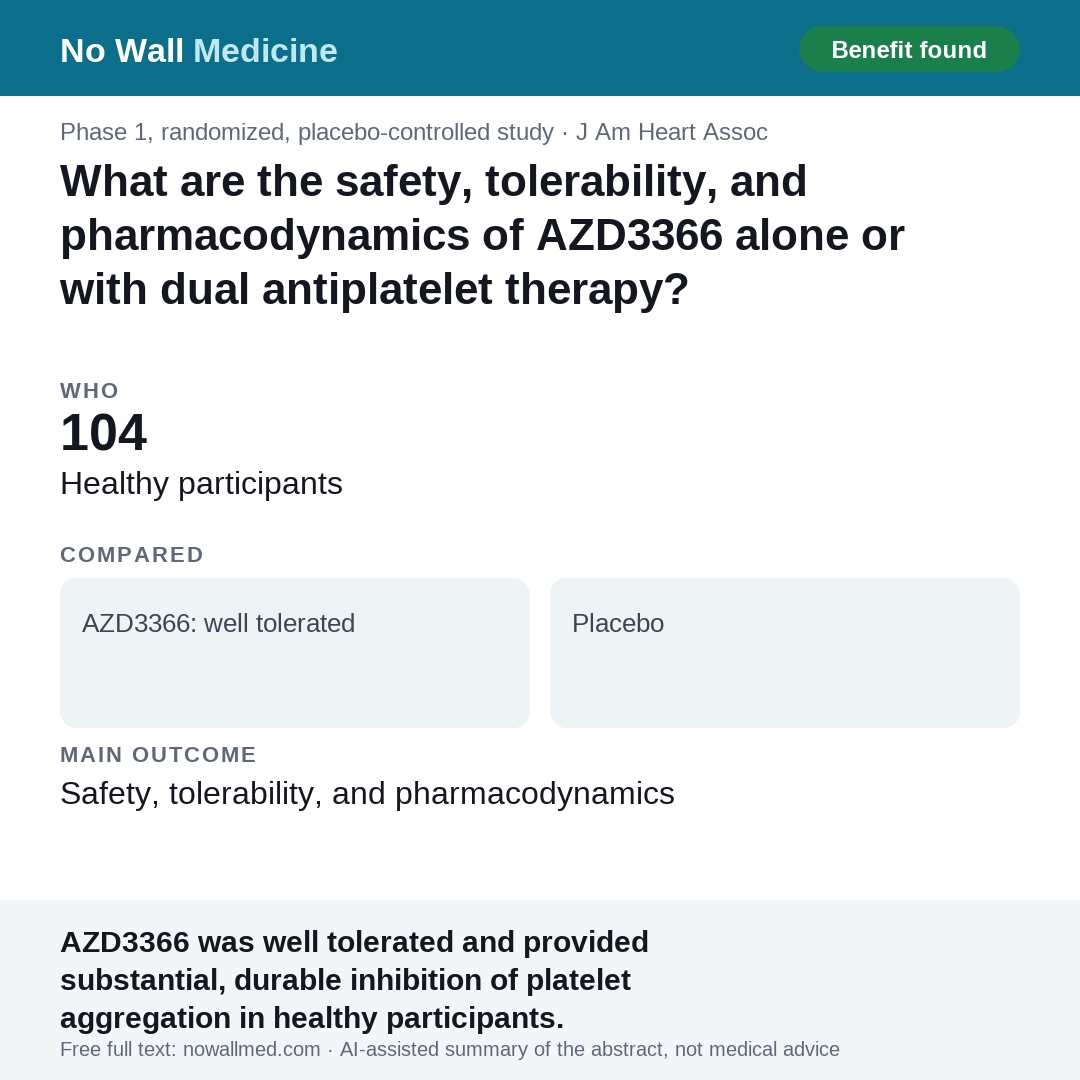
Clinical question: What are the safety, tolerability, and pharmacodynamics of AZD3366 alone or with dual antiplatelet therapy?
Why it matters: It was unknown if the long-acting enzyme AZD3366 is safe and how it affects blood clotting and nucleotide metabolism in humans.
Key points
- Researchers studied 104 healthy participants receiving single ascending doses of AZD3366, either alone or combined with ticagrelor and acetylsalicylic acid.
- AZD3366 was generally well tolerated and showed immediate, substantial, and durable inhibition of platelet aggregation, which is the process where blood cells clump together.
- Higher doses of the drug were associated with a prolongation of capillary bleeding time without changes in ex vivo thromboelastometric parameters.
Headline and key points written with AI from the paper’s abstract, with every number checked against it. Read the paper before relying on them.
Was this summary helpful?
Subject terms
Cite this article
Kardassis D, Egnell AC, Åstrand M, et al. Safety, Tolerability, and Pharmacodynamics of AZD3366 (Optimized Human CD39L3 Apyrase) Alone and in Combination With Ticagrelor and Acetylsalicylic Acid: A Phase 1, Randomized, Placebo-Controlled Study. J Am Heart Assoc. 2024. doi:10.1161/JAHA.123.033985
Spotted a mistake? Suggest a correction