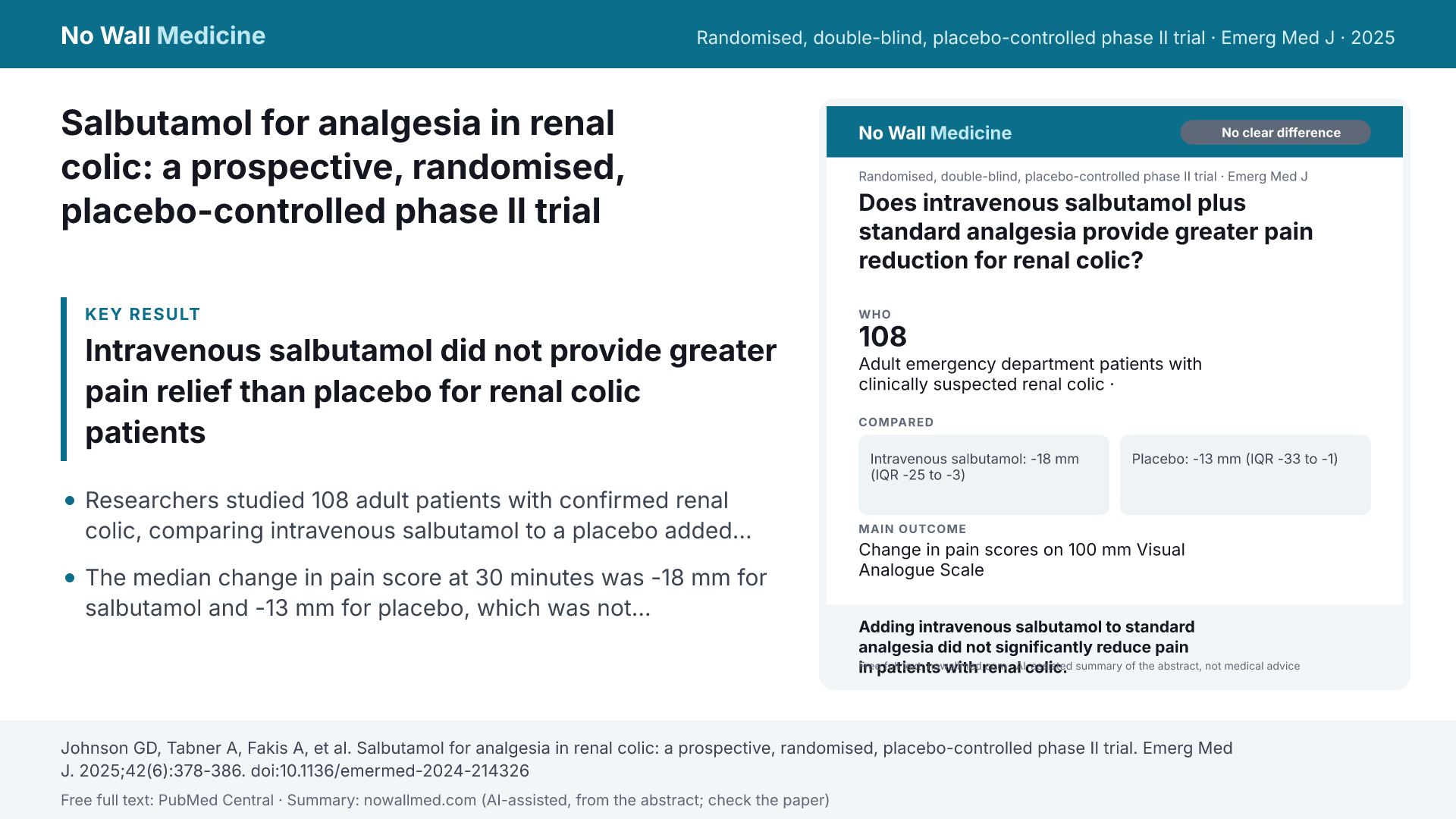
Intravenous salbutamol did not provide greater pain relief than placebo for renal colic patients
Salbutamol for analgesia in renal colic: a prospective, randomised, placebo-controlled phase II trial
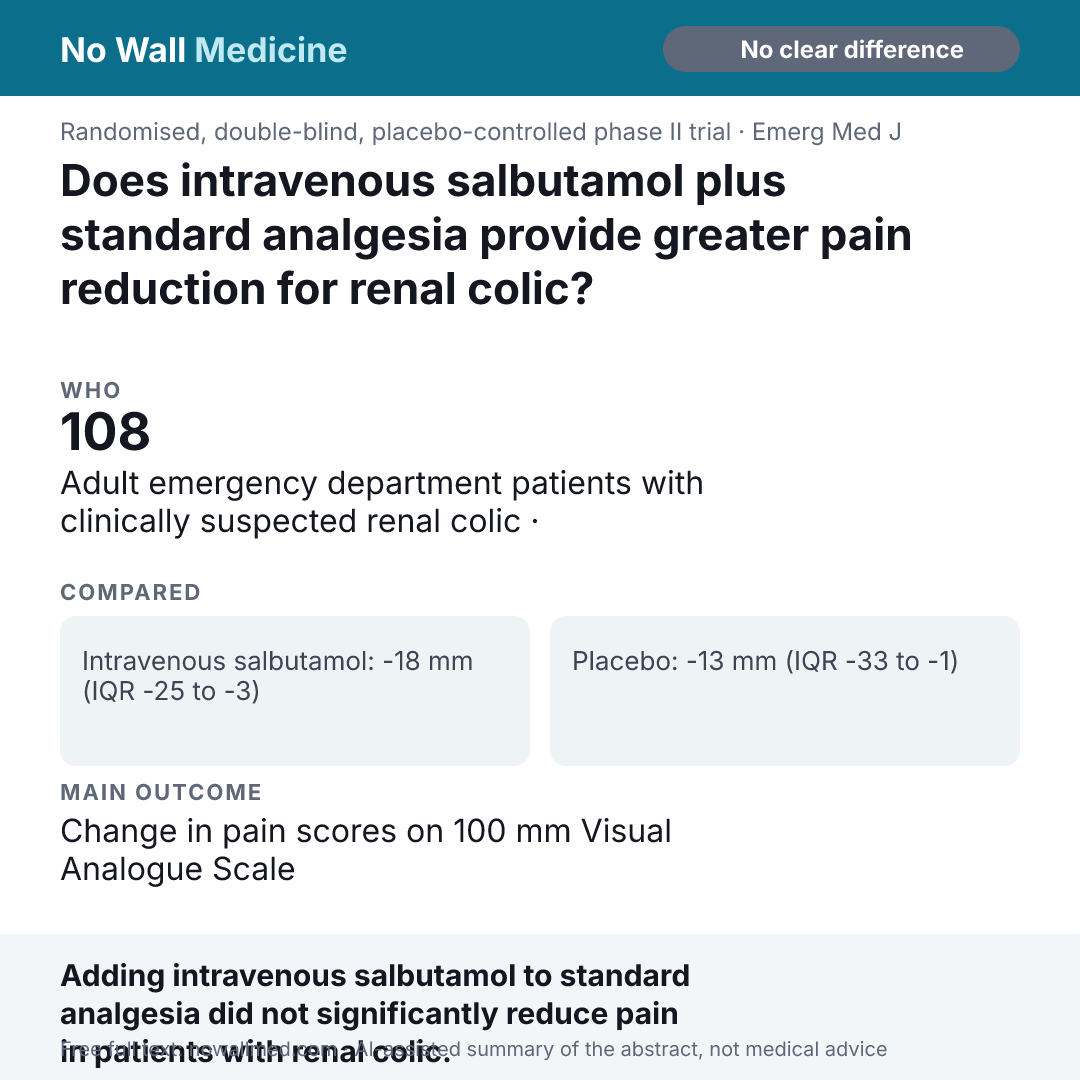
Randomised, double-blind, placebo-controlled phase II trialNo clear difference
Does intravenous salbutamol plus standard analgesia provide greater pain reduction for renal colic?
Who
108
Adult emergency department patients with clinically suspected renal colic · Single-centre
Compared
Intravenous salbutamol: -18 mm (IQR -25 to -3)
Placebo: -13 mm (IQR -33 to -1)
Main outcome
Change in pain scores on 100 mm Visual Analogue Scale
Result: difference 5 mm (95% CI -16 to 6, p=0.575)
Bottom line: Adding intravenous salbutamol to standard analgesia did not significantly reduce pain in patients with renal colic.
Emerg Med J · 2025-05-22 · Save PNG
Clinical question: Does intravenous salbutamol plus standard analgesia provide greater pain reduction for renal colic?
Key points
- Researchers studied 108 adult patients with confirmed renal colic, comparing intravenous salbutamol to a placebo added to standard pain medication.
- The median change in pain score at 30 minutes was -18 mm for salbutamol and -13 mm for placebo, which was not a statistically significant difference.
- More adverse events were observed in the salbutamol group (65) compared to the placebo group (42).
Limitation the authors note: This was a single-centre, phase II, randomized, placebo-controlled trial.
Headline and key points written with AI from the paper’s abstract, with every number checked against it. Read the paper before relying on them.
Was this summary helpful?
Abstract
Background
The pain of renal colic, mediated in part by ureteral spasm and inflammation, is often severe and difficult to control. Salbutamol has been shown to cause ureteral relaxation, but its effects on the pain of renal colic have never been studied. The objective of this trial was to investigate whether the use of intravenous salbutamol in addition to standard analgesia was associated with greater pain reduction compared with standard analgesia alone in patients presenting to emergency departments (EDs) with renal colic. Methods
This single-centre, double-blind, phase II, randomised, placebo-controlled trial recruited adult (≥18 years) ED patients with clinically suspected renal colic. Participants were randomised in a 1:1 ratio to receive either 250 µg of intravenous salbutamol or a placebo (0.9% sodium chloride). The primary outcome was the difference in the change in pain scores (measured on a 100 mm Visual Analogue Scale) from baseline to 30 min following trial treatment administration in participants with subsequently confirmed renal colic. A modified intention-to-treat analysis was undertaken for the primary population of participants with confirmed renal colic. Results
Consent was obtained from 151 patients; 108 participants with confirmed renal colic were included in the primary outcome analysis. There was no statistical difference between groups in median change in pain score at 30 min (salbutamol group -18 mm (IQR -25 to -3), placebo group -13 mm (IQR -33 to -1), difference 5 mm (95% CI -16 to 6, p=0.575)). No significant differences were found in the secondary outcomes related to pain, patient satisfaction or opiate requirement.More adverse events (AEs) were observed in the salbutamol group (65) compared with placebo (42, p=0.02); no unexpected AEs were identified. Conclusions
This trial has not identified a clinically or statistically significant benefit from the addition of intravenous salbutamol to standard care for patients presenting to an ED with pain caused by renal colic. Trial registration numbers
The trial was registered with the European Union Drug Regulating Authorities Clinical Trials Database (EudraCT), reference 2018-004305-11. It was also registered with the ISRCTN Registry, reference 14552440.
Abstract reproduced under the article’s CC BY licence.
Subject terms
Headline, design, result, key points, caveat and citation as plain text.
Cite this article
Johnson GD, Tabner A, Fakis A, et al. Salbutamol for analgesia in renal colic: a prospective, randomised, placebo-controlled phase II trial. Emerg Med J. 2025;42(6):378-386. doi:10.1136/emermed-2024-214326
Spotted a mistake? Suggest a correction