Sarcopenia evaluated by EASL/AASLD computed tomography-based criteria predicts mortality in patients with cirrhosis: A systematic review and meta-analysis
Systematic review and meta-analysisBenefit found
Does sarcopenia evaluated by computed tomography predict mortality in patients with cirrhosis?
Who
12827
Patients with cirrhosis
Compared
Sarcopenia present
Sarcopenia absent
Main outcome
Mortality
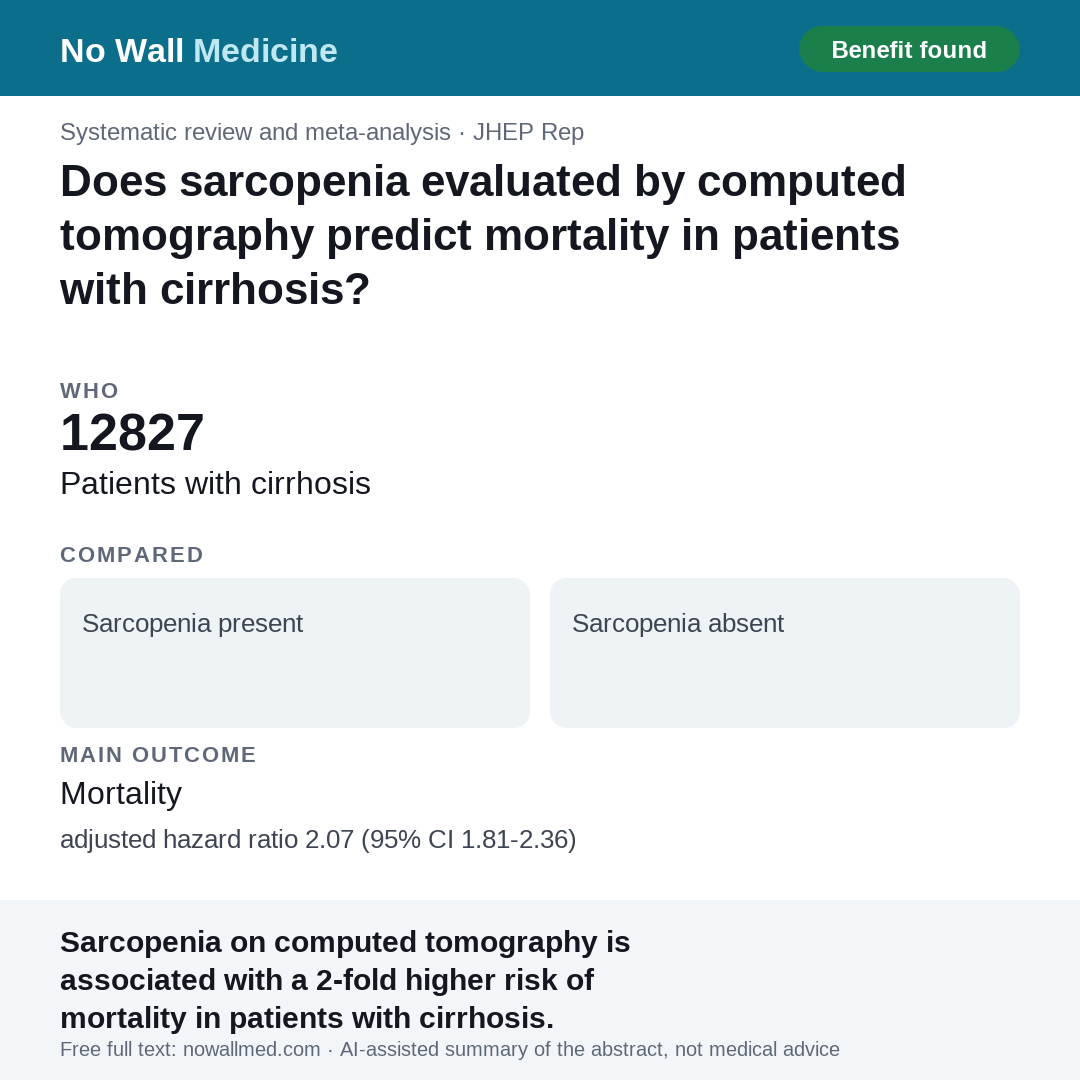
Result: adjusted hazard ratio 2.07 (95% CI 1.81-2.36)
Bottom line: Sarcopenia on computed tomography is associated with a 2-fold higher risk of mortality in patients with cirrhosis.
Limitation: Psoas muscle assessment data are too heterogeneous to recommend routine use at present.
JHEP Rep · 2024-05-06Download image
Clinical question: Does sarcopenia evaluated by computed tomography predict mortality in patients with cirrhosis?
Abstract
Background & aims
Sarcopenia is associated with increased morbidity and mortality in patients with cirrhosis, but its definition in current literature is very heterogeneous. We performed a systematic review and meta-analysis to assess the association between mortality and sarcopenia evaluated by computed tomography (CT) in patients with cirrhosis, both overall and stratified for the criteria used to define sarcopenia. Methods
Medline, Embase, Scopus, and Cochrane Library were searched up to January 2023. We included studies assessing sarcopenia presence with CT scans and providing data on the risk of mortality. Adjusted hazard ratios (HRs) and 95% CIs were pooled using a random-effects model. Results
Thirty-nine studies comprising 12,827 patients were included in the meta-analysis. The summary prevalence of sarcopenia was 44% (95% CI 38-50%). The presence of sarcopenia (any definition) was an independent predictor of mortality with an adjusted HR of 2.07 (95% CI 1.81-2.36), and the result was consistent in all subgroup analyses. The prognostic role of the EASL/AASLD criteria was confirmed for the first time with an HR of 1.86 (95% CI 1.53-2.26) (n = 14 studies). The cut-offs used to define sarcopenia based on psoas muscle parameters varied among studies, thus, a subgroup analysis was not feasible. There was no substantial heterogeneity for the main estimates and no significant risk of publication bias. Conclusions
Sarcopenia on CT is associated with a 2-fold higher risk of mortality in patients with cirrhosis. The cut-offs proposed by EASL/AASLD are prognostically relevant and should be the recommended criteria used to define sarcopenia in clinical practice. Impact and implications
Sarcopenia assessed by the reference standard (computed tomography scan) is an independent predictor of mortality in patients with cirrhosis, with a 2-fold increase in the risk of death in all sensitivity analyses. This finding is particularly valid in patients from Europe and North America, and in transplant candidates. Stratifying for the parameters and cut-offs used, we confirmed for the first time the prognostic impact of the definition proposed by EASL/AASLD, supporting their use in clinical practice. Psoas muscle assessment is promising, but data are still limited and too heterogeneous to recommend its routine use at present.
Cite this article
Dajti E, Rodrigues SG, Perazza F, Colecchia L, Marasco G, Renzulli M. Sarcopenia evaluated by EASL/AASLD computed tomography-based criteria predicts mortality in patients with cirrhosis: A systematic review and meta-analysis. JHEP Rep. 2024. doi:10.1016/j.jhepr.2024.101113
Spotted a mistake? Suggest a correction
Top studies every Monday
The week’s key trials and guidelines in your specialties, plus any topics you follow. By email, free.
Get the weekly digest