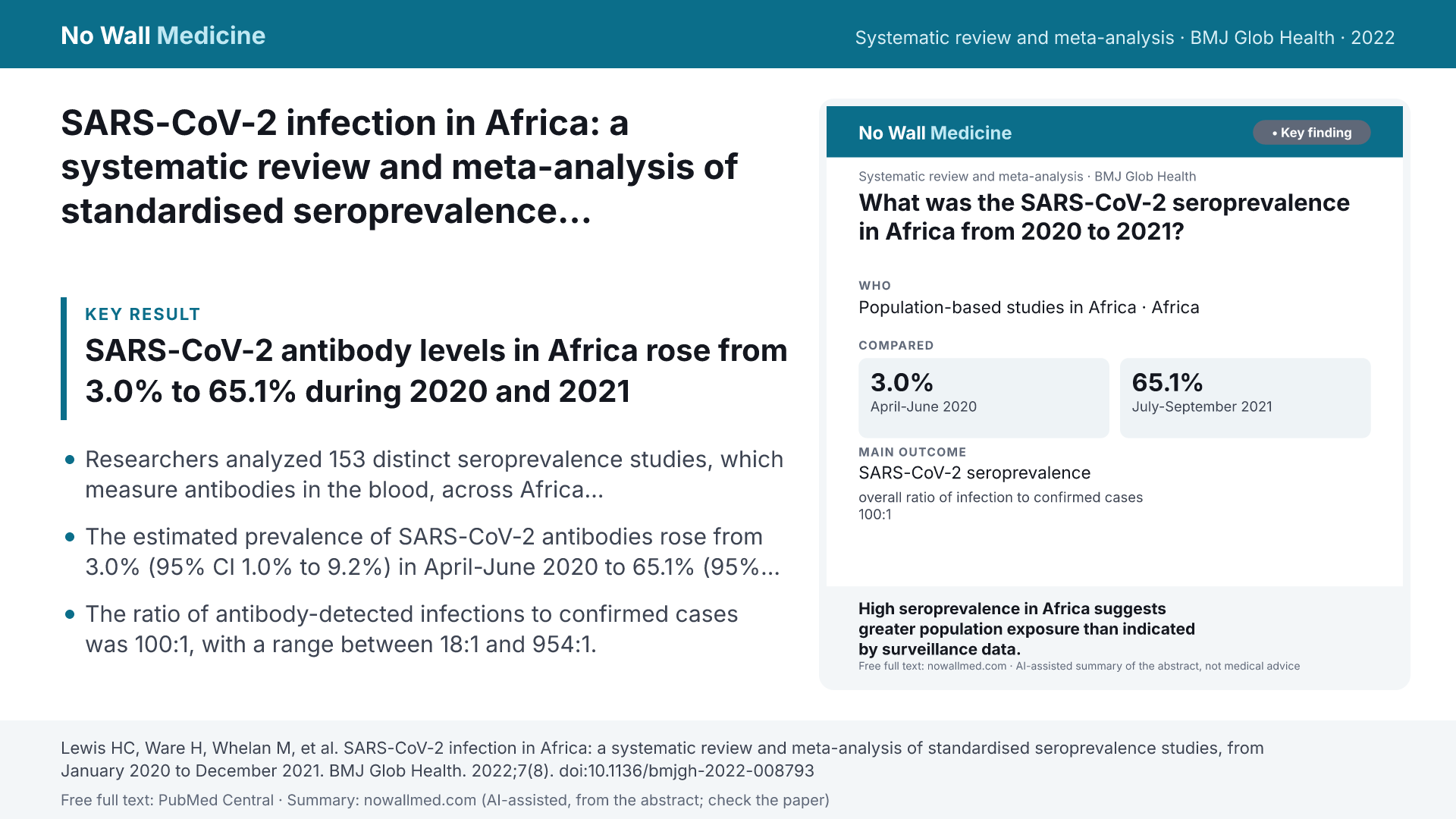
SARS-CoV-2 antibody levels in Africa rose from 3.0% to 65.1% during 2020 and 2021
SARS-CoV-2 infection in Africa: a systematic review and meta-analysis of standardised seroprevalence studies, from January 2020 to December 2021
Systematic review and meta-analysisKey finding
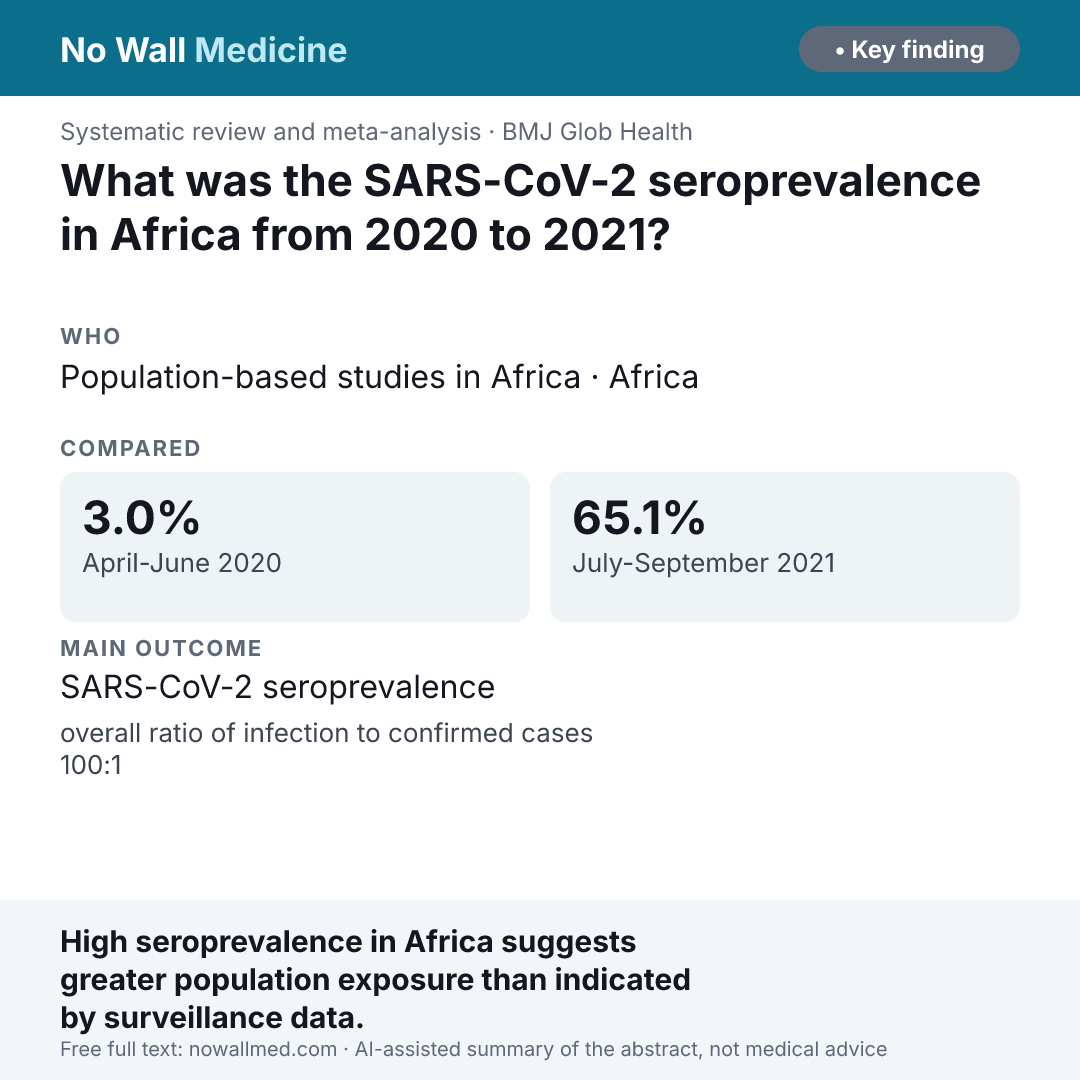
What was the SARS-CoV-2 seroprevalence in Africa from 2020 to 2021?
Who
Population-based studies in Africa · Africa
Compared
3.0%April-June 2020 (95% CI 1.0% to 9.2%)
65.1%July-September 2021 (95% CI 56.3% to 73.0%)
Main outcome
SARS-CoV-2 seroprevalence
Result: overall ratio of infection to confirmed cases 100:1
Bottom line: High seroprevalence in Africa suggests greater population exposure than indicated by surveillance data.
Limitation: Seroprevalence was highly heterogeneous between countries, subregions, and demographic groups.
BMJ Glob Health · 2022-08-23 · Save PNG
Clinical question: What was the SARS-CoV-2 seroprevalence in Africa from 2020 to 2021?
Why it matters: Estimating the total number of COVID-19 infections in Africa is difficult due to challenges with contact tracing, routine surveillance, and laboratory testing capacities.
Key points
- Researchers analyzed 153 distinct seroprevalence studies, which measure antibodies in the blood, across Africa published between January 2020 and December 2021.
- The estimated prevalence of SARS-CoV-2 antibodies rose from 3.0% (95% CI 1.0% to 9.2%) in April-June 2020 to 65.1% (95% CI 56.3% to 73.0%) in July-September 2021.
- The ratio of antibody-detected infections to confirmed cases was 100:1, with a range between 18:1 and 954:1.
Headline and key points written with AI from the paper’s abstract, with every number checked against it. Read the paper before relying on them.
Was this summary helpful?
Abstract
Introduction
Estimating COVID-19 cumulative incidence in Africa remains problematic due to challenges in contact tracing, routine surveillance systems and laboratory testing capacities and strategies. We undertook a meta-analysis of population-based seroprevalence studies to estimate SARS-CoV-2 seroprevalence in Africa to inform evidence-based decision making on public health and social measures (PHSM) and vaccine strategy. Methods
We searched for seroprevalence studies conducted in Africa published 1 January 2020-30 December 2021 in Medline, Embase, Web of Science and Europe PMC (preprints), grey literature, media releases and early results from WHO Unity studies. All studies were screened, extracted, assessed for risk of bias and evaluated for alignment with the WHO Unity seroprevalence protocol. We conducted descriptive analyses of seroprevalence and meta-analysed seroprevalence differences by demographic groups, place and time. We estimated the extent of undetected infections by comparing seroprevalence and cumulative incidence of confirmed cases reported to WHO. Prospero
CRD42020183634. Results
We identified 56 full texts or early results, reporting 153 distinct seroprevalence studies in Africa. Of these, 97 (63%) were low/moderate risk of bias studies. SARS-CoV-2 seroprevalence rose from 3.0% (95% CI 1.0% to 9.2%) in April-June 2020 to 65.1% (95% CI 56.3% to 73.0%) in July-September 2021. The ratios of seroprevalence from infection to cumulative incidence of confirmed cases was large (overall: 100:1, ranging from 18:1 to 954:1) and steady over time. Seroprevalence was highly heterogeneous both within countries-urban versus rural (lower seroprevalence for rural geographic areas), children versus adults (children aged 0-9 years had the lowest seroprevalence)-and between countries and African subregions. Conclusion
We report high seroprevalence in Africa suggesting greater population exposure to SARS-CoV-2 and potential protection against COVID-19 severe disease than indicated by surveillance data. As seroprevalence was heterogeneous, targeted PHSM and vaccination strategies need to be tailored to local epidemiological situations.
Abstract reproduced under the article’s CC BY NC licence.
Subject terms
Headline, design, result, key points, caveat and citation as plain text.
Cite this article
Lewis HC, Ware H, Whelan M, et al. SARS-CoV-2 infection in Africa: a systematic review and meta-analysis of standardised seroprevalence studies, from January 2020 to December 2021. BMJ Glob Health. 2022;7(8). doi:10.1136/bmjgh-2022-008793
Spotted a mistake? Suggest a correction