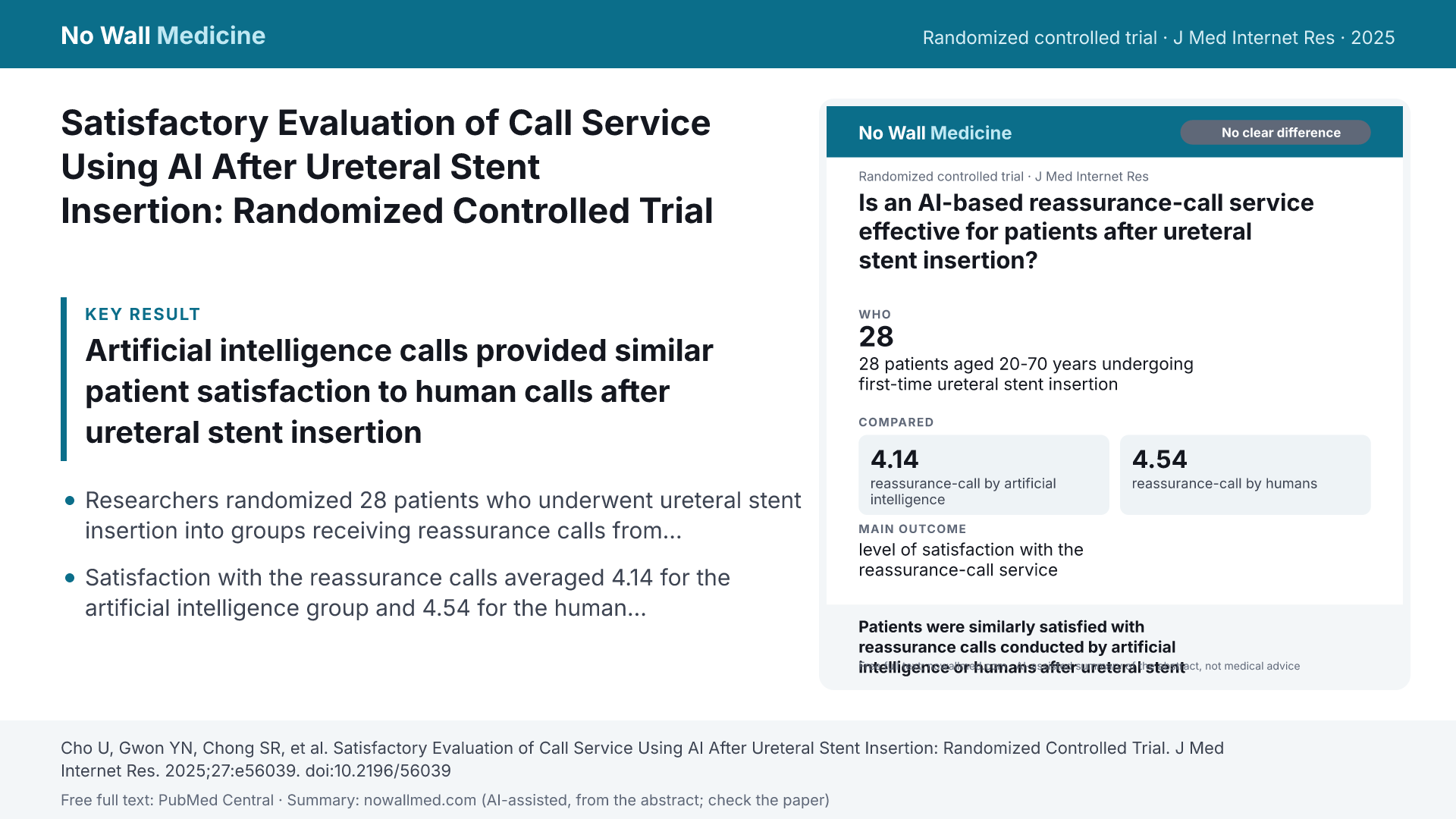
Artificial intelligence calls provided similar patient satisfaction to human calls after ureteral stent insertion
Satisfactory Evaluation of Call Service Using AI After Ureteral Stent Insertion: Randomized Controlled Trial
Randomized controlled trialNo clear difference
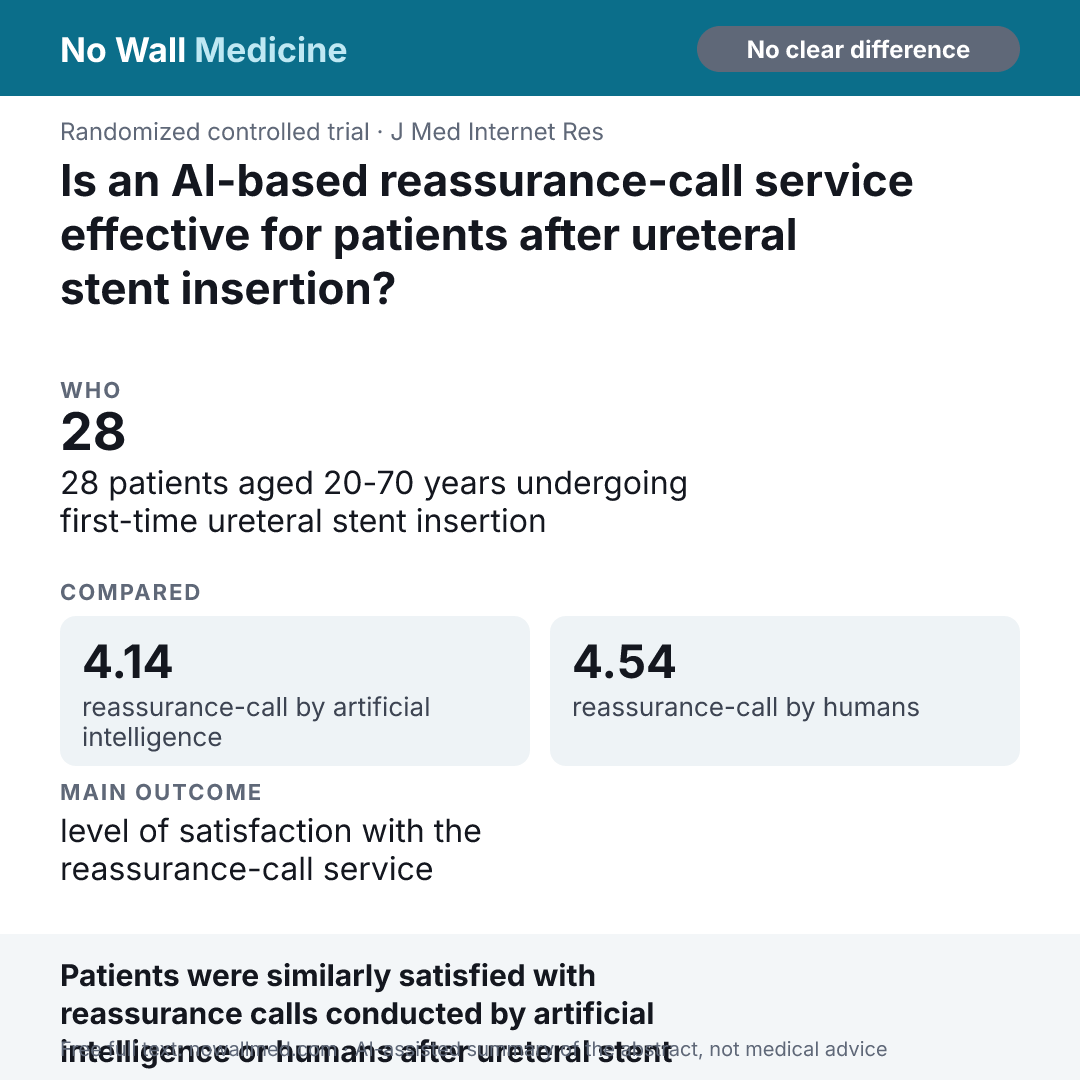
Is an AI-based reassurance-call service effective for patients after ureteral stent insertion?
Who
28
28 patients aged 20-70 years undergoing first-time ureteral stent insertion
Compared
4.14reassurance-call by artificial intelligence (SD 0.66)
4.54reassurance-call by humans (SD 0.52)
Main outcome
level of satisfaction with the reassurance-call service
Bottom line: Patients were similarly satisfied with reassurance calls conducted by artificial intelligence or humans after ureteral stent insertion.
J Med Internet Res · 2025-01-21 · Save PNG
Clinical question: Is an AI-based reassurance-call service effective for patients after ureteral stent insertion?
Key points
- Researchers randomized 28 patients who underwent ureteral stent insertion into groups receiving reassurance calls from either artificial intelligence or humans.
- Satisfaction with the reassurance calls averaged 4.14 for the artificial intelligence group and 4.54 for the human group, showing no significant difference.
- While most outcomes showed no significant difference, human calls were associated with higher satisfaction regarding complication management when measured by the Visual Analogue Scale.
Headline and key points written with AI from the paper’s abstract, with every number checked against it. Read the paper before relying on them.
Was this summary helpful?
Subject terms
Headline, design, result, key points, caveat and citation as plain text.
Cite this article
Cho U, Gwon YN, Chong SR, et al. Satisfactory Evaluation of Call Service Using AI After Ureteral Stent Insertion: Randomized Controlled Trial. J Med Internet Res. 2025;27:e56039. doi:10.2196/56039
Spotted a mistake? Suggest a correction