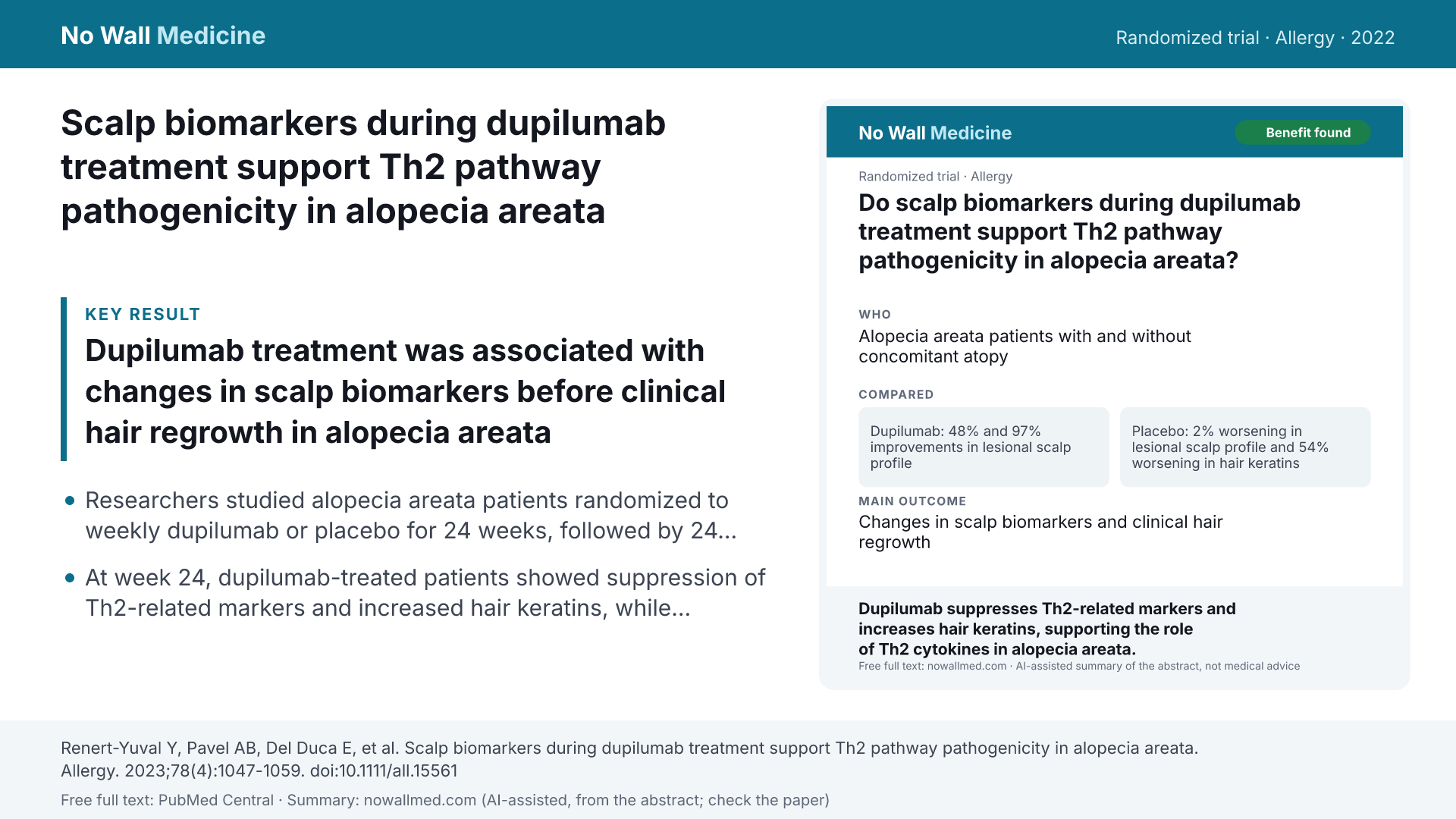
Dupilumab treatment was associated with changes in scalp biomarkers before clinical hair regrowth in alopecia areata
Scalp biomarkers during dupilumab treatment support Th2 pathway pathogenicity in alopecia areata
Randomized trialBenefit found
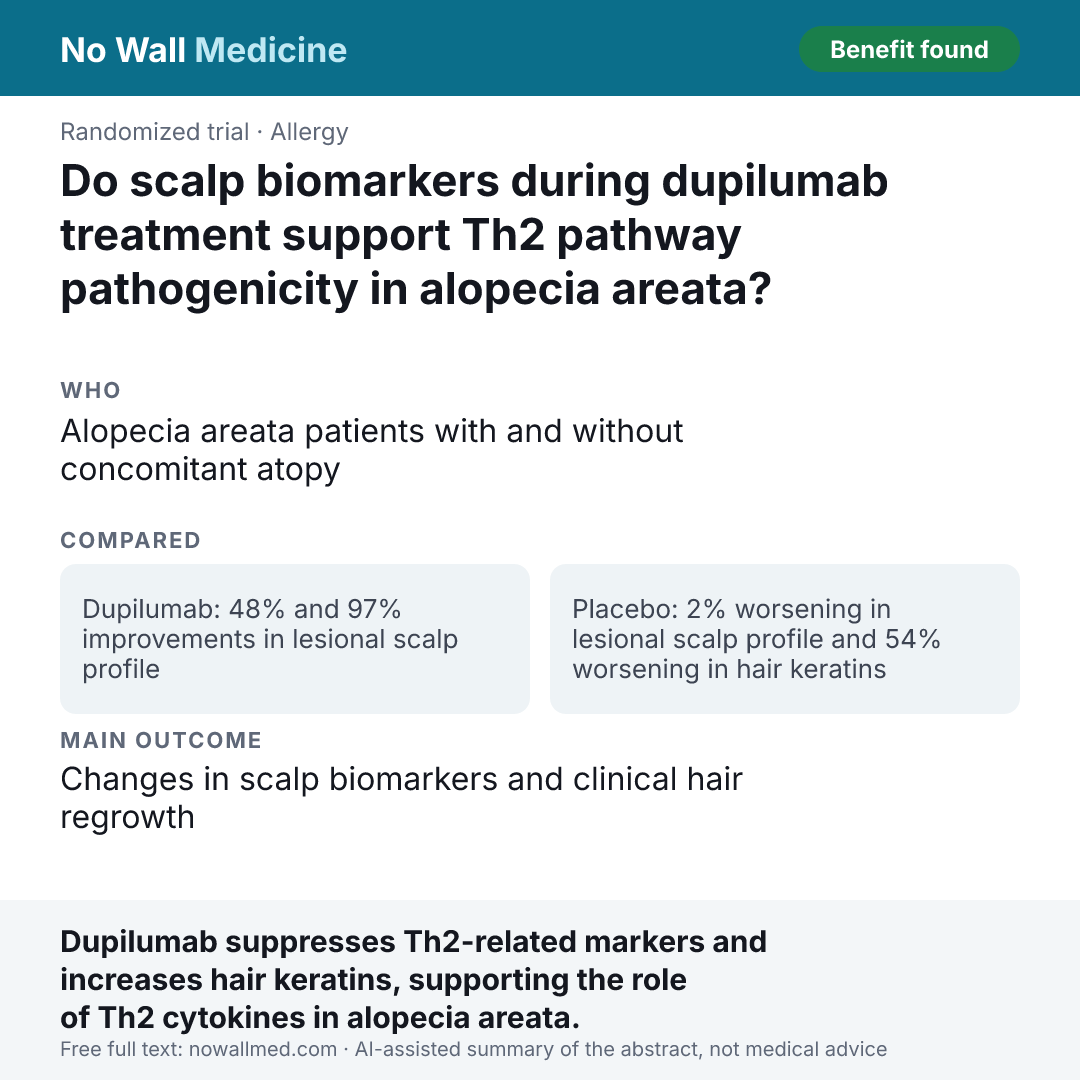
Do scalp biomarkers during dupilumab treatment support Th2 pathway pathogenicity in alopecia areata?
Who
Alopecia areata patients with and without concomitant atopy
Compared
Dupilumab: 48% and 97% improvements in lesional scalp profile
Placebo: 2% worsening in lesional scalp profile and 54% worsening in hair keratins
Main outcome
Changes in scalp biomarkers and clinical hair regrowth
Bottom line: Dupilumab suppresses Th2-related markers and increases hair keratins, supporting the role of Th2 cytokines in alopecia areata.
Allergy · 2022-11-05 · Save PNG
Clinical question: Do scalp biomarkers during dupilumab treatment support Th2 pathway pathogenicity in alopecia areata?
Why it matters: The mechanisms driving alopecia areata are unclear, making it difficult to develop targeted therapeutics.
Key points
- Researchers studied alopecia areata patients randomized to weekly dupilumab or placebo for 24 weeks, followed by 24 weeks of open-label dupilumab.
- At week 24, dupilumab-treated patients showed suppression of Th2-related markers and increased hair keratins, while placebo patients showed 54% worsening in hair keratins.
- Atopic patients receiving dupilumab showed 48% improvement in the scalp profile at week 24 and 97% improvement at week 48.
Headline and key points written with AI from the paper’s abstract, with every number checked against it. Read the paper before relying on them.
Was this summary helpful?
Subject terms
Headline, design, result, key points, caveat and citation as plain text.
Cite this article
Renert-Yuval Y, Pavel AB, Del Duca E, et al. Scalp biomarkers during dupilumab treatment support Th2 pathway pathogenicity in alopecia areata. Allergy. 2023;78(4):1047-1059. doi:10.1111/all.15561
Spotted a mistake? Suggest a correction