Digital mental health program improved stress, perfectionism, self-esteem, loneliness, and anxiety in adults
Schema-Informed Digital Mental Health Intervention for Maladaptive Cognitive-Emotional Patterns: Randomized Controlled Trial
Randomized controlled trialBenefit found
Does a schema-informed digital intervention reduce distress and enhance coping in adults?
Who
300
300 adults with elevated perceived stress and one dominant distress pattern · Web-based recruitment in South Korea
Compared
Intervention group: significantly greater improvement in perceived stress
Waitlist control
Main outcome
perceived stress, perfectionism, self-esteem, loneliness, and anxiety
Bottom line: The schema-informed digital intervention significantly improved perceived stress and pattern-linked psychological outcomes in adults.
Limitation: Limitations in study design, sample representativeness, and follow-up duration.
J Med Internet Res · 2025-08-14Download image
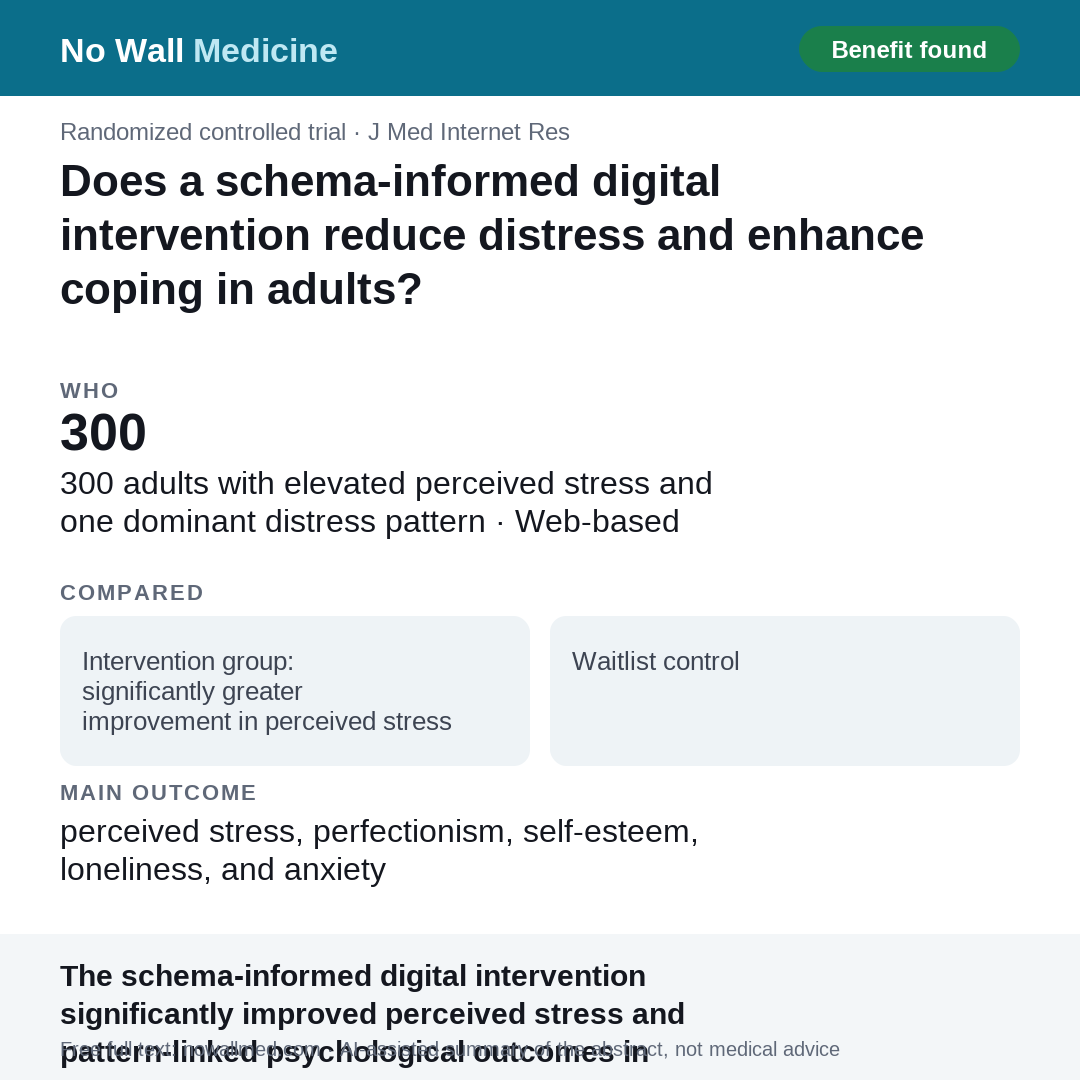
Clinical question: Does a schema-informed digital intervention reduce distress and enhance coping in adults?
Why it matters: Digital interventions are needed to address underlying cognitive-emotional patterns in areas where mental health services are limited by stigma, cost, and self-reliance.
Key points
- Researchers studied 300 adults with elevated stress and assigned 201 to a 10-week web-based program and 99 to a waitlist control group.
- The intervention group showed significantly greater improvements in perceived stress, perfectionism, self-esteem, loneliness, and anxiety compared to the waitlist group.
- Among those who accessed the platform, 70.1% (131/187) completed all 10 sessions, and effects were maintained at a 1-month follow-up.
Limitation the authors note: The authors noted limitations in study design, sample representativeness, and follow-up duration.
Headline and key points written with AI from the paper’s abstract, with every number checked against it. Read the paper before relying on them.
Topics
Cite this article
Jeong S, Kim H, Lho SK, Hwang I, Mun S, Kim S. Schema-Informed Digital Mental Health Intervention for Maladaptive Cognitive-Emotional Patterns: Randomized Controlled Trial. J Med Internet Res. 2025. doi:10.2196/65892
Spotted a mistake? Suggest a correction
Top studies every Monday
The week’s key trials and guidelines in your specialties, by email. Free.
Get the weekly digest