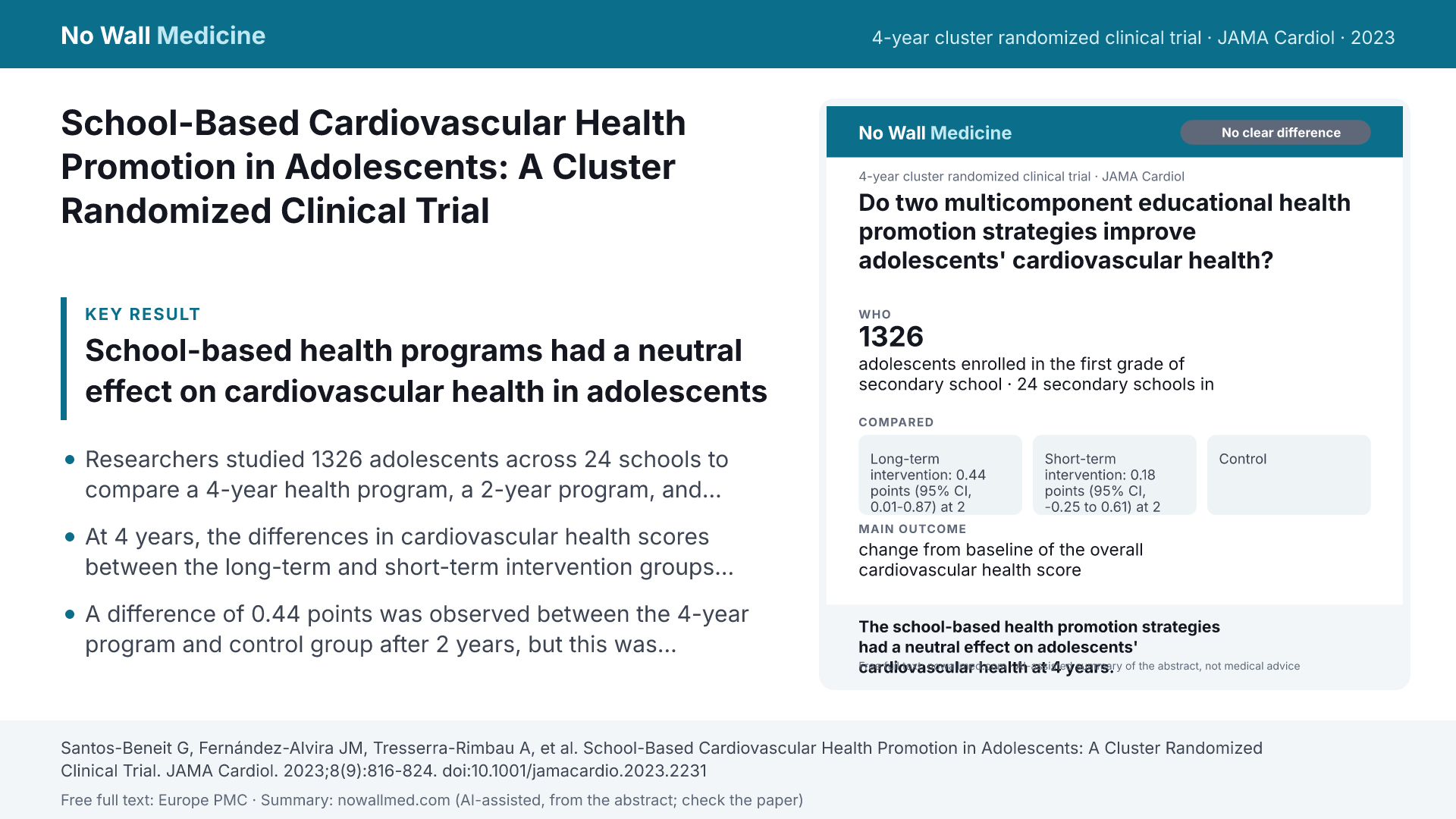
School-based health programs had a neutral effect on cardiovascular health in adolescents
School-Based Cardiovascular Health Promotion in Adolescents: A Cluster Randomized Clinical Trial
4-year cluster randomized clinical trialNo clear difference
Do two multicomponent educational health promotion strategies improve adolescents' cardiovascular health?
Who
1326
adolescents enrolled in the first grade of secondary school · 24 secondary schools in Barcelona and Madrid, Spain
Compared
Long-term intervention: 0.44 points (95% CI, 0.01-0.87) at 2 years
Short-term intervention: 0.18 points (95% CI, -0.25 to 0.61) at 2 years
Control
Main outcome
change from baseline of the overall cardiovascular health score
Result: 0.12 points (95% CI, -0.19 to 0.43) for LTI at 4 years
Bottom line: The school-based health promotion strategies had a neutral effect on adolescents' cardiovascular health at 4 years.
JAMA Cardiol · 2023-08-02 · Save PNG
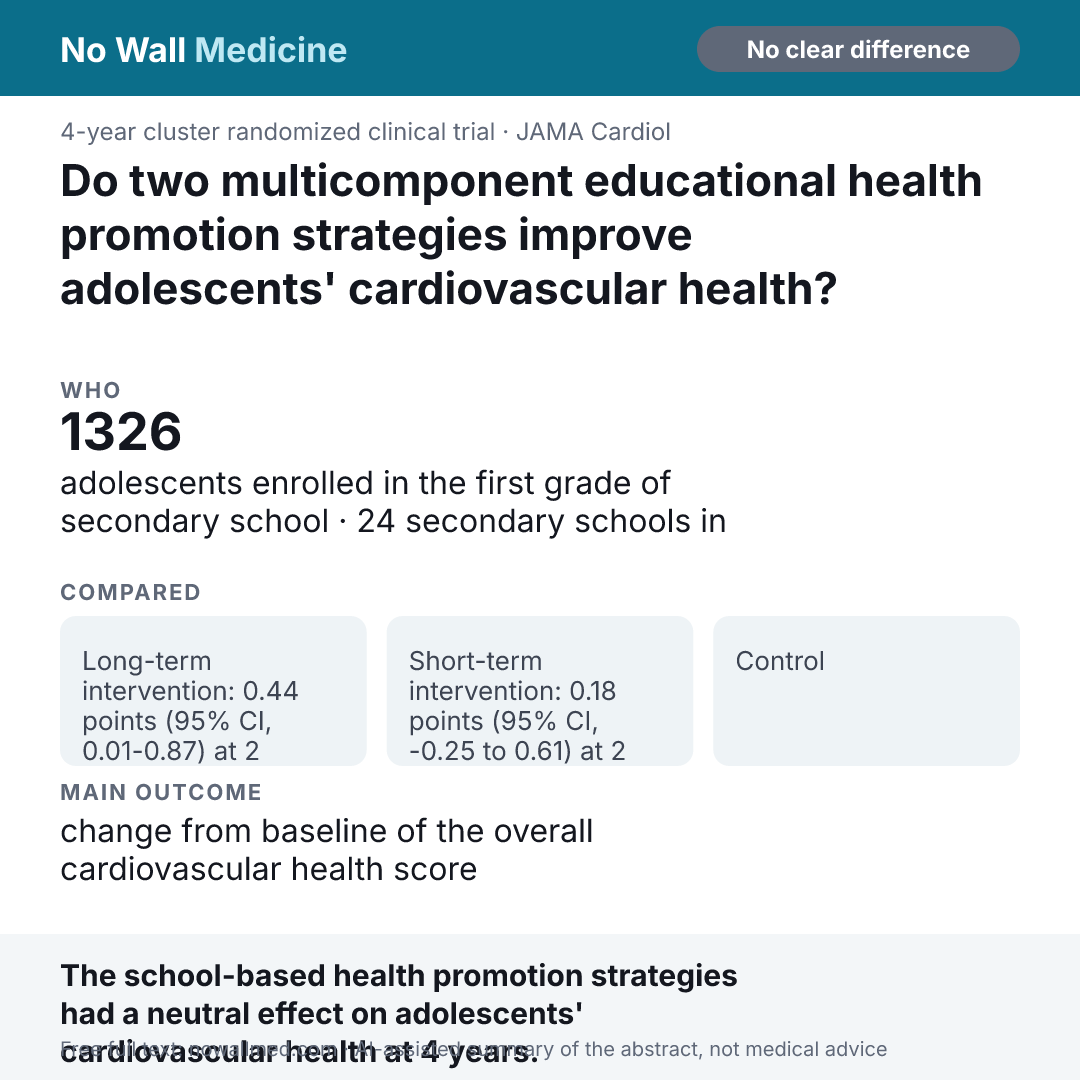
Clinical question: Do two multicomponent educational health promotion strategies improve adolescents' cardiovascular health?
Key points
- Researchers studied 1326 adolescents across 24 schools to compare a 4-year health program, a 2-year program, and a standard curriculum.
- At 4 years, the differences in cardiovascular health scores between the long-term and short-term intervention groups and the control group were 0.12 points and 0.13 points.
- A difference of 0.44 points was observed between the 4-year program and control group after 2 years, but this was not sustained at 4 years.
Headline and key points written with AI from the paper’s abstract, with every number checked against it. Read the paper before relying on them.
Was this summary helpful?
Abstract
Importance
School-based interventions offer an opportunity for health promotion in adolescence.Objective
To assess the effect of 2 multicomponent educational health promotion strategies of differing duration and intensity on adolescents' cardiovascular health (CVH).Design, setting, and participants
The SI! Program for Secondary Schools is a 4-year cluster randomized clinical intervention trial conducted in 24 secondary schools from Barcelona and Madrid, Spain, from September 7, 2017, to July 31, 2021. Eligible participants were adolescents enrolled in the first grade of secondary school.Interventions
Schools and their participants were randomized to receive a health promotion intervention (SI! Program) over 4 school years (long-term intervention [LTI], 8 schools, 412 adolescents) or 2 school years (short-term intervention [STI], 8 schools, 504 adolescents) or to receive the standard curriculum (control, 8 schools, 441 adolescents).Main outcome and measures
The primary end point was the between-group difference at 2 and 4 years in the change from baseline of the overall CVH score, as defined by the American Heart Association (range, 0-14 points, with a higher score indicating a healthier CVH profile). Intervention effects were tested with multilevel mixed-effects models. A complete-case intention-to-treat analysis was performed as the primary analysis.Results
Of the randomized students, the study enrolled 1326 adolescents (684 [51.6%] boys, mean [SD] age, 12.5 [0.4] years at recruitment) with a study completion rate of 86.0%. Baseline overall CVH scores were 10.3 points in the LTI group, 10.6 points in the STI group, and 10.5 points in the control group. After 2 years, at halfway through the LTI and at the end of the STI, the difference in the CVH score change was 0.44 points (95% CI, 0.01-0.87; P = .04) between the LTI group and the control group and 0.18 points (95% CI, -0.25 to 0.61; P = .39) between the STI group and the control group. At 4 years, differences for the LTI and STI groups vs control were 0.12 points (LTI: 95% CI, -0.19 to 0.43; P = .42) and 0.13 points (STI: 95% CI, -0.17 to 0.44; P = .38). No adverse events were reported.Conclusions and relevance
Overall, the tested school-based health promotion strategies in this randomized clinical trial had a neutral effect on the CVH of the adolescents. Although there was evidence of a marginal beneficial effect at a point halfway through implementation in the LTI group, such a benefit was not noted at 4 years. Further research is warranted into the efficacy of school-based health promotion programs.Trial registration
ClinicalTrials.gov Identifier: NCT03504059.
Abstract reproduced under the article’s CC BY licence.
Subject terms
Headline, design, result, key points, caveat and citation as plain text.
Cite this article
Santos-Beneit G, Fernández-Alvira JM, Tresserra-Rimbau A, et al. School-Based Cardiovascular Health Promotion in Adolescents: A Cluster Randomized Clinical Trial. JAMA Cardiol. 2023;8(9):816-824. doi:10.1001/jamacardio.2023.2231
Spotted a mistake? Suggest a correction