School-based motor skill training improves motor performance in children and adolescents with developmental coordination disorder
School-based Motor Skill Interventions for Children and Adolescents with Developmental Coordination Disorder: A Systematic Review and Meta-Analysis
Systematic review and meta-analysisBenefit found
Do school-based interventions improve motor performance in children and adolescents with developmental coordination disorder?
Who
Children and adolescents aged 5 to 19 years with developmental coordination disorder · School settings
Compared
Motor skill training
Nontraining control group
Main outcome
Motor performance
Result: Hedges g=1.06 (95% CI, 0.60-1.53)
Bottom line: School-based motor skill interventions significantly improve motor performance in children and adolescents with developmental coordination disorder.
Arch Phys Med Rehabil · 2026-06-12Download image
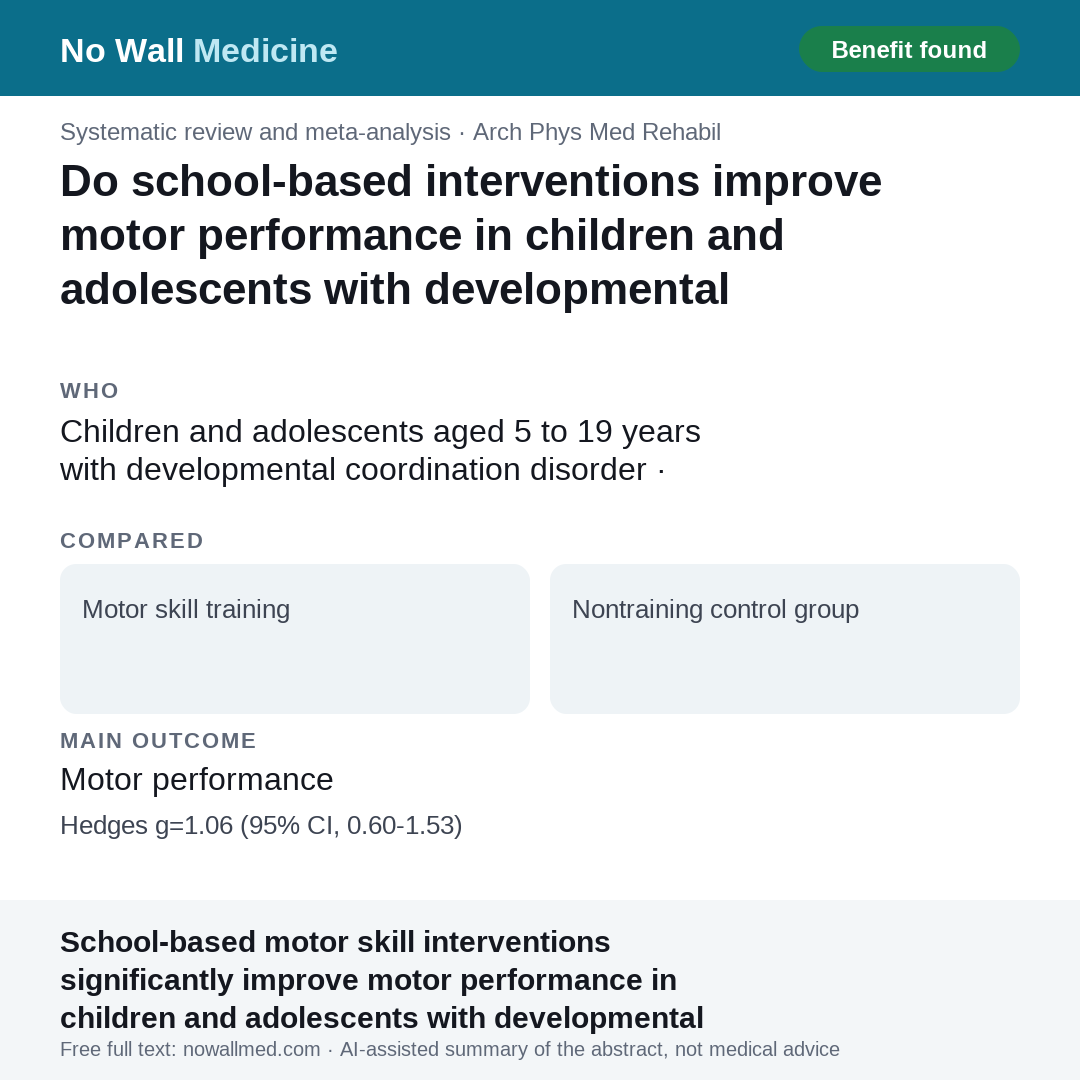
Clinical question: Do school-based interventions improve motor performance in children and adolescents with developmental coordination disorder?
Why it matters: Researchers sought to investigate how school-based interventions affect motor performance and what factors might influence these effects in children with developmental coordination disorder.
Key points
- Researchers reviewed 35 studies involving children and adolescents aged 5 to 19 years with developmental coordination disorder or probable developmental coordination disorder.
- A meta-analysis of 18 studies showed a large effect on motor performance with a Hedges g of 1.06 (95% CI, 0.60-1.53).
- The largest effects occurred with training at least 3 times a week and a total dose of at least 500 minutes.
Headline and key points written with AI from the paper’s abstract, with every number checked against it. Read the paper before relying on them.
Topics
Spotted a mistake? Suggest a correction