Screening and brief intervention reduced alcohol use more than usual care in Zambian refugee settlement
Screening, brief intervention, and referral to treatment compared with treatment as usual for alcohol use in an integrated refugee settlement in Zambia: a hybrid, type 1, randomised controlled trial
Parallel, individually randomised trialBenefit found
Does screening, brief intervention, and referral to treatment reduce alcohol use in a refugee settlement?
Who
400
Congolese refugees and Zambian host community members aged 15 years and older · Mantapala refugee settlement in Zambia
Compared
-12·6screening, brief intervention, and referral to treatment (95% CI -14·3 to -11·0)
-8·1treatment as usual (-9·8 to -6·3)
Main outcome
Alcohol Use Identification Test score at 6 months
Result: -4·6 (95% CI -6·9 to -2·2)
Bottom line: Screening, brief intervention, and referral to treatment significantly reduced alcohol use scores compared to treatment as usual at 6 months.
Funded by: Elrha's Research for Health in Humanitarian Crises Programme
Lancet Glob Health · 2026-07-24Download image
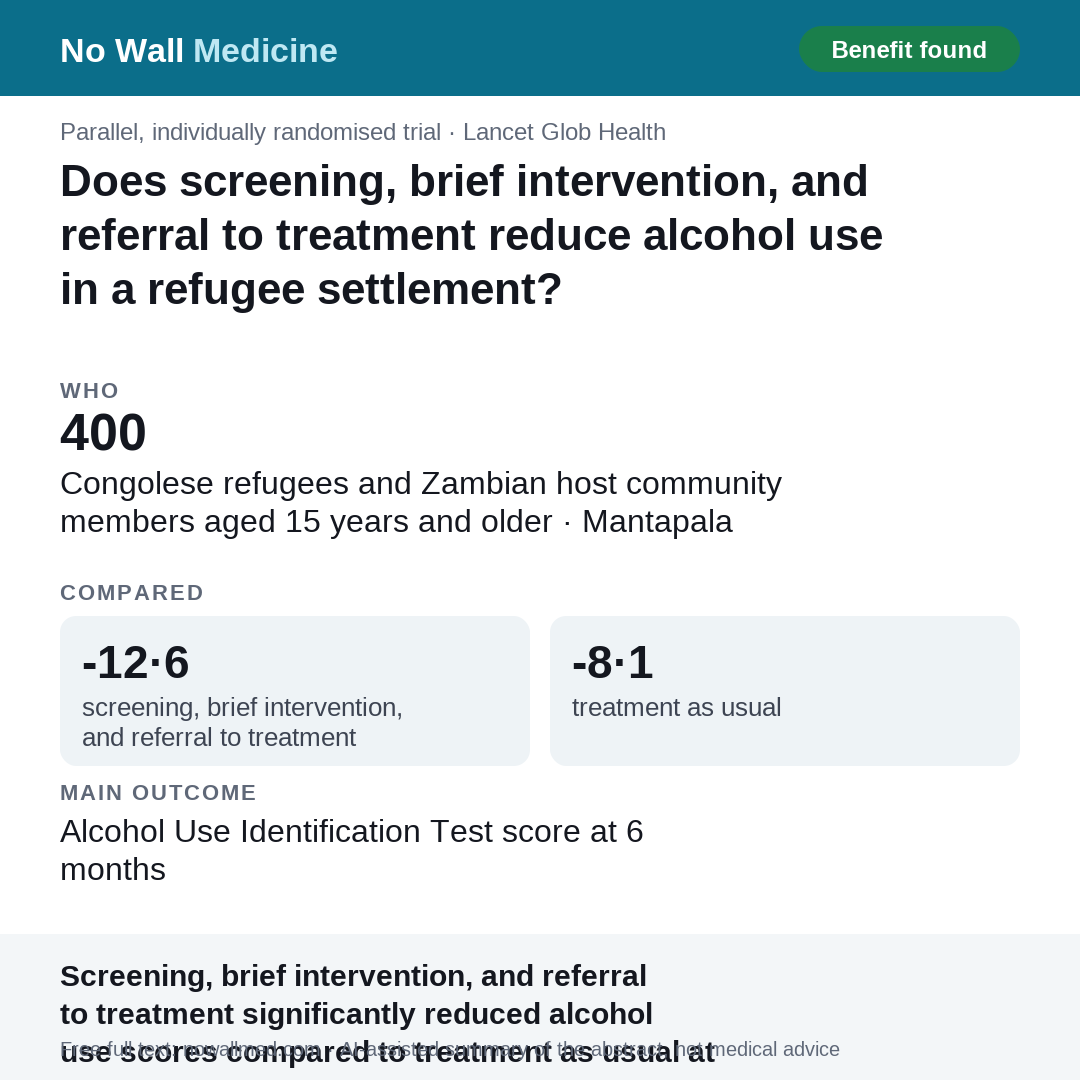
Clinical question: Does screening, brief intervention, and referral to treatment reduce alcohol use in a refugee settlement?
Why it matters: Alcohol and other drug use interventions are often neglected in humanitarian health research and programming in low-resource settings.
Key points
- Researchers studied 400 Congolese refugees and Zambian host community members aged 15 years or older to compare a multicomponent intervention against usual care.
- At 6 months, the screening, brief intervention, and referral to treatment group showed a significantly greater reduction in alcohol use scores than the usual care group.
- The mean change in alcohol use scores was -12.6 for the intervention group and -8.1 for the usual care group at the 6-month assessment.
Headline and key points written with AI from the paper’s abstract, with every number checked against it. Read the paper before relying on them.
Topics
Spotted a mistake? Suggest a correction