Deep learning algorithm outperformed radiologists in predicting extranodal extension in oropharyngeal cancer patients
Screening for extranodal extension in HPV-associated oropharyngeal carcinoma: evaluation of a CT-based deep learning algorithm in patient data from a multicentre, randomised de-escalation trial
Retrospective evaluation of deep learning algorithm performanceKey finding
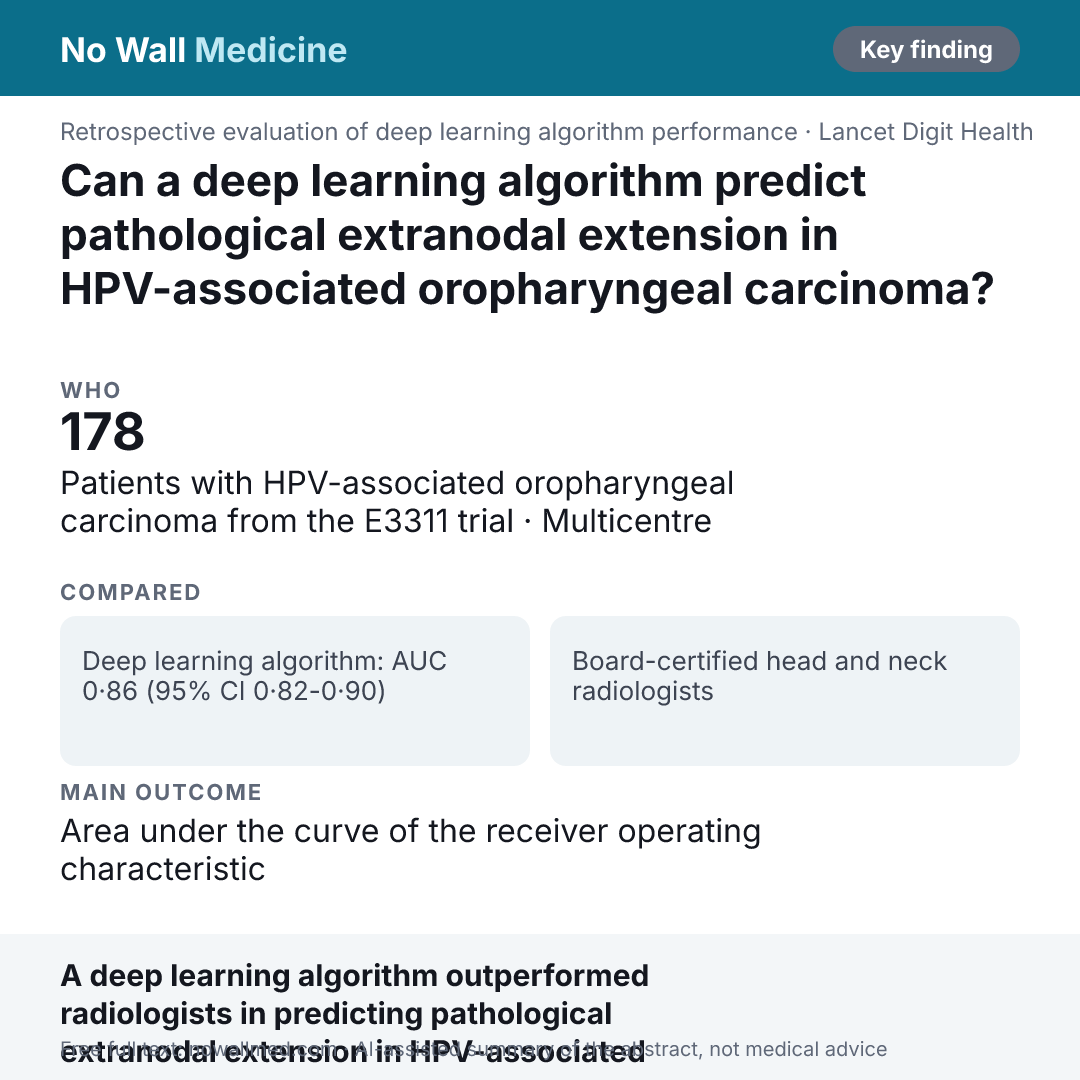
Can a deep learning algorithm predict pathological extranodal extension in HPV-associated oropharyngeal carcinoma?
Who
178
Patients with HPV-associated oropharyngeal carcinoma from the E3311 trial · Multicentre trial
Compared
Deep learning algorithm: AUC 0·86 (95% CI 0·82-0·90)
Board-certified head and neck radiologists
Main outcome
Area under the curve of the receiver operating characteristic
Result: AUC 0·86 (95% CI 0·82-0·90)
Bottom line: A deep learning algorithm outperformed radiologists in predicting pathological extranodal extension in HPV-associated oropharyngeal carcinoma.
Funded by: ECOG-ACRIN Cancer Research Group and National Cancer Institute
Lancet Digit Health · 2023-04-21 · Save PNG
Clinical question: Can a deep learning algorithm predict pathological extranodal extension in HPV-associated oropharyngeal carcinoma?
Why it matters: Identifying extranodal extension through imaging is diagnostically challenging and necessary to guide therapy de-escalation strategies for patients with human papillomavirus-associated oropharyngeal carcinoma.
Key points
- Researchers evaluated a deep learning algorithm against four board-certified radiologists using 178 scans from a multicentre trial of patients with human papillomavirus-associated oropharyngeal cancer.
- The algorithm achieved an area under the curve of 0.86 for classifying extranodal extension, which is cancer spreading outside a lymph node, outperforming all human readers.
- Radiologists showed high variability in performance, with specificity ranging from 43% to 86% and sensitivity ranging from 45% to 96%.
Limitation the authors note: This was a retrospective evaluation of deep learning algorithm performance.
Headline and key points written with AI from the paper’s abstract, with every number checked against it. Read the paper before relying on them.
Was this summary helpful?
Abstract
Background
Pretreatment identification of pathological extranodal extension (ENE) would guide therapy de-escalation strategies for in human papillomavirus (HPV)-associated oropharyngeal carcinoma but is diagnostically challenging. ECOG-ACRIN Cancer Research Group E3311 was a multicentre trial wherein patients with HPV-associated oropharyngeal carcinoma were treated surgically and assigned to a pathological risk-based adjuvant strategy of observation, radiation, or concurrent chemoradiation. Despite protocol exclusion of patients with overt radiographic ENE, more than 30% had pathological ENE and required postoperative chemoradiation. We aimed to evaluate a CT-based deep learning algorithm for prediction of ENE in E3311, a diagnostically challenging cohort wherein algorithm use would be impactful in guiding decision-making. Methods
For this retrospective evaluation of deep learning algorithm performance, we obtained pretreatment CTs and corresponding surgical pathology reports from the multicentre, randomised de-escalation trial E3311. All enrolled patients on E3311 required pretreatment and diagnostic head and neck imaging; patients with radiographically overt ENE were excluded per study protocol. The lymph node with largest short-axis diameter and up to two additional nodes were segmented on each scan and annotated for ENE per pathology reports. Deep learning algorithm performance for ENE prediction was compared with four board-certified head and neck radiologists. The primary endpoint was the area under the curve (AUC) of the receiver operating characteristic. Findings
From 178 collected scans, 313 nodes were annotated: 71 (23%) with ENE in general, 39 (13%) with ENE larger than 1 mm ENE. The deep learning algorithm AUC for ENE classification was 0·86 (95% CI 0·82-0·90), outperforming all readers (p<0·0001 for each). Among radiologists, there was high variability in specificity (43-86%) and sensitivity (45-96%) with poor inter-reader agreement (κ 0·32). Matching the algorithm specificity to that of the reader with highest AUC (R2, false positive rate 22%) yielded improved sensitivity to 75% (+ 13%). Setting the algorithm false positive rate to 30% yielded 90% sensitivity. The algorithm showed improved performance compared with radiologists for ENE larger than 1 mm (p<0·0001) and in nodes with short-axis diameter 1 cm or larger. Interpretation
The deep learning algorithm outperformed experts in predicting pathological ENE on a challenging cohort of patients with HPV-associated oropharyngeal carcinoma from a randomised clinical trial. Deep learning algorithms should be evaluated prospectively as a treatment selection tool. Funding
ECOG-ACRIN Cancer Research Group and the National Cancer Institute of the US National Institutes of Health.
Abstract reproduced under the article’s CC BY NC ND licence.
Subject terms
Headline, design, result, key points, caveat and citation as plain text.
Cite this article
Kann BH, Likitlersuang J, Bontempi D, et al. Screening for extranodal extension in HPV-associated oropharyngeal carcinoma: evaluation of a CT-based deep learning algorithm in patient data from a multicentre, randomised de-escalation trial. Lancet Digit Health. 2023;5(6):e360-e369. doi:10.1016/S2589-7500(23)00046-8
Spotted a mistake? Suggest a correction