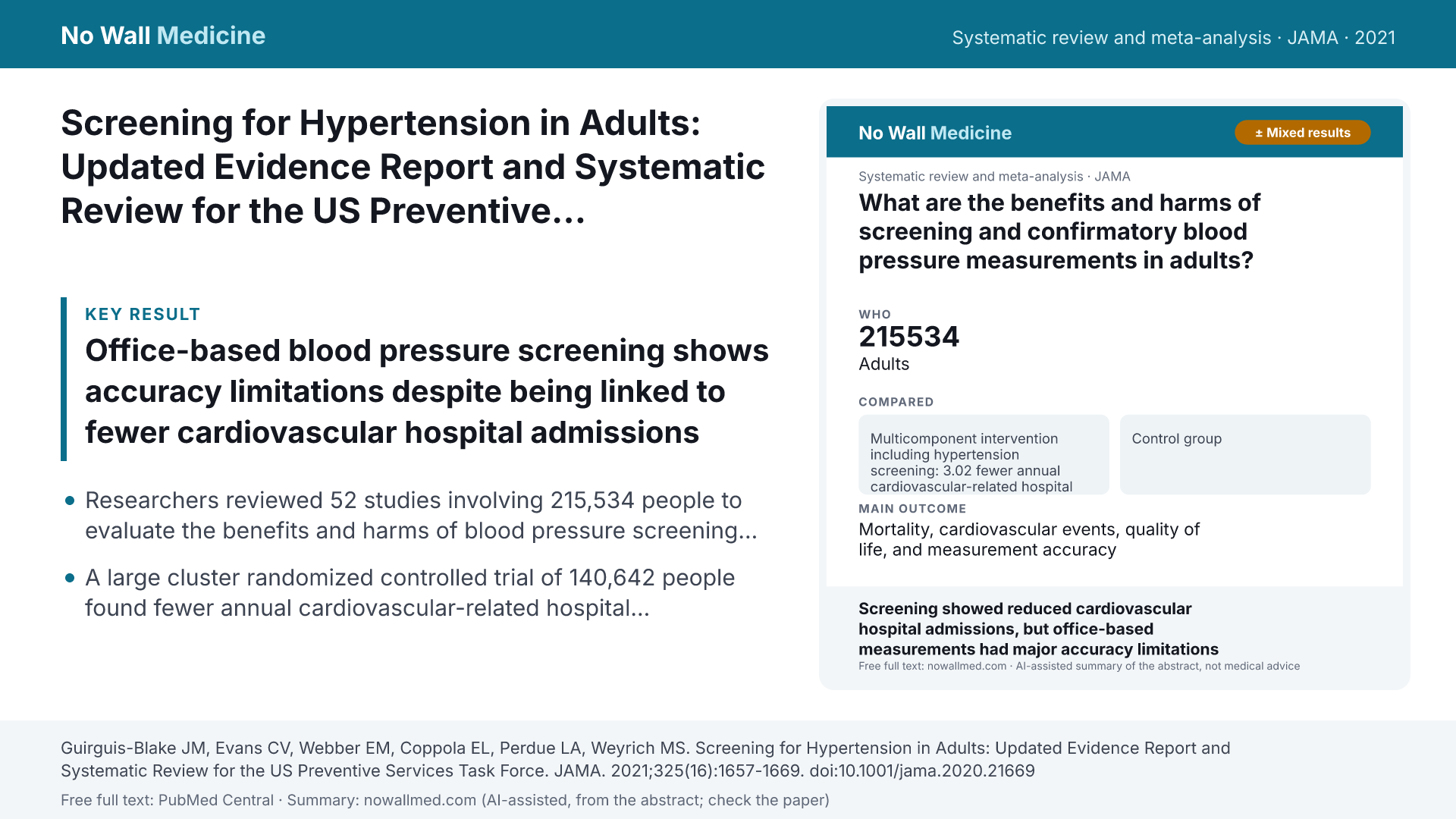
Office-based blood pressure screening shows accuracy limitations despite being linked to fewer cardiovascular hospital admissions
Screening for Hypertension in Adults: Updated Evidence Report and Systematic Review for the US Preventive Services Task Force
Systematic review and meta-analysisMixed results
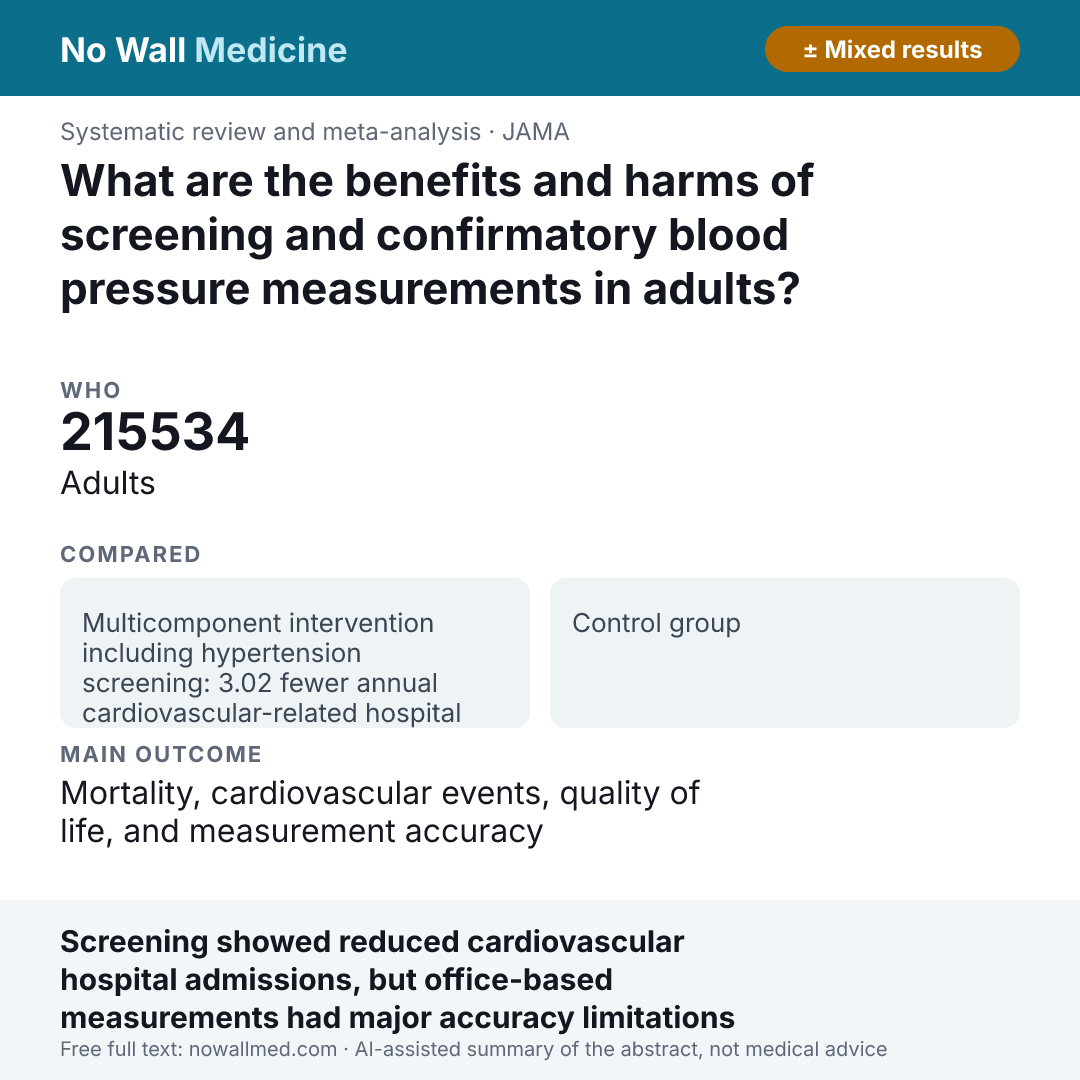
What are the benefits and harms of screening and confirmatory blood pressure measurements in adults?
Who
215534
Adults
Compared
Multicomponent intervention including hypertension screening: 3.02 fewer annual cardiovascular-related hospital admissions per 1000 people
Control group
Main outcome
Mortality, cardiovascular events, quality of life, and measurement accuracy
Result: rate ratio, 0.91 (95% CI, 0.86-0.97)
Bottom line: Screening showed reduced cardiovascular hospital admissions, but office-based measurements had major accuracy limitations including misdiagnosis.
Limitation: Considerable clinical and statistical heterogeneity in meta-analyses.
JAMA · 2021-04-27 · Save PNG
Clinical question: What are the benefits and harms of screening and confirmatory blood pressure measurements in adults?
Why it matters: The optimal screening and confirmatory algorithms for clinical practice are currently unknown.
Key points
- Researchers reviewed 52 studies involving 215,534 people to evaluate the benefits and harms of blood pressure screening and confirmatory measurements.
- A large cluster randomized controlled trial of 140,642 people found fewer annual cardiovascular-related hospital admissions in the intervention group (difference, 3.02 per 1000 people; rate ratio, 0.91).
- Office-based screening of 11,309 people had a pooled sensitivity of 0.54 and specificity of 0.90, while office-based confirmation of 53,183 people had a sensitivity of 0.80 and specificity of 0.55.
Headline and key points written with AI from the paper’s abstract, with every number checked against it. Read the paper before relying on them.
Was this summary helpful?
Subject terms
Headline, design, result, key points, caveat and citation as plain text.
Cite this article
Guirguis-Blake JM, Evans CV, Webber EM, Coppola EL, Perdue LA, Weyrich MS. Screening for Hypertension in Adults: Updated Evidence Report and Systematic Review for the US Preventive Services Task Force. JAMA. 2021;325(16):1657-1669. doi:10.1001/jama.2020.21669
Spotted a mistake? Suggest a correction