Skin tests and blood tests have low predictive value for active tuberculosis in transplant recipients
Screening for Latent Tuberculosis Infection in Solid Organ Transplant Recipients to Predict Active Disease: A Systematic Review and Meta-Analysis of Diagnostic Studies
Systematic review and meta-analysisMixed results
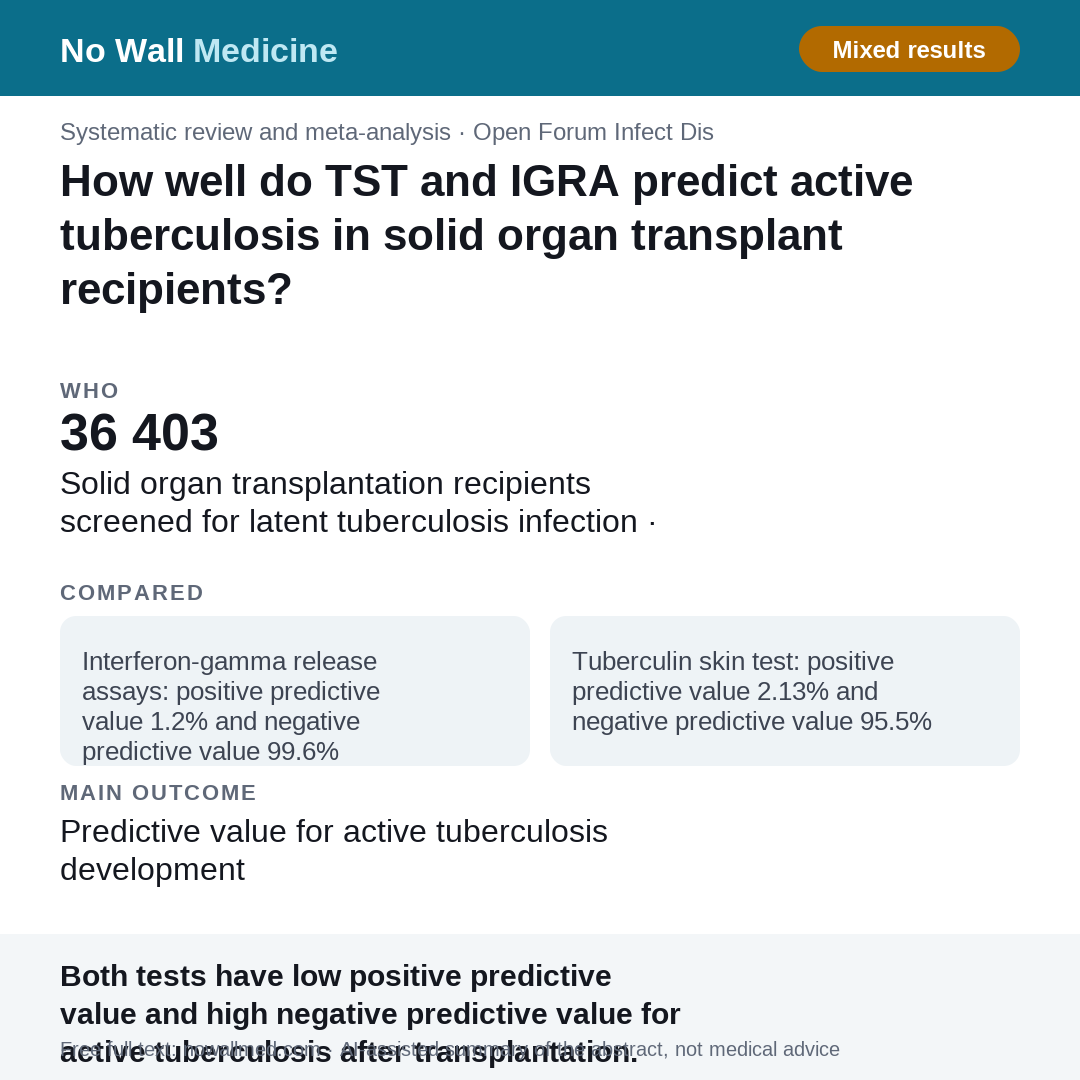
How well do TST and IGRA predict active tuberculosis in solid organ transplant recipients?
Who
36 403
Solid organ transplantation recipients screened for latent tuberculosis infection · multiple different countries
Compared
Interferon-gamma release assays: positive predictive value 1.2% and negative predictive value 99.6%
Tuberculin skin test: positive predictive value 2.13% and negative predictive value 95.5%
Main outcome
Predictive value for active tuberculosis development
Bottom line: Both tests have low positive predictive value and high negative predictive value for active tuberculosis after transplantation.
Limitation: Absence of gold standard for diagnosis of latent tuberculosis and low incidence of active tuberculosis.
Open Forum Infect Dis · 2023-07-05Download image
Clinical question: How well do TST and IGRA predict active tuberculosis in solid organ transplant recipients?
Why it matters: It is unknown how accurately skin tests or blood tests can predict the development of active tuberculosis in patients receiving solid organ transplants.
Key points
- Researchers analyzed 43 studies involving 36,403 solid organ transplant recipients to evaluate the accuracy of skin tests and blood tests for predicting active tuberculosis.
- Interferon-gamma release assays, a type of blood test, had a positive predictive value of 1.2% and a negative predictive value of 99.6%.
- Tuberculin skin tests had a positive predictive value of 2.13% and a negative predictive value of 95.5%.
Limitation the authors note: The authors noted the absence of a gold standard for diagnosing latent tuberculosis infection and a low incidence of active tuberculosis.
Headline and key points written with AI from the paper’s abstract, with every number checked against it. Read the paper before relying on them.
Was this summary helpful?
Cite this article
Yahav D, Gitman MR, Margalit I, Avni T, Leeflang MMG, Husain S. Screening for Latent Tuberculosis Infection in Solid Organ Transplant Recipients to Predict Active Disease: A Systematic Review and Meta-Analysis of Diagnostic Studies. Open Forum Infect Dis. 2023. doi:10.1093/ofid/ofad324
Spotted a mistake? Suggest a correction
Top studies every Monday
The week’s key trials and guidelines in your specialties, plus any topics you follow. By email, free.
Get the weekly digest