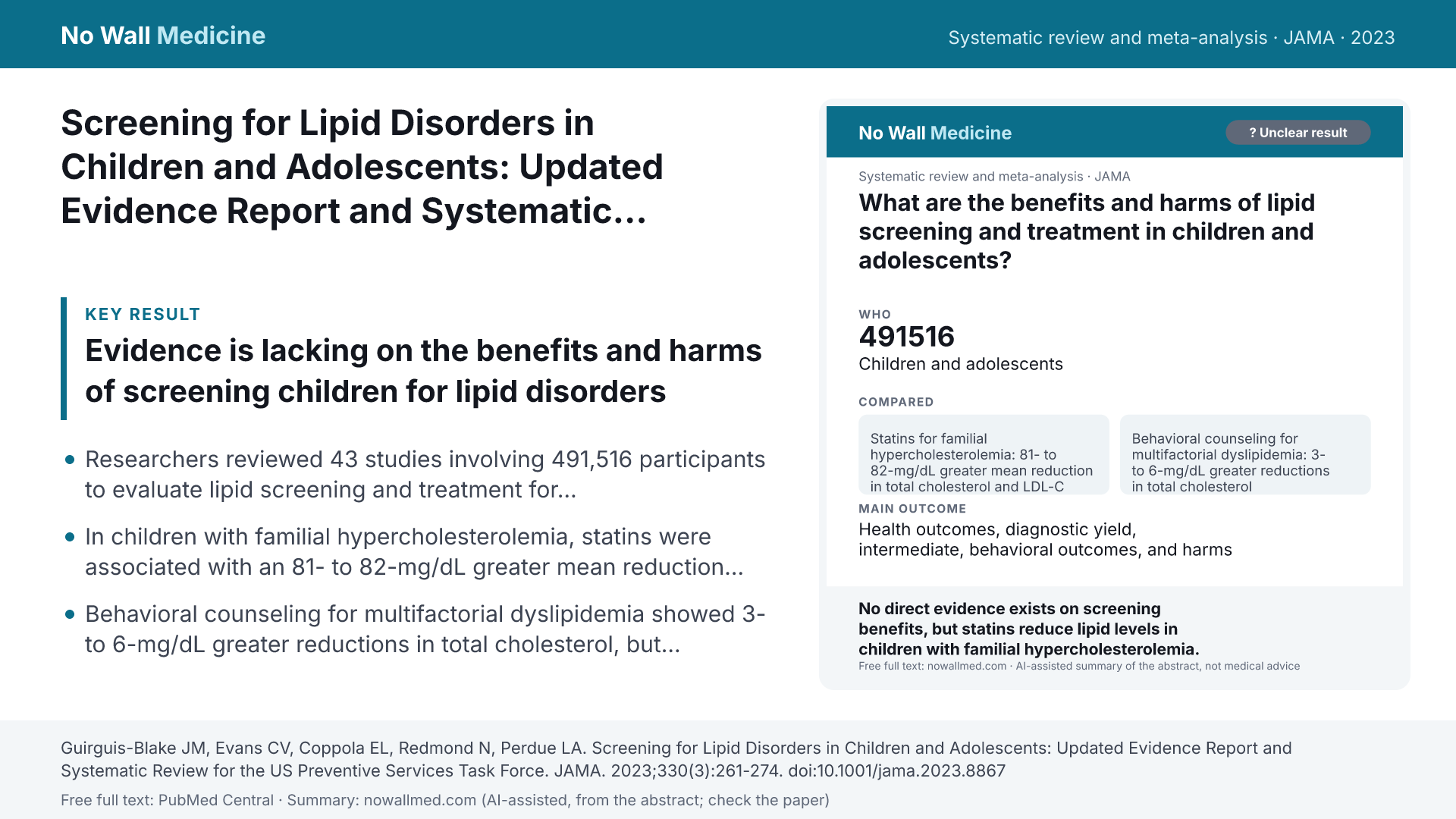
Evidence is lacking on the benefits and harms of screening children for lipid disorders
Screening for Lipid Disorders in Children and Adolescents: Updated Evidence Report and Systematic Review for the US Preventive Services Task Force
Systematic review and meta-analysisUnclear result
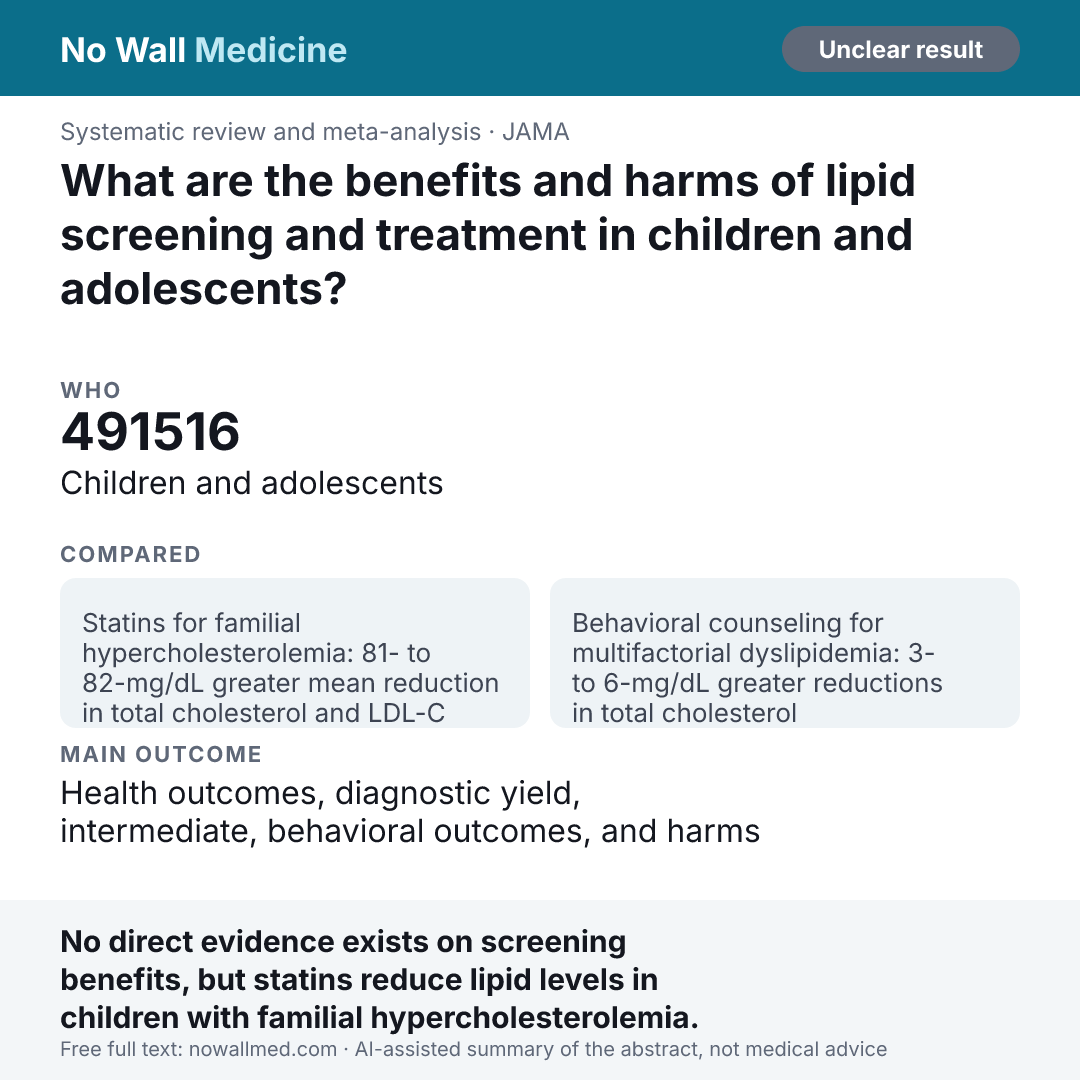
What are the benefits and harms of lipid screening and treatment in children and adolescents?
Who
491516
Children and adolescents
Compared
Statins for familial hypercholesterolemia: 81- to 82-mg/dL greater mean reduction in total cholesterol and LDL-C
Behavioral counseling for multifactorial dyslipidemia: 3- to 6-mg/dL greater reductions in total cholesterol
Main outcome
Health outcomes, diagnostic yield, intermediate, behavioral outcomes, and harms
Bottom line: No direct evidence exists on screening benefits, but statins reduce lipid levels in children with familial hypercholesterolemia.
JAMA · 2023-07-18 · Save PNG
Clinical question: What are the benefits and harms of lipid screening and treatment in children and adolescents?
Key points
- Researchers reviewed 43 studies involving 491,516 participants to evaluate lipid screening and treatment for familial hypercholesterolemia and multifactorial dyslipidemia.
- In children with familial hypercholesterolemia, statins were associated with an 81- to 82-mg/dL greater mean reduction in total cholesterol and low-density lipoprotein cholesterol compared to placebo.
- Behavioral counseling for multifactorial dyslipidemia showed 3- to 6-mg/dL greater reductions in total cholesterol, but these findings did not persist at the longest follow-up.
Limitation the authors note: No randomized clinical trials directly addressed the effectiveness and harms of lipid screening in this population.
Headline and key points written with AI from the paper’s abstract, with every number checked against it. Read the paper before relying on them.
Was this summary helpful?
Subject terms
Headline, design, result, key points, caveat and citation as plain text.
Cite this article
Guirguis-Blake JM, Evans CV, Coppola EL, Redmond N, Perdue LA. Screening for Lipid Disorders in Children and Adolescents: Updated Evidence Report and Systematic Review for the US Preventive Services Task Force. JAMA. 2023;330(3):261-274. doi:10.1001/jama.2023.8867
Spotted a mistake? Suggest a correction