Screening-guided spironolactone treatment of subclinical left ventricular dysfunction for heart failure prevention in at-risk patients
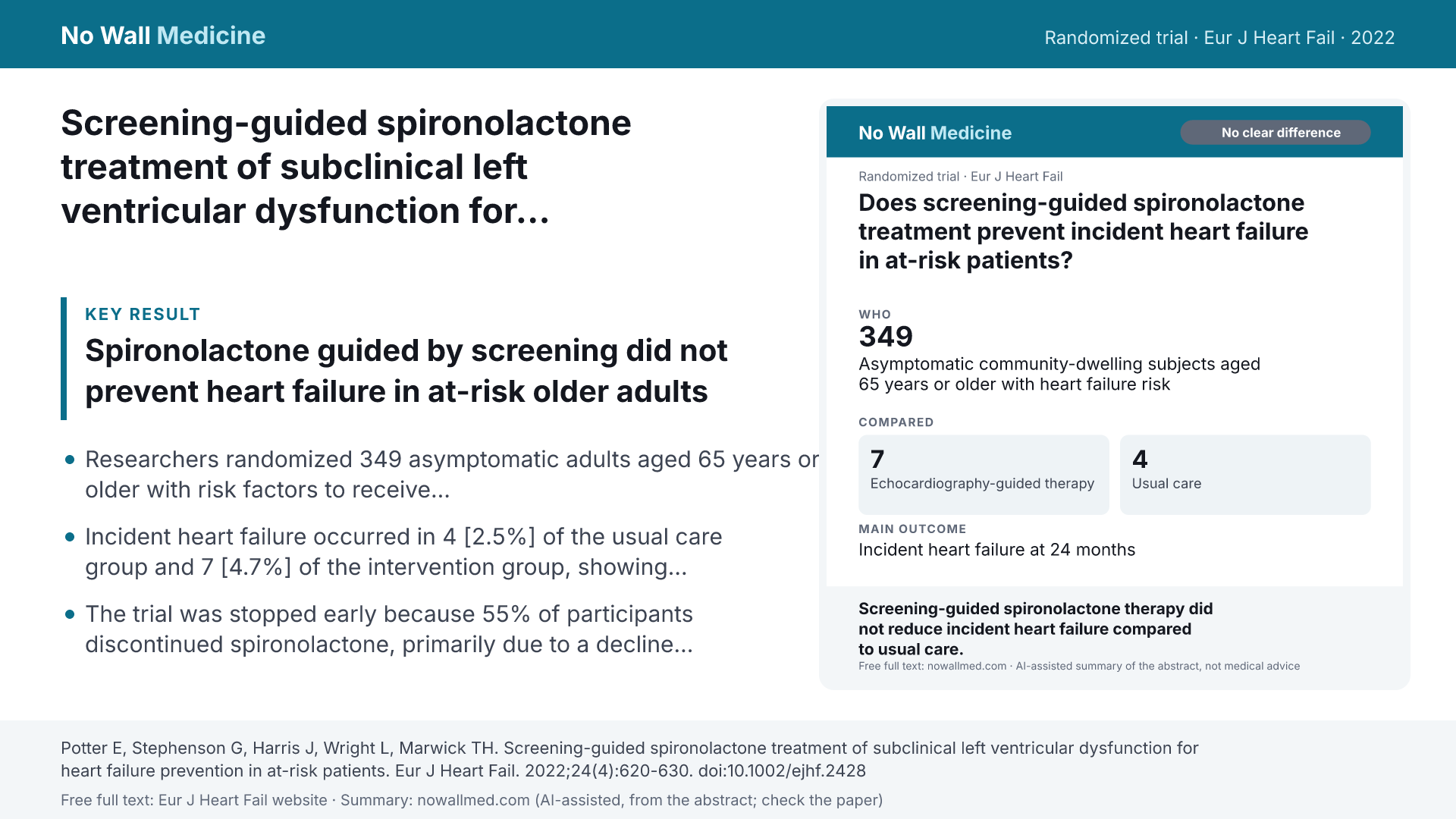
Key result: Spironolactone guided by screening did not prevent heart failure in at-risk older adults
Randomized trialNo clear difference
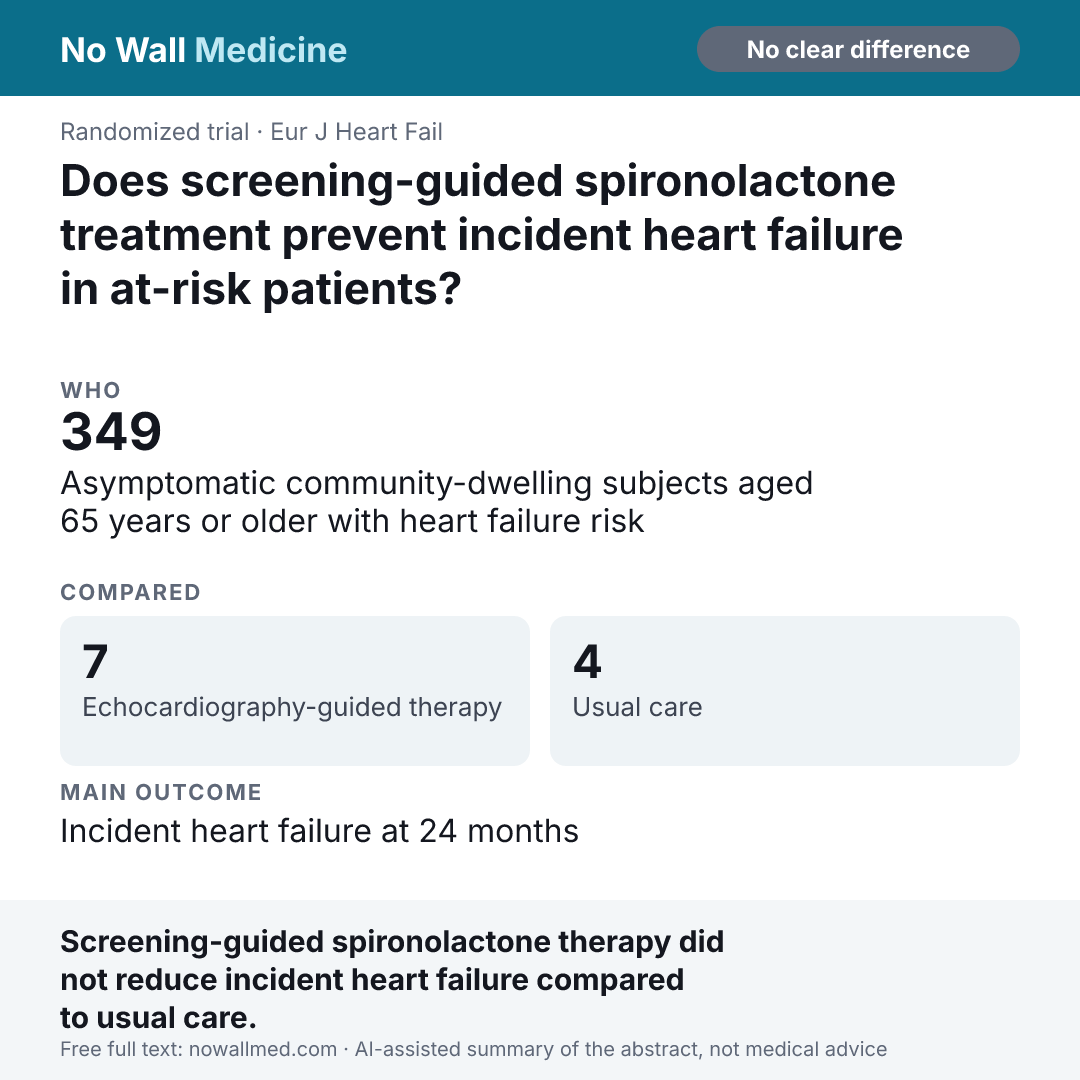
Does screening-guided spironolactone treatment prevent incident heart failure in at-risk patients?
Who
349
Asymptomatic community-dwelling subjects aged 65 years or older with heart failure risk factors
Compared
7Echocardiography-guided therapy (4.7%)
4Usual care (2.5%)
Main outcome
Incident heart failure at 24 months
Bottom line: Screening-guided spironolactone therapy did not reduce incident heart failure compared to usual care.
Limitation: The trial was underpowered because spironolactone was frequently discontinued due to renal function decline.
Eur J Heart Fail · 2022-01-27 · Save PNG
Key points
- Researchers randomized 349 asymptomatic adults aged 65 years or older with risk factors to receive echocardiography-guided spironolactone therapy or usual care.
- Incident heart failure occurred in 4 [2.5%] of the usual care group and 7 [4.7%] of the intervention group, showing no significant difference.
- The trial was stopped early because 55% of participants discontinued spironolactone, primarily due to a decline in kidney function.
Discussion prompts
- Would these patients look like yours? Who was left out?
- Is the main outcome one that matters to patients?
- Is the difference large enough to change what you do?
Cite: Potter E, Stephenson G, Harris J, Wright L, Marwick TH. Screening-guided spironolactone treatment of subclinical left ventricular dysfunction for heart failure prevention in at-risk patients. Eur J Heart Fail. 2022;24(4):620-630. doi:10.1002/ejhf.2428
Free full text: Eur J Heart Fail website · Summary and visual abstract: nowallmed.com/a/screening-guided-spironolactone-treatment-of-subclinical-left-17d1axb/ (AI-assisted from the abstract; check the paper before relying on it).