Screening tools for identifying early palliative care needs show varying clinical performance
Screening instruments for early identification of unmet palliative care needs: a systematic review and meta-analysis
Systematic review and meta-analysisMixed results
What are the psychometric properties and clinical performance of palliative care screening instruments?
Who
Patients requiring early identification of unmet palliative care needs · Not specified
Compared
Pooled sensitivity: 60.0% to 73.8%
Pooled specificity: 70.4% to 90.2%
Main outcome
Clinical performance of screening instruments
Bottom line: Existing screening instruments show poor to reasonable clinical performance for identifying palliative care needs.
Limitation: Content validity was doubtful or inadequate due to very low to moderate quality evidence.
BMJ Support Palliat Care · 2024-08-19Download image
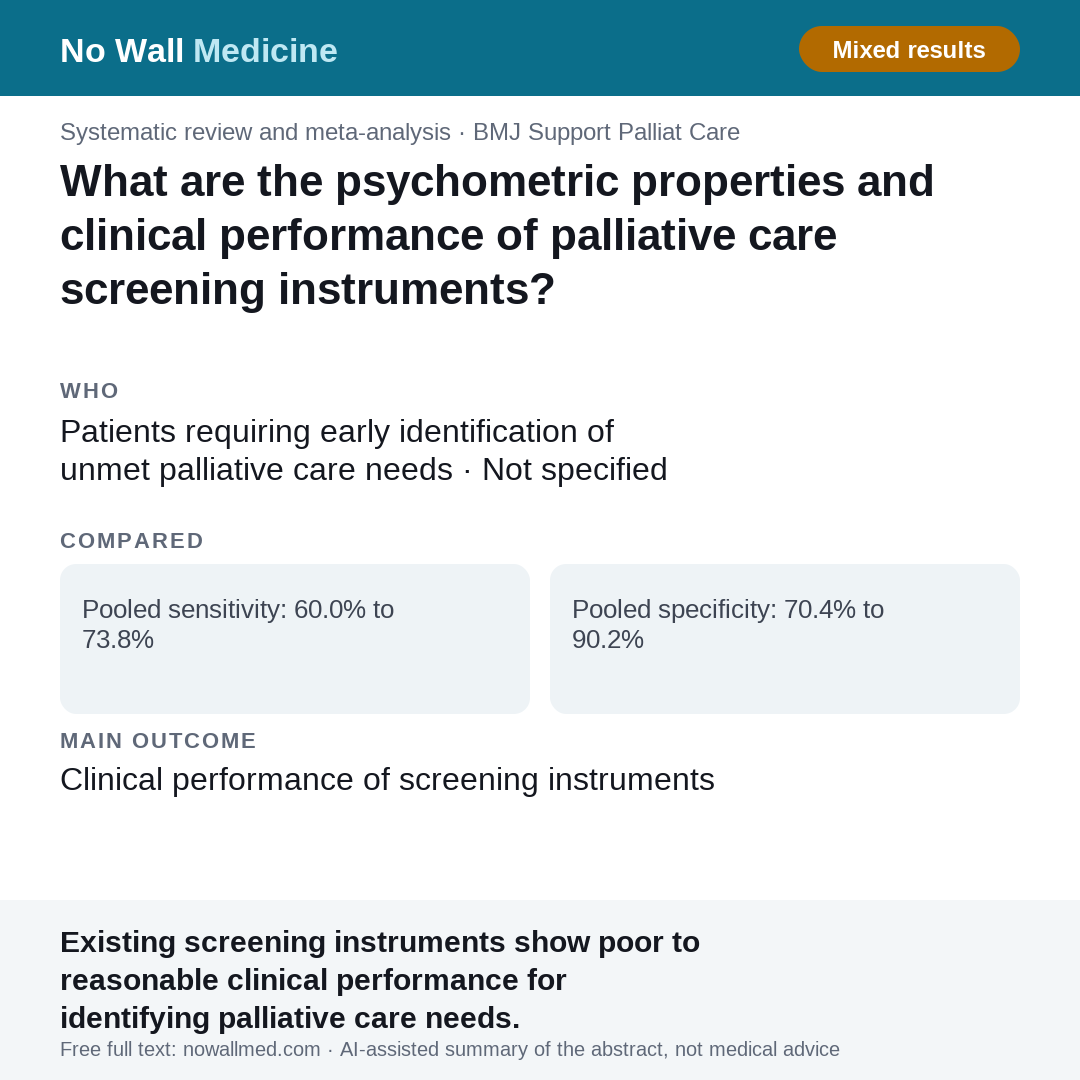
Clinical question: What are the psychometric properties and clinical performance of palliative care screening instruments?
Why it matters: It is unknown which screening instruments are most effective for the early identification of patients who require palliative care services.
Key points
- Researchers analyzed 31 studies involving seven different screening tools used by health professionals to identify patients needing palliative care.
- The pooled sensitivity of these tools ranged from 60.0% to 73.8%, while pooled specificity ranged from 70.4% to 90.2%.
- The Supportive and Palliative Care Indicators Tool had a sensitivity of 79.8% in hospitals compared to 45.3% in general practice.
Limitation the authors note: The content validity of the instruments was doubtful or inadequate because of very low to moderate quality evidence.
Headline and key points written with AI from the paper’s abstract, with every number checked against it. Read the paper before relying on them.
Was this summary helpful?
Abstract
Background
The early detection of individuals who require palliative care is essential for the timely initiation of palliative care services. This systematic review and meta-analysis aimed to (1) Identify the screening instruments used by health professionals to promote early identification of patients who may benefit from palliative care; and (2) Assess the psychometric properties and clinical performance of the instruments. Methods
A comprehensive literature search was conducted in PubMed, Embase, CINAHL, Scopus, CNKI and Wanfang from inception to May 2023. We used the COnsensus-based Standards for the Selection of Health Measurement INstruments to assess the methodological quality of the development process for the instruments. The clinical performance of the instruments was assessed by narrative summary or meta-analysis. Subgroup analyses were conducted where necessary. The quality of included studies was assessed using the Newcastle-Ottawa Scale and the Cochrane Collaboration's risk of bias assessment tool. Results
We included 31 studies that involved seven instruments. Thirteen studies reported the development and validation process of these instruments and 18 studies related to assessment of clinical performance of these instruments. The content validity of the instruments was doubtful or inadequate because of very low to moderate quality evidence. The pooled sensitivity (Se) ranged from 60.0% to 73.8%, with high heterogeneity (I2 of 88.15% to 99.36%). The pooled specificity (Sp) ranges from 70.4% to 90.2%, with high heterogeneity (I2 of 96.81% to 99.94%). The Supportive and Palliative Care Indicators Tool (SPICT) had better performance in hospitals than in general practice settings (Se=79.8% vs 45.3%, p=0.004; Sp=59.1% vs 97.0%, p=0.000). Conclusion
The clinical performance of existing instruments in identifying patients with palliative care needs early ranged from poor to reasonable. The SPICT is used most commonly, has better clinical performance than other instruments but performs better in hospital settings than in general practice settings.
Abstract reproduced under the article’s CC BY NC licence.
Subject terms
Cite this article
Xie Z, Ding J, Jiao J, Tang S, Huang C. Screening instruments for early identification of unmet palliative care needs: a systematic review and meta-analysis. BMJ Support Palliat Care. 2024. doi:10.1136/spcare-2023-004465
Spotted a mistake? Suggest a correction
Top studies every Monday
The week’s key trials and guidelines in your specialties, plus any topics you follow. By email, free.
Get the weekly digest