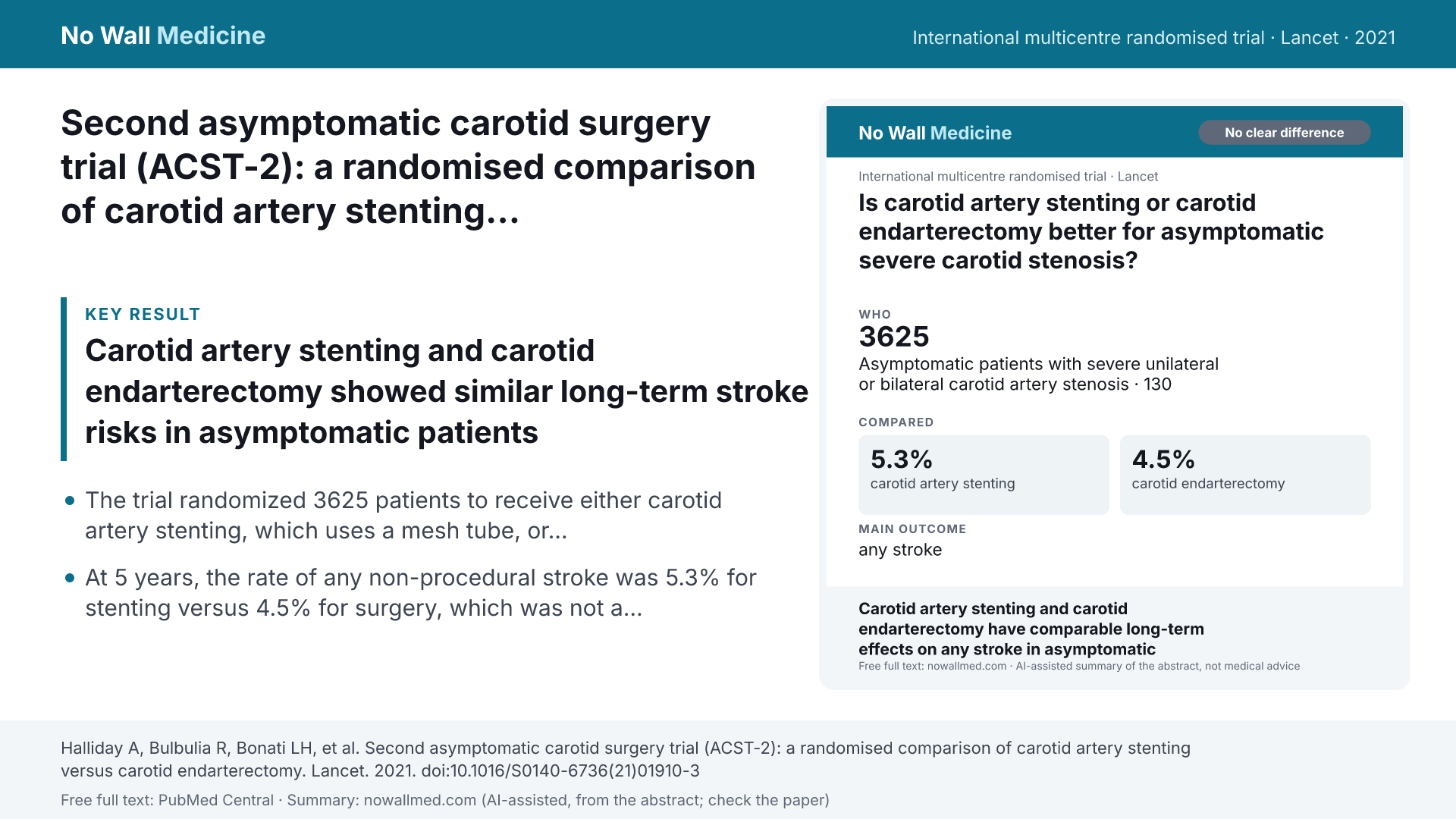
Carotid artery stenting and carotid endarterectomy showed similar long-term stroke risks in asymptomatic patients
Second asymptomatic carotid surgery trial (ACST-2): a randomised comparison of carotid artery stenting versus carotid endarterectomy
International multicentre randomised trialNo clear difference
Is carotid artery stenting or carotid endarterectomy better for asymptomatic severe carotid stenosis?
Who
3625
Asymptomatic patients with severe unilateral or bilateral carotid artery stenosis · 130 centres
Compared
5.3%carotid artery stenting
4.5%carotid endarterectomy
Main outcome
any stroke
Result: rate ratio 1.16 (95% CI 0.86 to 1.57)
Bottom line: Carotid artery stenting and carotid endarterectomy have comparable long-term effects on any stroke in asymptomatic patients.
Funded by: UK Medical Research Council and Health Technology Assessment Programme
Lancet · 2021-08-29 · Save PNG
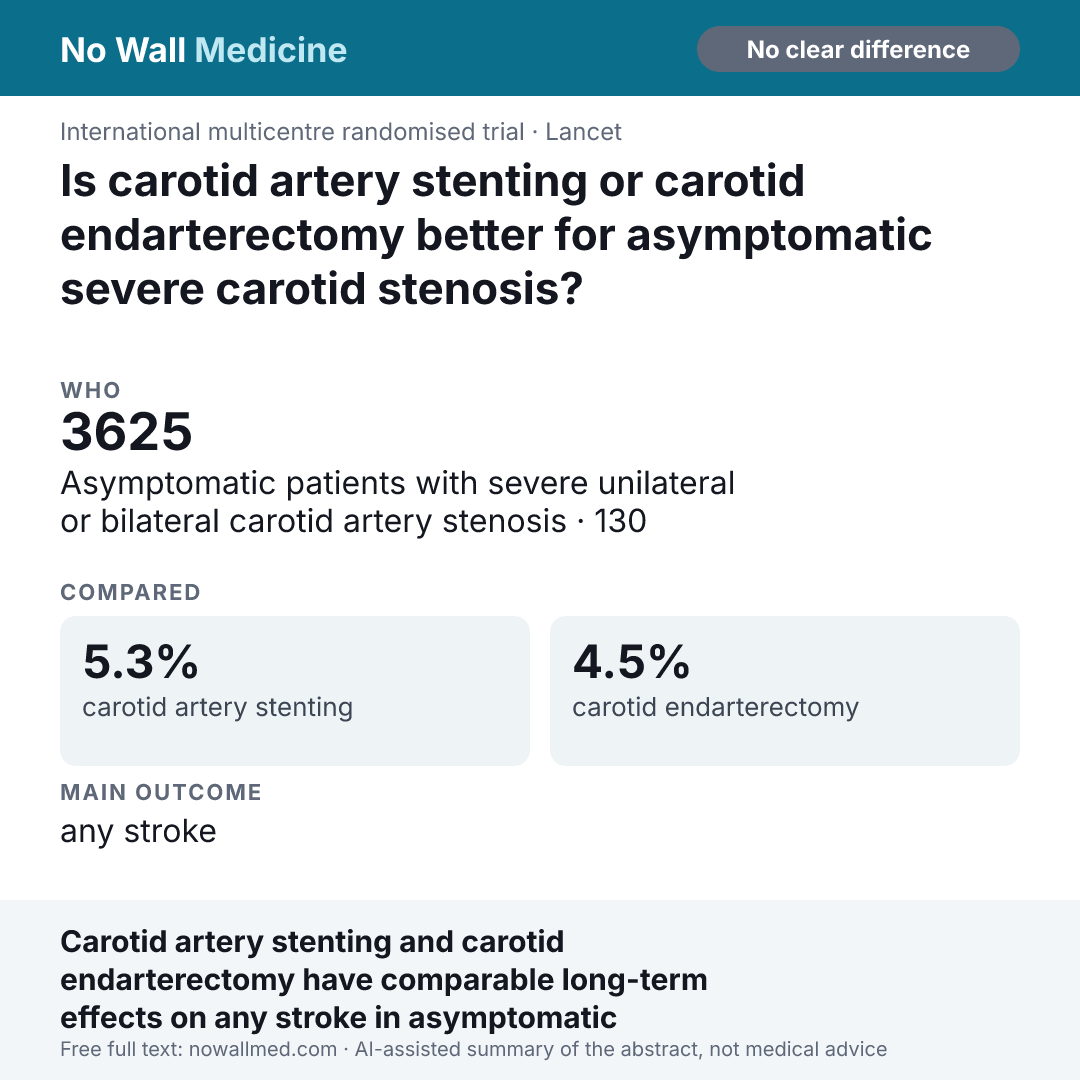
Clinical question: Is carotid artery stenting or carotid endarterectomy better for asymptomatic severe carotid stenosis?
Key points
- The trial randomized 3625 patients to receive either carotid artery stenting, which uses a mesh tube, or carotid endarterectomy, which is surgical removal of plaque.
- At 5 years, the rate of any non-procedural stroke was 5.3% for stenting versus 4.5% for surgery, which was not a statistically significant difference.
- Procedural risks of disabling stroke or death were 1% overall, with 15 cases in the stenting group and 18 in the surgery group.
Headline and key points written with AI from the paper’s abstract, with every number checked against it. Read the paper before relying on them.
Was this summary helpful?
Abstract
Background
Among asymptomatic patients with severe carotid artery stenosis but no recent stroke or transient cerebral ischaemia, either carotid artery stenting (CAS) or carotid endarterectomy (CEA) can restore patency and reduce long-term stroke risks. However, from recent national registry data, each option causes about 1% procedural risk of disabling stroke or death. Comparison of their long-term protective effects requires large-scale randomised evidence. Methods
ACST-2 is an international multicentre randomised trial of CAS versus CEA among asymptomatic patients with severe stenosis thought to require intervention, interpreted with all other relevant trials. Patients were eligible if they had severe unilateral or bilateral carotid artery stenosis and both doctor and patient agreed that a carotid procedure should be undertaken, but they were substantially uncertain which one to choose. Patients were randomly allocated to CAS or CEA and followed up at 1 month and then annually, for a mean 5 years. Procedural events were those within 30 days of the intervention. Intention-to-treat analyses are provided. Analyses including procedural hazards use tabular methods. Analyses and meta-analyses of non-procedural strokes use Kaplan-Meier and log-rank methods. The trial is registered with the ISRCTN registry, ISRCTN21144362. Findings
Between Jan 15, 2008, and Dec 31, 2020, 3625 patients in 130 centres were randomly allocated, 1811 to CAS and 1814 to CEA, with good compliance, good medical therapy and a mean 5 years of follow-up. Overall, 1% had disabling stroke or death procedurally (15 allocated to CAS and 18 to CEA) and 2% had non-disabling procedural stroke (48 allocated to CAS and 29 to CEA). Kaplan-Meier estimates of 5-year non-procedural stroke were 2·5% in each group for fatal or disabling stroke, and 5·3% with CAS versus 4·5% with CEA for any stroke (rate ratio [RR] 1·16, 95% CI 0·86-1·57; p=0·33). Combining RRs for any non-procedural stroke in all CAS versus CEA trials, the RR was similar in symptomatic and asymptomatic patients (overall RR 1·11, 95% CI 0·91-1·32; p=0·21). Interpretation
Serious complications are similarly uncommon after competent CAS and CEA, and the long-term effects of these two carotid artery procedures on fatal or disabling stroke are comparable. Funding
UK Medical Research Council and Health Technology Assessment Programme.
Abstract reproduced under the article’s CC BY licence.
Subject terms
Headline, design, result, key points, caveat and citation as plain text.
Cite this article
Halliday A, Bulbulia R, Bonati LH, et al. Second asymptomatic carotid surgery trial (ACST-2): a randomised comparison of carotid artery stenting versus carotid endarterectomy. Lancet. 2021. doi:10.1016/S0140-6736(21)01910-3
Spotted a mistake? Suggest a correction