Sustained low disease activity was associated with better physical function and quality of life in psoriatic arthritis
Secukinumab improves physical function and quality of life and inhibits structural damage in patients with PsA with sustained remission or low disease activity: results from the 2-year phase 3 FUTURE 5 study
Randomized, double-blind, placebo-controlled, phase 3 studyBenefit found
Does sustained low disease activity or remission improve outcomes in psoriatic arthritis patients?
Who
996
Patients with active psoriatic arthritis
Compared
secukinumab 300 mg
secukinumab 150 mg loading
secukinumab 150 mg non-loading
placebo
Main outcome
physical function, quality of life, and structural outcomes
Bottom line: Sustained low disease activity or remission was associated with improved physical function, quality of life, and inhibited structural damage.
RMD Open · 2023-04-25Download image
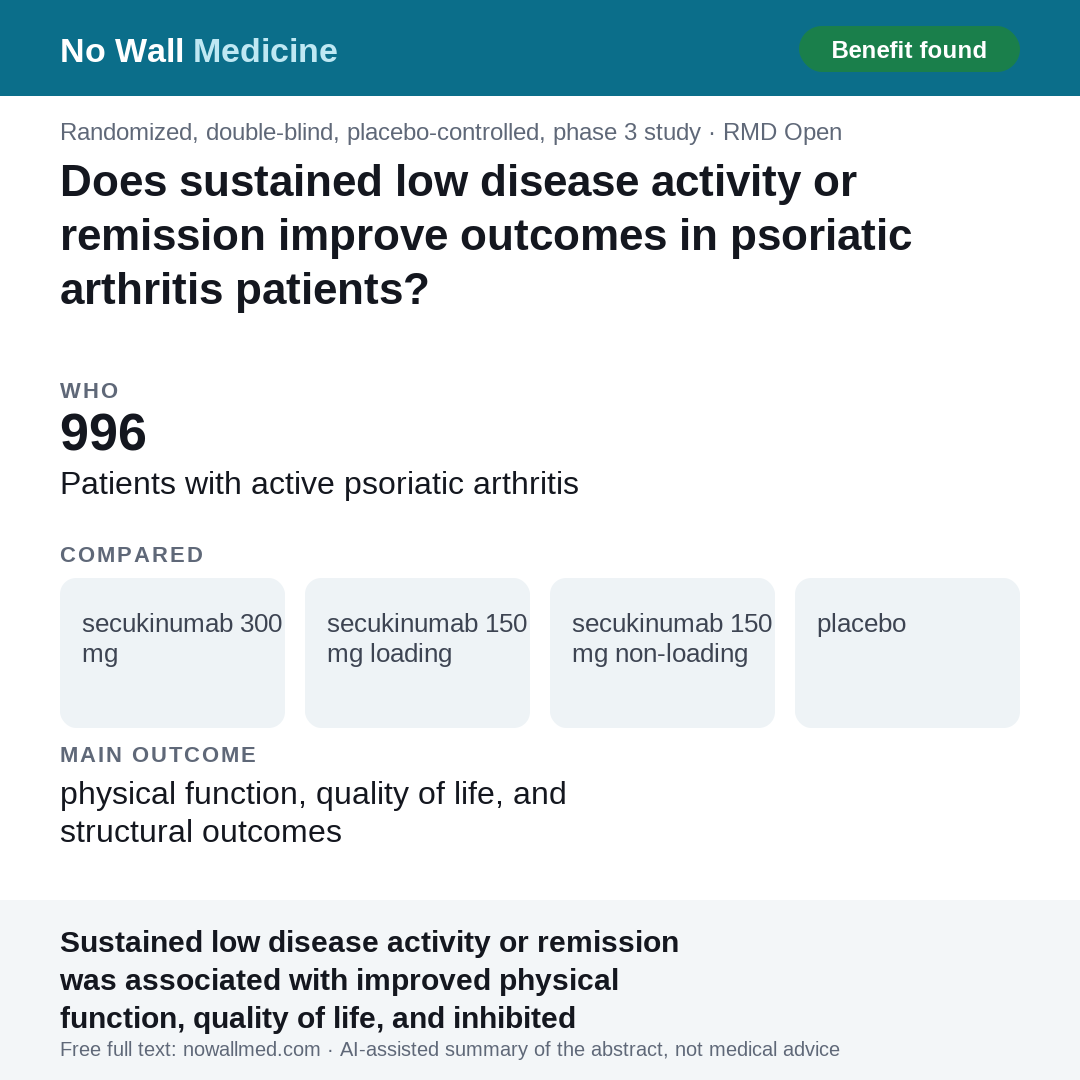
Clinical question: Does sustained low disease activity or remission improve outcomes in psoriatic arthritis patients?
Why it matters: It was unknown how achieving and maintaining low disease activity or remission affects physical function, quality of life, and structural damage in patients treated with secukinumab.
Key points
- The study followed 996 patients with active psoriatic arthritis randomized to receive secukinumab at 300 mg, 150 mg, or a placebo.
- By week 104, 48%-81% of secukinumab-treated patients achieved sustained low disease activity and 19%-36% achieved sustained remission.
- Sustained low disease activity or remission was associated with greater improvements in physical function and quality of life compared to other groups.
Headline and key points written with AI from the paper’s abstract, with every number checked against it. Read the paper before relying on them.
Was this summary helpful?
Abstract
Objective
To investigate the impact of sustained low disease activity (LDA)/remission (REM) on physical function, quality of life (QoL) and structural outcomes in secukinumab-treated psoriatic arthritis (PsA) patients from the FUTURE 5 study. Methods
FUTURE 5 was a randomised, double-blind, placebo-controlled, parallel-group, phase 3 study in patients with active PsA. Patients were categorised according to LDA (Minimal Disease Activity, MDA/Disease Activity index for Psoriatic Arthritis, DAPSA LDA+REM) or REM (very LDA/DAPSA REM): not achieving LDA/REM, achieving it once or sustained LDA/REM ≥3 times up to week 104. Key outcomes were improvements in Health Assessment Questionnaire Disability Index and Short Form-36 Physical Component Summary Score, proportion of non-radiographic progressors and predictors of sustained LDA response. Results
Patients were randomised (N=996) into the following treatment groups: secukinumab 300 mg (N=222), secukinumab 150 mg loading (N=220)/non-loading (N=222) and placebo (N=332). Baseline characteristics were comparable between patients with sustained DAPSA and MDA responses. By week 104, 48%-81% and 19%-36% of the secukinumab-treated patients achieved sustained LDA and REM, respectively. Numerically greater improvements in physical function and QoL were observed with sustained LDA/REM versus LDA/REM achieved once or not at all, although patients reached the established minimal clinically important difference for all composite indices. A high proportion of secukinumab-treated patients were non-structural progressors at 2 years irrespective of achieving sustained LDA/REM. Younger age, lower body mass index at baseline, reduced tender joint count and PsA pain at week 16 were key predictors of sustained LDA in secukinumab-treated patients. Conclusion
Sustained LDA/REM was associated with improvements in physical function, QoL and inhibition of structural damage progression.
Abstract reproduced under the article’s CC BY NC licence.
Subject terms
Cite this article
Coates LC, Mease PJ, Gladman DD, Navarra S, Bao W, Gaillez C. Secukinumab improves physical function and quality of life and inhibits structural damage in patients with PsA with sustained remission or low disease activity: results from the 2-year phase 3 FUTURE 5 study. RMD Open. 2023. doi:10.1136/rmdopen-2022-002939
Spotted a mistake? Suggest a correction
Top studies every Monday
The week’s key trials and guidelines in your specialties, plus any topics you follow. By email, free.
Get the weekly digest