Secukinumab provided sustained symptom relief and low bone damage progression in psoriatic arthritis patients
Secukinumab provides sustained improvement in signs and symptoms and low radiographic progression in patients with psoriatic arthritis: 2-year (end-of-study) results from the FUTURE 5 study
Randomized trialBenefit found
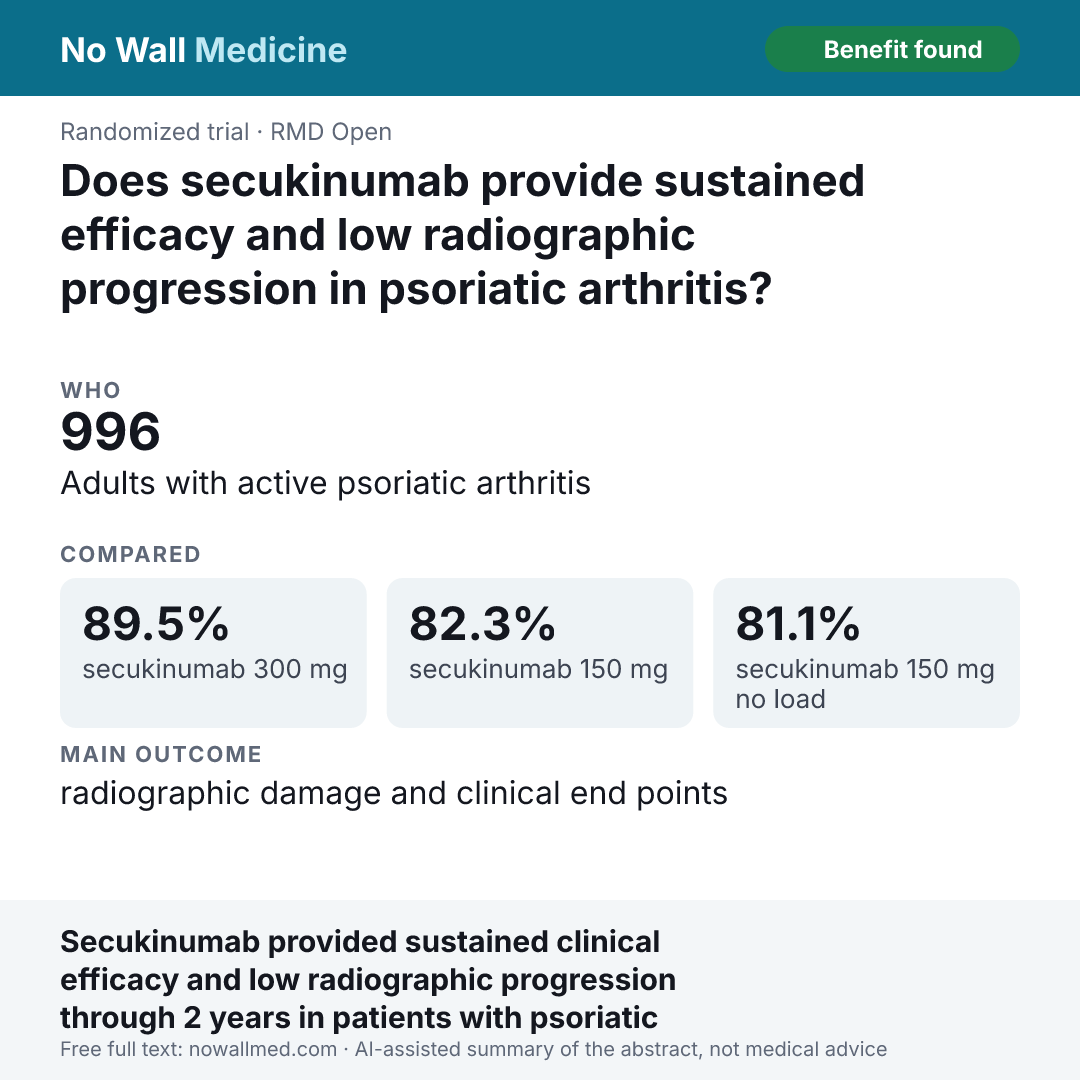
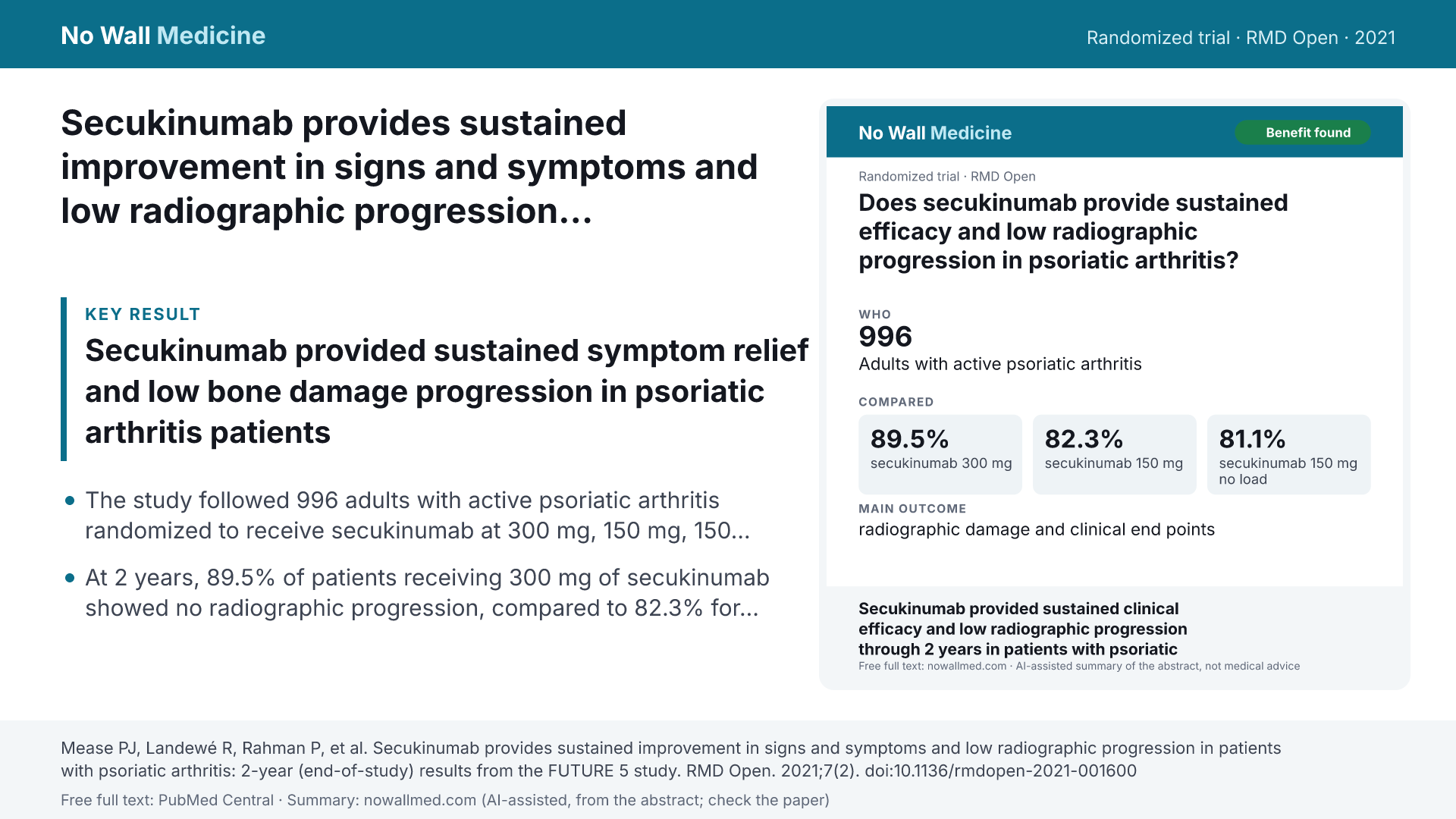
Does secukinumab provide sustained efficacy and low radiographic progression in psoriatic arthritis?
Who
996
Adults with active psoriatic arthritis
Compared
89.5%secukinumab 300 mg (no radiographic progression)
82.3%secukinumab 150 mg (no radiographic progression)
81.1%secukinumab 150 mg no load (no radiographic progression)
Main outcome
radiographic damage and clinical end points
Bottom line: Secukinumab provided sustained clinical efficacy and low radiographic progression through 2 years in patients with psoriatic arthritis.
RMD Open · 2021-07-31 · Save PNG
Same trial (NCT02404350)
Papers we list that report this registered trial, oldest first. Read a secondary analysis alongside the main results.
- Main results Benefit found
This paper RMD Open 2021-07 - Secondary analysis Benefit found
Patients without bone damage progression achieved higher rates of low disease activity on secukinumab Rheumatology 2025-09
Clinical question: Does secukinumab provide sustained efficacy and low radiographic progression in psoriatic arthritis?
Key points
- The study followed 996 adults with active psoriatic arthritis randomized to receive secukinumab at 300 mg, 150 mg, 150 mg without a loading dose, or a placebo.
- At 2 years, 89.5% of patients receiving 300 mg of secukinumab showed no radiographic progression, compared to 82.3% for the 150 mg dose and 81.1% for the 150 mg no load dose.
- The mean change in the van der Heijde-modified total Sharp score, which measures bone damage, was 0.10 (SD 1.74) for the 300 mg group and 0.52 (SD 2.66) for the 150 mg group.
Headline and key points written with AI from the paper’s abstract, with every number checked against it. Read the paper before relying on them.
Was this summary helpful?
Abstract
Objective
Secukinumab provided sustained efficacy, low radiographic progression and consistent safety over 52 weeks in patients with psoriatic arthritis (PsA) in the FUTURE 5 study. Here, we report 2-year (end-of-study) results from this study. Methods
Adults with active PsA were randomised 2:2:2:3 to receive subcutaneous secukinumab 300 mg load (300 mg), 150 mg load (150 mg), 150 mg no load or placebo at baseline; weeks 1, 2, 3 and 4; and every 4 weeks thereafter. Secukinumab could be escalated from 150 mg to 300 mg starting at week 52, if active signs of disease were observed based on physician's assessment. Assessments at week 104 (2 years) included clinical end points and radiographic damage (mean change in van der Heijde-modified total Sharp score (vdH-mTSS)). Safety analysis included all patients who received ≥1 dose of study medication. Results
Of the 996 patients randomised, 783 patients (78.6%) completed 2 years of treatment. Improvement in clinical end points was sustained through 2 years. The vdH-mTSS (mean change (SD)) was 0.10 (1.74; 300 mg), 0.52 (2.66; 150 mg) and 0.41 (2.20; 150 mg no load) at 2 years. The proportion of patients with no radiographic progression (change from baseline in vdH-mTSS ≤0.5) at 2 years was 89.5% (300 mg), 82.3% (150 mg) and 81.1% (150 mg no load). Conclusion
Secukinumab with and without loading regimen provided sustained clinical efficacy and low radiographic progression through 2 years in patients with PsA. No new safety findings were reported. Trial registration number
NCT02404350.
Abstract reproduced under the article’s CC BY NC licence.
Subject terms
Headline, design, result, key points, caveat and citation as plain text.
Cite this article
Mease PJ, Landewé R, Rahman P, et al. Secukinumab provides sustained improvement in signs and symptoms and low radiographic progression in patients with psoriatic arthritis: 2-year (end-of-study) results from the FUTURE 5 study. RMD Open. 2021;7(2). doi:10.1136/rmdopen-2021-001600
Spotted a mistake? Suggest a correction