Seizure Outcome After Intraoperative Electrocorticography-Tailored Epilepsy Surgery: A Systematic Review and Meta-Analysis
NeurologyAdult and pediatric
Systematic review and meta-analysisBenefit found
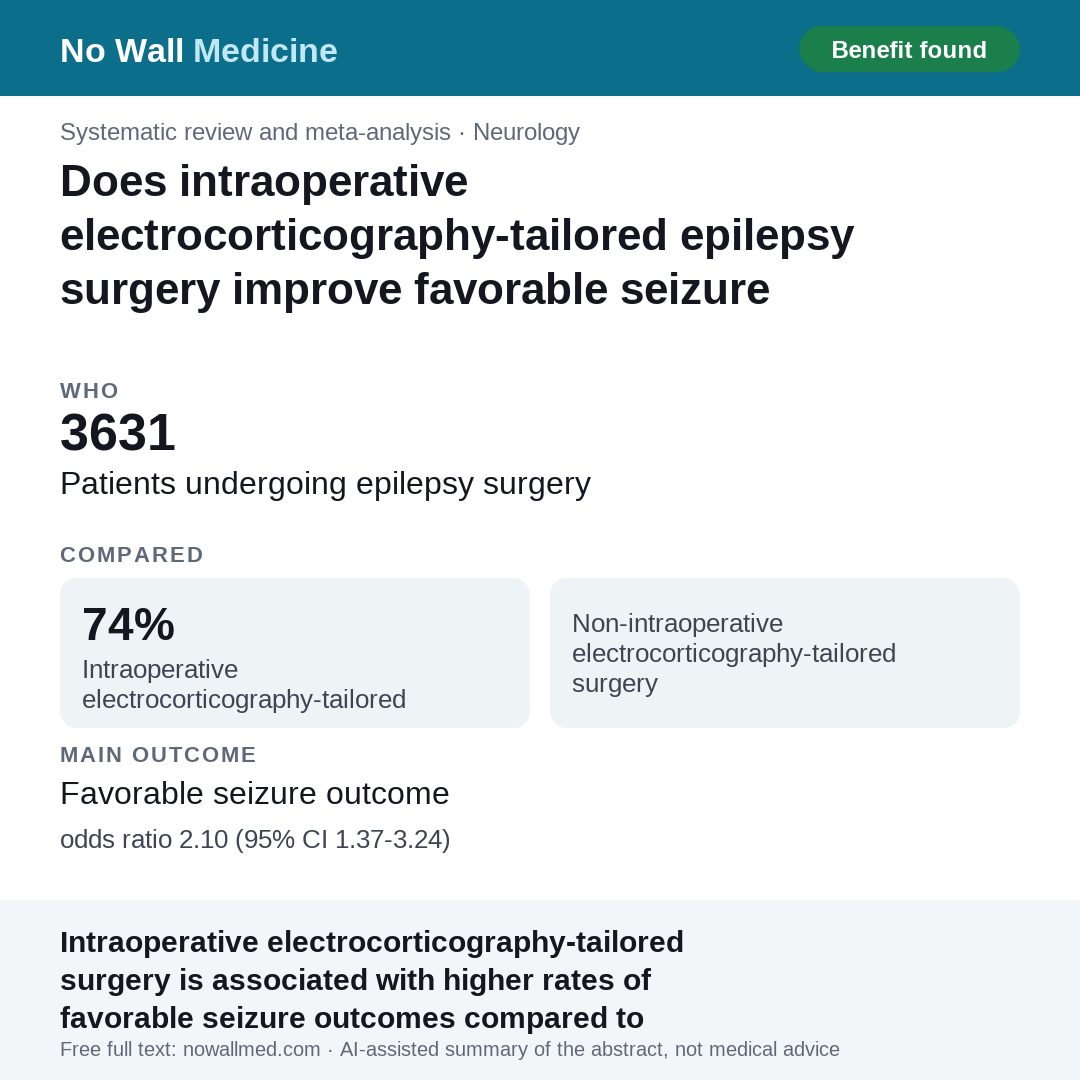
Does intraoperative electrocorticography-tailored epilepsy surgery improve favorable seizure outcomes?
Who
3631
Patients undergoing epilepsy surgery
Compared
74%Intraoperative electrocorticography-tailored surgery (95% CI 71-77)
Non-intraoperative electrocorticography-tailored surgery
Main outcome
Favorable seizure outcome
Result: odds ratio 2.10 (95% CI 1.37-3.24)
Bottom line: Intraoperative electrocorticography-tailored surgery is associated with higher rates of favorable seizure outcomes compared to non-tailored surgery.
Limitation: Limited by low-quality evidence and significant heterogeneity.
Neurology · 2024-05-20Download image
Clinical question: Does intraoperative electrocorticography-tailored epilepsy surgery improve favorable seizure outcomes?
Abstract
Background and objectives
Tailoring epilepsy surgery using intraoperative electrocorticography (ioECoG) has been debated, and modest number of epilepsy surgery centers apply this diagnostic method. We assessed the current evidence to use ioECoG-tailored epilepsy surgery for improving postsurgical outcome. Methods
PubMed and Embase were searched for original studies reporting on ≥10 cases who underwent ioECoG-tailored surgery for epilepsy, with a follow-up of at least 6 months. We used a random-effects model to calculate the overall rate of patients achieving favorable seizure outcome (FSO), defined as Engel class I, ILAE class 1, or seizure-free status. Meta-regression was used to investigate potential sources of heterogeneity. We calculated the odds ratio (OR) for estimating variables on FSO:ioECoG vs non-ioECoG-tailored surgery (if included studies contained patients with non-ioECoG-tailored surgery), ioECoG-tailored epilepsy surgery in children vs adults, temporal (TL) vs extratemporal lobe (eTL), MRI-positive vs MRI-negative, and complete vs incomplete resection of tissue that generated interictal epileptiform discharges (IEDs). A Bayesian network meta-analysis was conducted for underlying pathologies. We assessed the evidence certainty using the Grading of Recommendations, Assessment, Development, and Evaluation (GRADE). Results
Eighty-three studies (82 observational studies, 1 trial) comprising 3,631 patients with ioECoG-tailored surgery were included. The overall pooled rate of patients who attained FSO after ioECoG-tailored surgery was 74% (95% CI 71-77) with significant heterogeneity, which was predominantly attributed to pathologies and seizure outcome classifications. Twenty-two studies contained non-ioECoG-tailored surgeries. IoECoG-tailored surgeries reached a higher rate of FSO than non-ioECoG-tailored surgeries (OR 2.10 [95% CI 1.37-3.24]; p < 0.01; very low certainty). Complete resection of tissue that displayed IEDs in ioECoG predicted FSO better compared with incomplete resection (OR 3.04 [1.76-5.25]; p < 0.01; low certainty). We found insignificant difference in FSO after ioECoG-tailored surgery in children vs adults, TL vs eTL, or MRI-positive vs MRI-negative. The network meta-analysis showed that the odds of FSO was lower for malformations of cortical development than for tumors (OR 0.47 95% credible interval 0.25-0.87). Discussion
Although limited by low-quality evidence, our meta-analysis shows a relatively good surgical outcome (74% FSO) after epilepsy surgery with ioECoG, especially in tumors, with better outcome for ioECoG-tailored surgeries in studies describing both and better outcome after complete removal of IED areas.
Subject terms
Cite this article
Guo J, Wang Z, van 't Klooster MA, Van Der Salm SM, Leijten FS, Braun KP. Seizure Outcome After Intraoperative Electrocorticography-Tailored Epilepsy Surgery: A Systematic Review and Meta-Analysis. Neurology. 2024. doi:10.1212/WNL.0000000000209430
Spotted a mistake? Suggest a correction
Top studies every Monday
The week’s key trials and guidelines in your specialties, plus any topics you follow. By email, free.
Get the weekly digest