Selective face mask use for preterm infants did not reduce the need for breathing support
Selective or routine face mask application for breathing support of preterm infants at birth: a randomised trial
Randomized trialNo clear difference
Does selective or routine face mask application reduce positive pressure ventilation in preterm infants?
Who
200
Infants born before 32 weeks of gestation
Compared
Selective group: 63/98 (64 %)
Routine group: 53/102 (52 %)
Main outcome
Face mask positive pressure ventilation in the delivery room
Result: relative risk 1.24 (95% CI 0.98-1.57)
Bottom line: Selective face mask application did not result in fewer preterm infants receiving positive pressure ventilation in the delivery room.
Resuscitation · 2024-12-17Download image
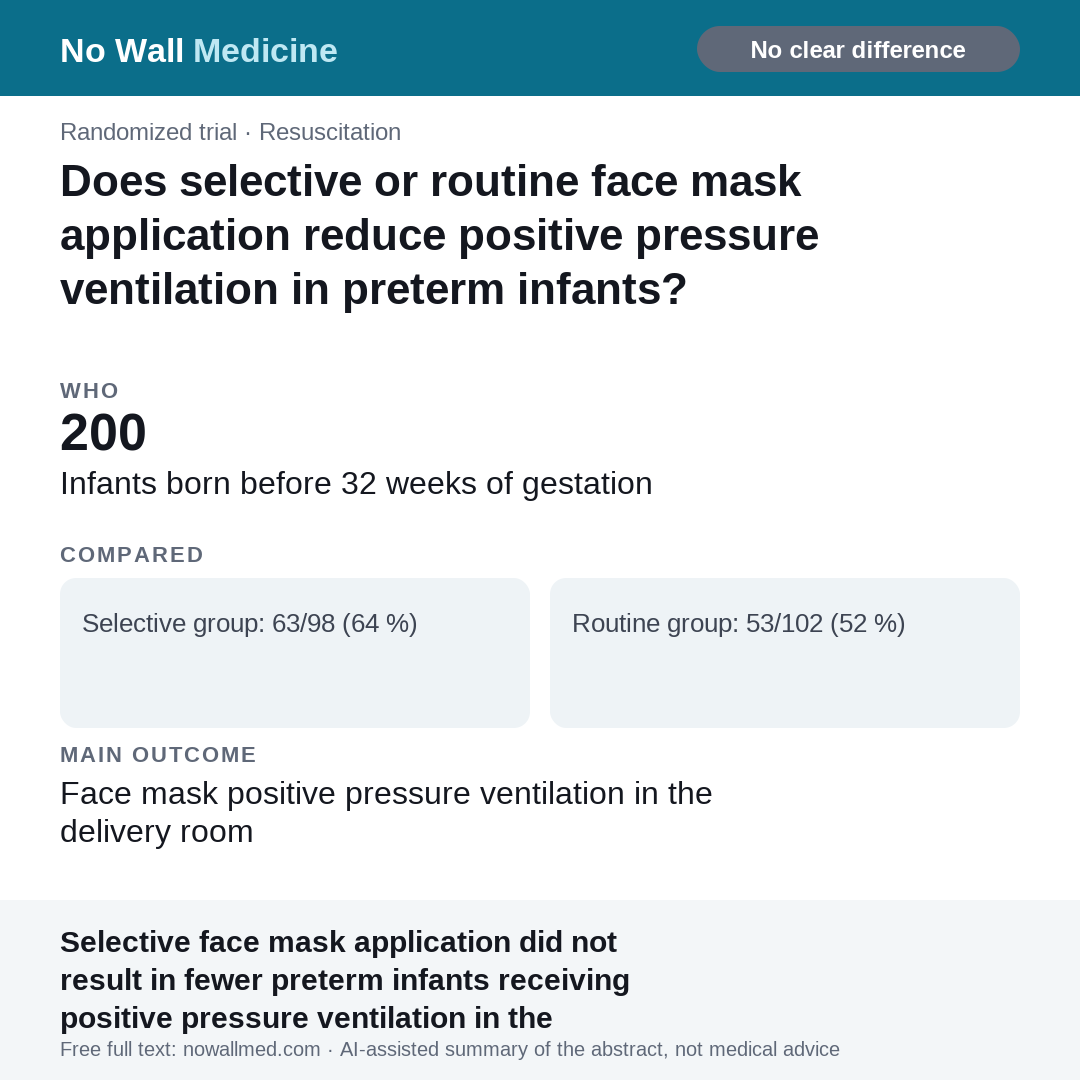
Clinical question: Does selective or routine face mask application reduce positive pressure ventilation in preterm infants?
Why it matters: It is unknown if applying a face mask only when breathing issues occur, rather than routinely, reduces the need for positive pressure ventilation in preterm infants.
Key points
- Researchers studied 200 preterm infants born before 32 weeks of gestation, comparing selective mask use for breathing issues against routine continuous positive airway pressure.
- The rate of positive pressure ventilation in the delivery room was 64% in the selective group and 52% in the routine group.
- The difference in breathing support rates between the two groups was not statistically significant.
Headline and key points written with AI from the paper’s abstract, with every number checked against it. Read the paper before relying on them.
Topics
Cite this article
Ní Chathasaigh CM, Dunne EA, Geraghty LE, Murphy MC, O'Currain E, McCarthy LK. Selective or routine face mask application for breathing support of preterm infants at birth: a randomised trial. Resuscitation. 2024. doi:10.1016/j.resuscitation.2024.110467
Spotted a mistake? Suggest a correction
Top studies every Monday
The week’s key trials and guidelines in your specialties, by email. Free.
Get the weekly digest