Intranasal etripamil was more effective than placebo for converting rapid heart rhythms to normal rhythm
Self-administered intranasal etripamil using a symptom-prompted, repeat-dose regimen for atrioventricular-nodal-dependent supraventricular tachycardia (RAPID): a multicentre, randomised trial
Multicentre, randomised, placebo-controlled, event-driven trialBenefit found
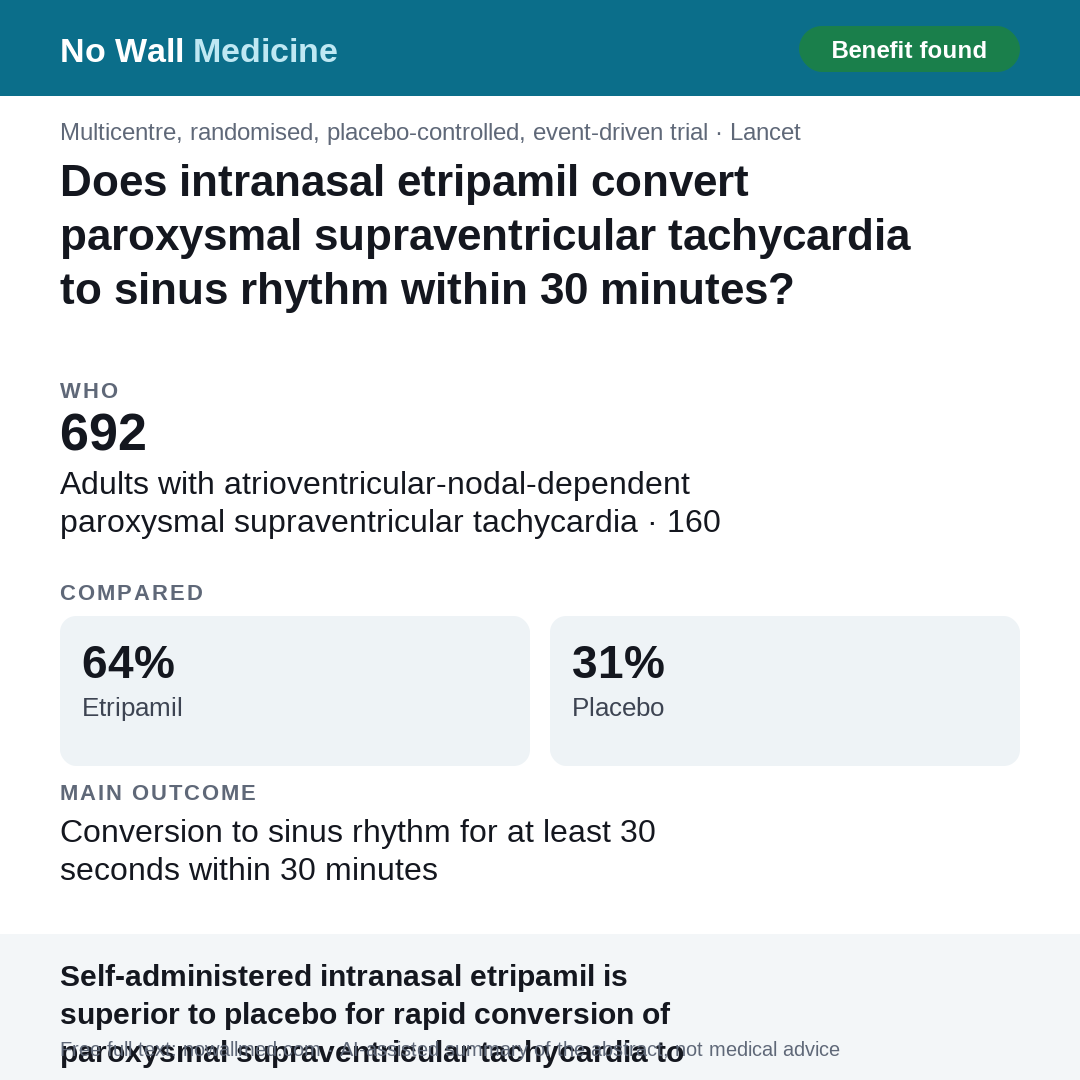
Does intranasal etripamil convert paroxysmal supraventricular tachycardia to sinus rhythm within 30 minutes?
Who
692
Adults with atrioventricular-nodal-dependent paroxysmal supraventricular tachycardia · 160 sites in North America and Europe
Compared
64%Etripamil (63/99)
31%Placebo (26/85)
Main outcome
Conversion to sinus rhythm for at least 30 seconds within 30 minutes
Result: hazard ratio 2·62 (95% CI 1·66-4·15)
Bottom line: Self-administered intranasal etripamil is superior to placebo for rapid conversion of paroxysmal supraventricular tachycardia to sinus rhythm.
Funded by: Milestone Pharmaceuticals
Lancet · 2023-06-15Download image
Clinical question: Does intranasal etripamil convert paroxysmal supraventricular tachycardia to sinus rhythm within 30 minutes?
Why it matters: Researchers investigated if a self-administered nasal spray could convert paroxysmal supraventricular tachycardia to sinus rhythm outside of a healthcare setting.
In absolute numbers
Etripamil: 64% · Placebo: 31% → a difference of 33 percentage points, so about 4 people would need the treatment for 1 more to benefit (number needed to treat) over the trial’s follow-up.
Worked out by us from the two group results above, not reported by the authors. Check the paper for the exact outcome and timing.
Key points
- In this randomized trial, 692 patients were assigned to receive either etripamil or a placebo for atrioventricular-nodal-dependent paroxysmal supraventricular tachycardia.
- The conversion rate to sinus rhythm within 30 minutes was 64% for etripamil compared to 31% for placebo.
- Adverse events occurred in 50% of the etripamil group, including nasal discomfort (23%), nasal congestion (13%), and runny nose (9%).
Headline and key points written with AI from the paper’s abstract, with every number checked against it. Read the paper before relying on them.
Abstract
Background
Etripamil is a fast-acting, intranasally administered calcium-channel blocker in development for on-demand therapy outside a health-care setting for paroxysmal supraventricular tachycardia. We aimed to evaluate the efficacy and safety of etripamil 70 mg nasal spray using a symptom-prompted, repeat-dose regimen for acute conversion of atrioventricular-nodal-dependent paroxysmal supraventricular tachycardia to sinus rhythm within 30 min. Methods
RAPID was a multicentre, randomised, placebo-controlled, event-driven trial, conducted at 160 sites in North America and Europe as part 2 of the NODE-301 study. Eligible patients were aged at least 18 years and had a history of paroxysmal supraventricular tachycardia with sustained, symptomatic episodes (≥20 min) as documented by electrocardiogram. Patients were administered two test doses of intranasal etripamil (each 70 mg, 10 min apart) during sinus rhythm; those who tolerated the test doses were randomly assigned (1:1) using an interactive response technology system to receive either etripamil or placebo. Prompted by symptoms of paroxysmal supraventricular tachycardia, patients self-administered a first dose of intranasal 70 mg etripamil or placebo and, if symptoms persisted beyond 10 min, a repeat dose. Continuously recorded electrocardiographic data were adjudicated, by individuals masked to patient assignment, for the primary endpoint of time to conversion of paroxysmal supraventricular tachycardia to sinus rhythm for at least 30 s within 30 min after the first dose, which was measured in all patients who administered blinded study drug for a confirmed atrioventricular-nodal-dependent event. Safety outcomes were assessed in all patients who self-administered blinded study drug for an episode of perceived paroxysmal supraventricular tachycardia. This trial is registered at ClinicalTrials.gov, NCT03464019, and is complete. Findings
Between Oct 13, 2020, and July 20, 2022, among 692 patients randomly assigned, 184 (99 from the etripamil group and 85 from the placebo group) self-administered study drug for atrioventricular-nodal-dependent paroxysmal supraventricular tachycardia, with diagnosis and timing confirmed. Kaplan-Meier estimates of conversion rates by 30 min were 64% (63/99) with etripamil and 31% (26/85) with placebo (hazard ratio 2·62; 95% CI 1·66-4·15; p<0·0001). Median time to conversion was 17·2 min (95% CI 13·4-26·5) with the etripamil regimen versus 53·5 min (38·7-87·3) with placebo. Prespecified sensitivity analyses of the primary assessment were conducted to test robustness, yielding supporting results. Treatment-emergent adverse events occurred in 68 (50%) of 99 patients treated with etripamil and 12 (11%) of 85 patients in the placebo group, most of which were located at the administration site and were mild or moderate, and all of which were transient and resolved without intervention. Adverse events occurring in at least 5% of patients treated with etripamil were nasal discomfort (23%), nasal congestion (13%), and rhinorrhea (9%). No serious etripamil-related adverse events or deaths were reported. Interpretation
Using a symptom-prompted, self-administered, initial and optional-repeat-dosing regimen, intranasal etripamil was well tolerated, safe, and superior to placebo for the rapid conversion of atrioventricular-nodal-dependent paroxysmal supraventricular tachycardia to sinus rhythm. This approach could empower patients to treat paroxysmal supraventricular tachycardia themselves outside of a health-care setting, and has the potential to reduce the need for additional medical interventions, such as intravenous medications given in an acute-care setting. Funding
Milestone Pharmaceuticals.
Abstract reproduced under the article’s CC BY licence.
Topics
Cite this article
Stambler BS, Camm AJ, Alings M, Dorian P, Heidbuchel H, Houtgraaf J. Self-administered intranasal etripamil using a symptom-prompted, repeat-dose regimen for atrioventricular-nodal-dependent supraventricular tachycardia (RAPID): a multicentre, randomised trial. Lancet. 2023. doi:10.1016/S0140-6736(23)00776-6
Spotted a mistake? Suggest a correction