Tailored self-management support reduced clinical outcomes for low-income older adults at high cardiovascular risk
Self-Management Support Using Advertising Principles for Older Adults With Low Income at High Cardiovascular Risk: A Randomized Controlled Trial
Randomized trialBenefit found
Does a tailored self-management education and support program reduce clinical cardiovascular outcomes?
Who
4761
Older adults with low income at high cardiovascular risk · Alberta, Canada
Compared
Self-management education and support
Control group
Main outcome
Composite of death, myocardial infarction, stroke, coronary revascularization, and hospitalizations
Result: incidence rate ratio 0.78 (95% CI 0.61 to 1.00)
Bottom line: A tailored self-management education and support program reduced clinical cardiovascular outcomes in low-income older adults.
Circulation · 2023-03-05Download image
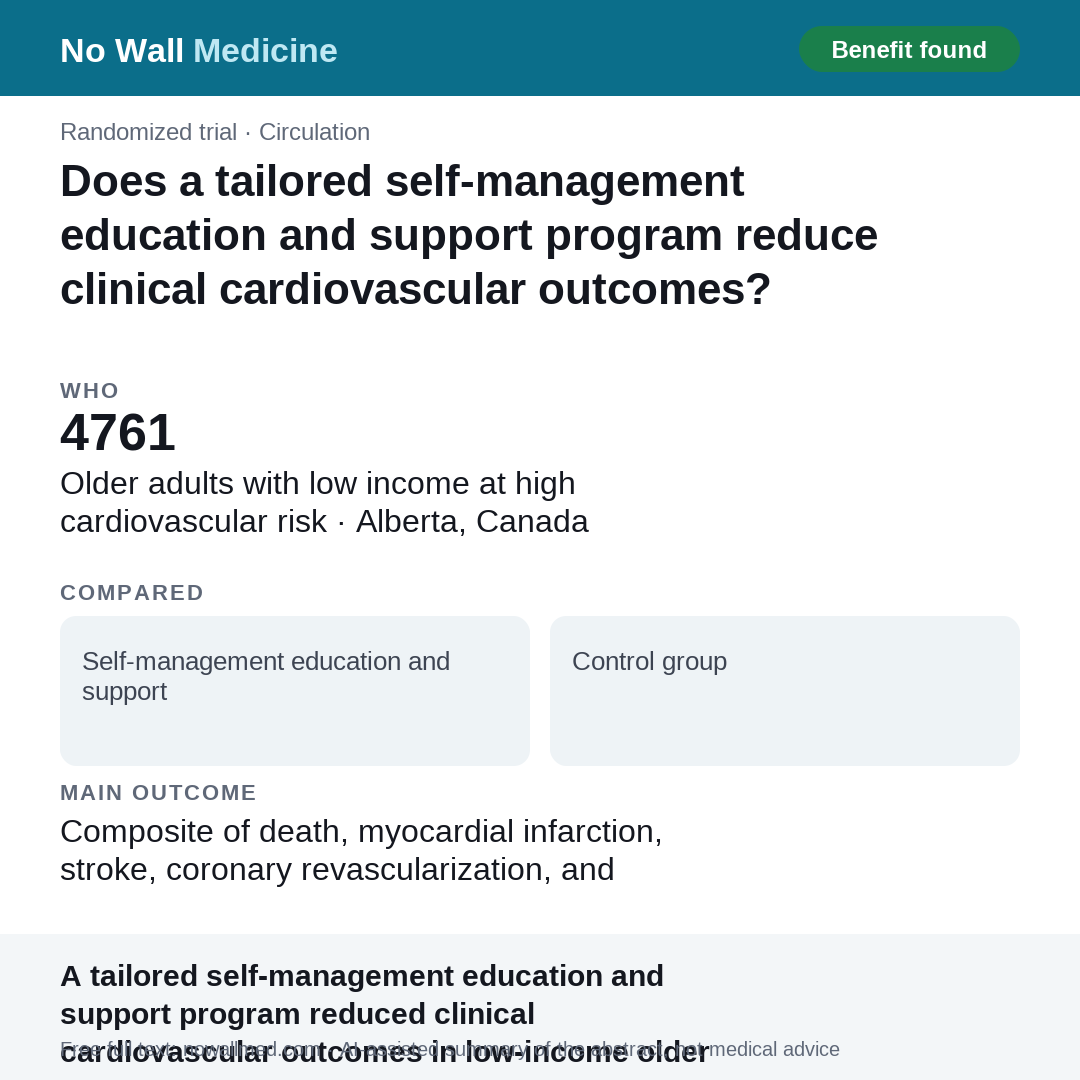
Clinical question: Does a tailored self-management education and support program reduce clinical cardiovascular outcomes?
Why it matters: It is unknown if incorporating advertising principles into self-management education and support can affect clinical end points for low-income older adults at high cardiovascular risk.
Key points
- Researchers randomized 4761 older adults with a mean age of 74.4 years to compare a tailored self-management education and support program against usual care.
- Over a median follow-up of 36 months, the rate of death, heart attack, stroke, heart revascularization, and specific hospitalizations was lower in the self-management group (incidence rate ratio, 0.78 [95% CI, 0.61 to 1.00]; P=0.047).
- There were no significant differences between groups regarding quality of life, medication adherence, or overall adjusted health care costs.
Headline and key points written with AI from the paper’s abstract, with every number checked against it. Read the paper before relying on them.
Topics
Cite this article
Campbell DJT, Tonelli M, Hemmelgarn BR, Faris P, Zhang J, Au F. Self-Management Support Using Advertising Principles for Older Adults With Low Income at High Cardiovascular Risk: A Randomized Controlled Trial. Circulation. 2023. doi:10.1161/CIRCULATIONAHA.123.064189
Spotted a mistake? Suggest a correction
Top studies every Monday
The week’s key trials and guidelines in your specialties, plus any topics you follow. By email, free.
Get the weekly digest