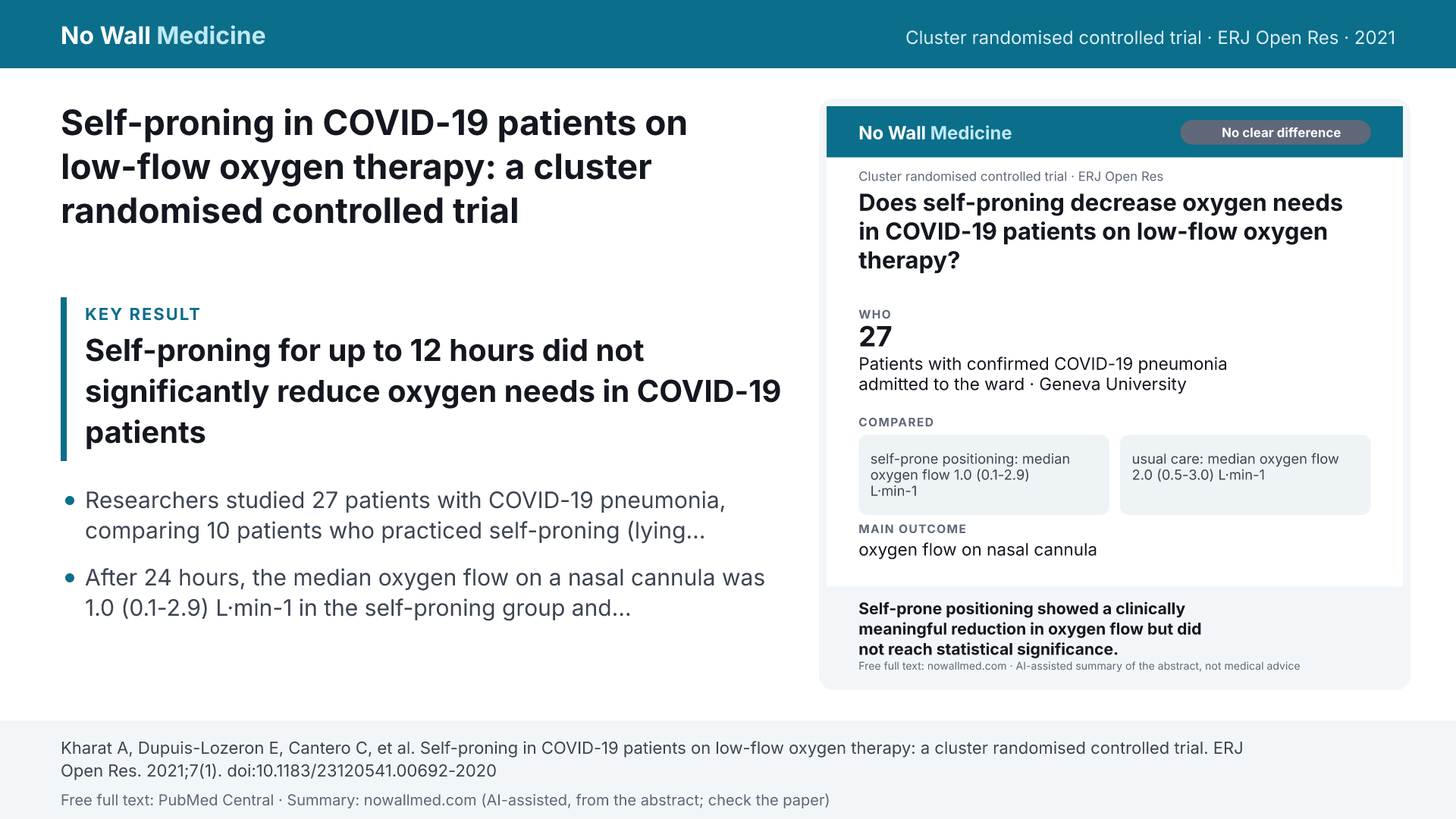
Self-proning for up to 12 hours did not significantly reduce oxygen needs in COVID-19 patients
Self-proning in COVID-19 patients on low-flow oxygen therapy: a cluster randomised controlled trial
Cluster randomised controlled trialNo clear difference
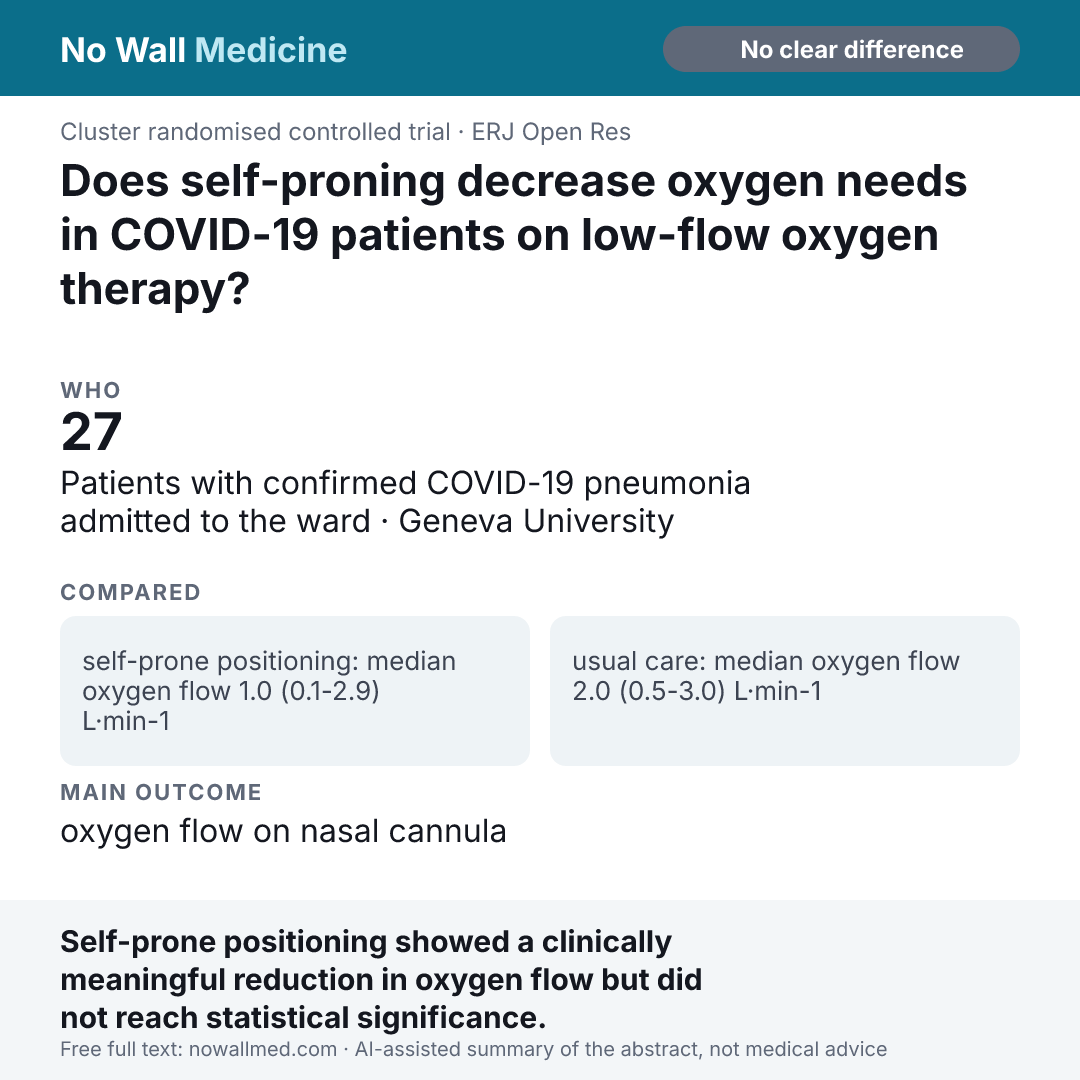
Does self-proning decrease oxygen needs in COVID-19 patients on low-flow oxygen therapy?
Who
27
Patients with confirmed COVID-19 pneumonia admitted to the ward · Geneva University Hospitals
Compared
self-prone positioning: median oxygen flow 1.0 (0.1-2.9) L·min-1
usual care: median oxygen flow 2.0 (0.5-3.0) L·min-1
Main outcome
oxygen flow on nasal cannula
Bottom line: Self-prone positioning showed a clinically meaningful reduction in oxygen flow but did not reach statistical significance.
ERJ Open Res · 2021-03-08 · Save PNG
Clinical question: Does self-proning decrease oxygen needs in COVID-19 patients on low-flow oxygen therapy?
Key points
- Researchers studied 27 patients with COVID-19 pneumonia, comparing 10 patients who practiced self-proning (lying on their stomachs) to 17 patients receiving usual care.
- After 24 hours, the median oxygen flow on a nasal cannula was 1.0 (0.1-2.9) L·min-1 in the self-proning group and 2.0 (0.5-3.0) L·min-1 in the control group (p=0.507).
- The median oxygen saturation to inspired oxygen ratio was 390 (300-432) in the self-proning group and 336 (294-422) in the control group (p=0.633).
Headline and key points written with AI from the paper’s abstract, with every number checked against it. Read the paper before relying on them.
Was this summary helpful?
Headline, design, result, key points, caveat and citation as plain text.
Cite this article
Kharat A, Dupuis-Lozeron E, Cantero C, et al. Self-proning in COVID-19 patients on low-flow oxygen therapy: a cluster randomised controlled trial. ERJ Open Res. 2021;7(1). doi:10.1183/23120541.00692-2020
Spotted a mistake? Suggest a correction