Semaglutide increases walking distance in patients with obesity-related heart failure with preserved ejection fraction
Semaglutide and Exercise Function in Obesity-Related HFpEF: Insights From the STEP-HFpEF Program
Randomized trial, secondary analysis of pooled dataBenefit found
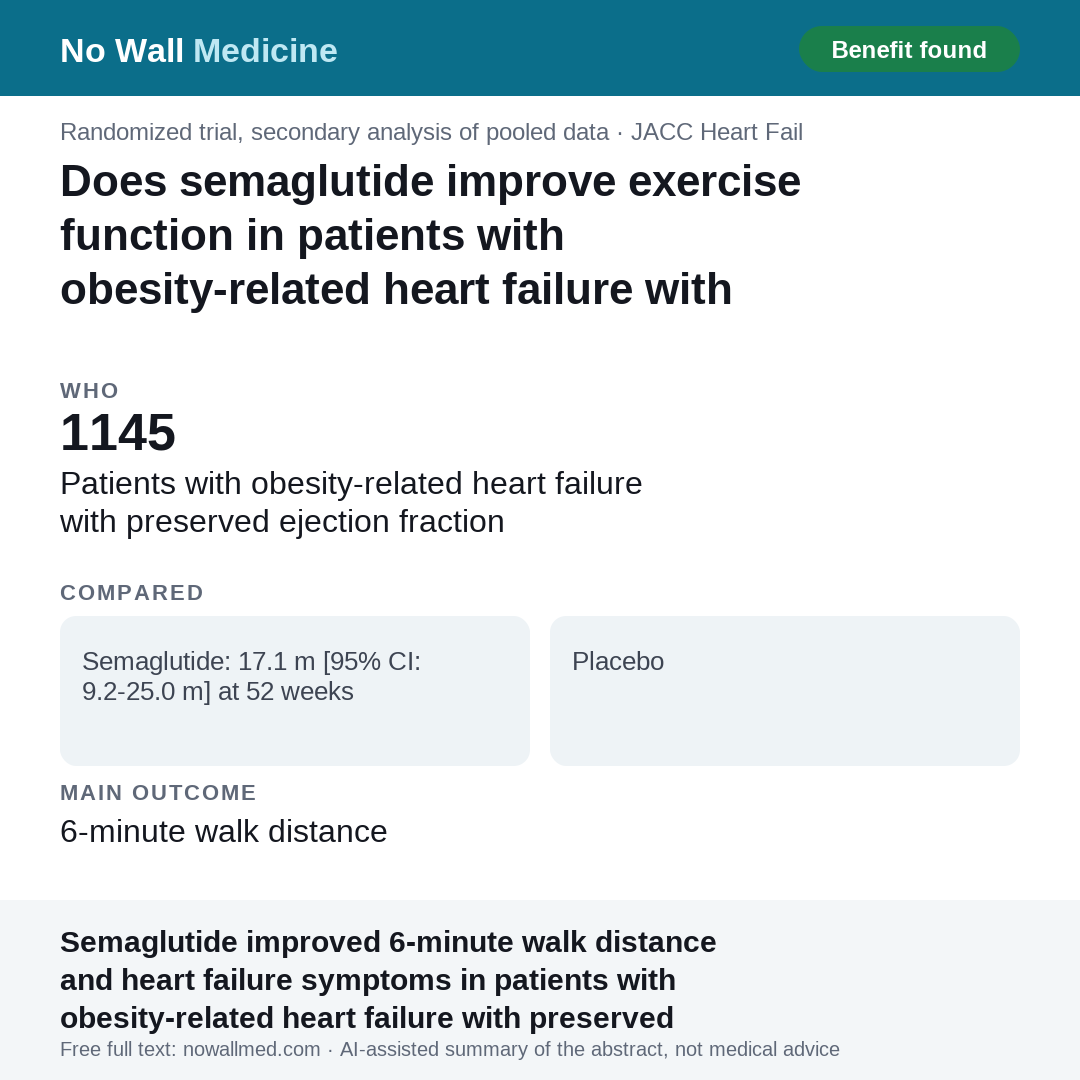
Does semaglutide improve exercise function in patients with obesity-related heart failure with preserved ejection fraction?
Who
1145
Patients with obesity-related heart failure with preserved ejection fraction
Compared
Semaglutide: 17.1 m [95% CI: 9.2-25.0 m] at 52 weeks
Placebo
Main outcome
6-minute walk distance
Result: treatment difference 17.1 m (95% CI 9.2-25.0 m)
Bottom line: Semaglutide improved 6-minute walk distance and heart failure symptoms in patients with obesity-related heart failure with preserved ejection fraction.
JACC Heart Fail · 2025-10-03Download image
Clinical question: Does semaglutide improve exercise function in patients with obesity-related heart failure with preserved ejection fraction?
Why it matters: It is unclear how baseline exercise function, measured by walking distance, relates to the effectiveness of semaglutide in patients with obesity-related heart failure.
Key points
- Researchers randomized 1,145 patients with obesity-related heart failure with preserved ejection fraction to receive either semaglutide or a placebo.
- Semaglutide increased the 6-minute walk distance by 14.6 m at 20 weeks and by 17.1 m at 52 weeks compared to placebo.
- Each 1-unit decrease in body mass index during semaglutide treatment was associated with a 4.1 m increase in the 6-minute walk distance.
Headline and key points written with AI from the paper’s abstract, with every number checked against it. Read the paper before relying on them.
Was this summary helpful?
Subject terms
Cite this article
Borlaug BA, Kitzman DW, Patel S, Chinnakondepalli KM, Butler J, Davies MJ. Semaglutide and Exercise Function in Obesity-Related HFpEF: Insights From the STEP-HFpEF Program. JACC Heart Fail. 2025. doi:10.1016/j.jchf.2025.102660
Spotted a mistake? Suggest a correction
Top studies every Monday
The week’s key trials and guidelines in your specialties, plus any topics you follow. By email, free.
Get the weekly digest