A 30 degree head elevation reduces low blood oxygen levels after abdominal surgery
Semirecumbent Positioning During Anesthesia Recovery and Postoperative Hypoxemia: A Randomized Clinical Trial
Randomized clinical trialBenefit found
Does semirecumbent positioning reduce postoperative hypoxemia compared to supine position?
Who
700
Patients scheduled for laparoscopic upper abdominal surgery under general anesthesia · A tertiary hospital in China
Compared
46.8%Supine position
45.1%15 degree semirecumbent position
32.5%30 degree semirecumbent position
Main outcome
Incidence of postoperative hypoxemia in the postanesthesia care unit
Result: risk ratio 0.69 (95% CI, 0.55-0.87) for 30 degree vs supine
Bottom line: A 30 degree semirecumbent position significantly reduces postoperative hypoxemia compared to supine or 15 degree positioning.
JAMA Netw Open · 2024-06-03Download image
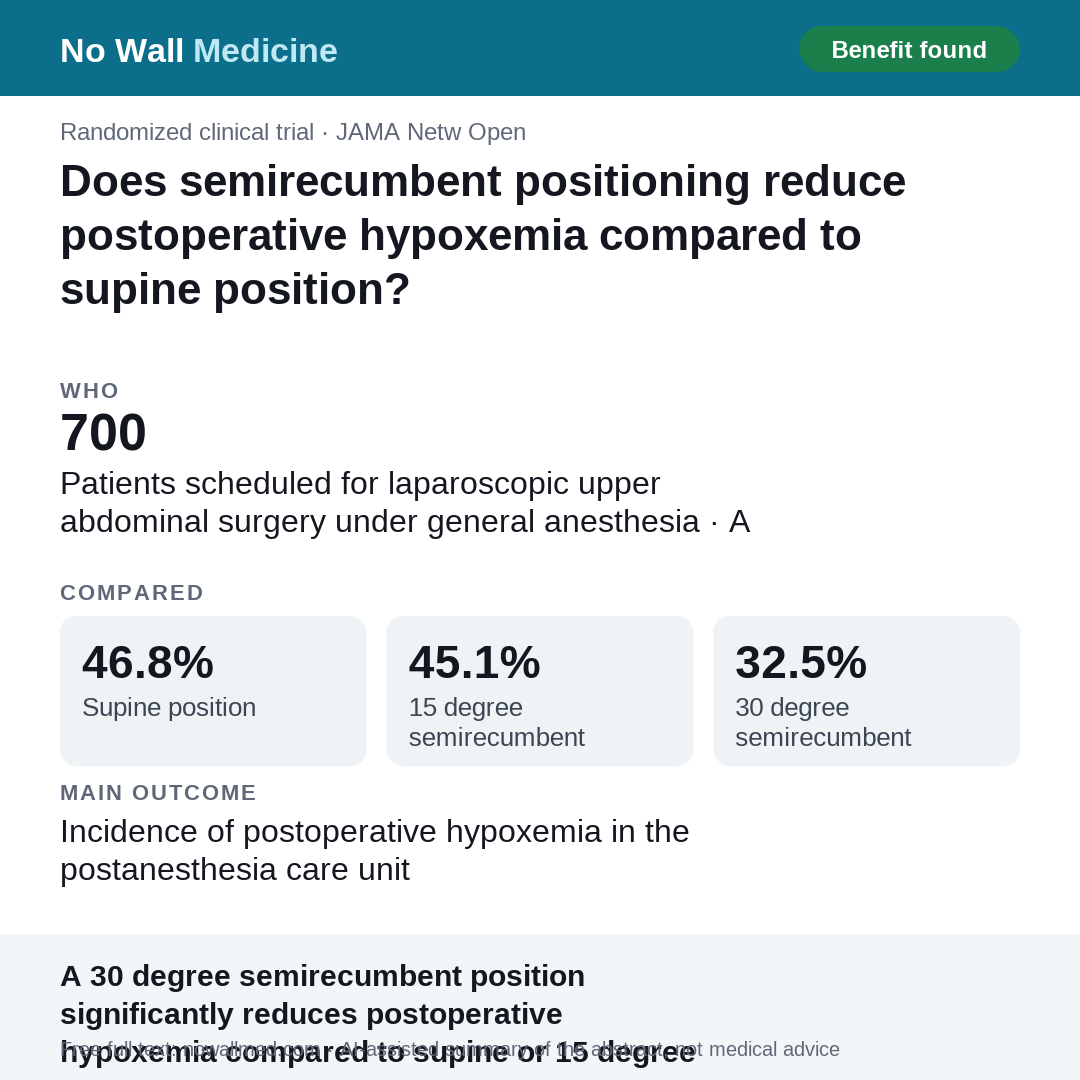
Clinical question: Does semirecumbent positioning reduce postoperative hypoxemia compared to supine position?
Why it matters: It is unclear if using a semirecumbent position, where the head is elevated, is effective at reducing low blood oxygen levels during recovery from anesthesia.
Key points
- Researchers randomized 700 patients undergoing laparoscopic upper abdominal surgery to either a flat supine position, a 15 degree semirecumbent position, or a 30 degree semirecumbent position.
- Postoperative hypoxemia, or low blood oxygen, occurred in 46.8% of the supine group, 45.1% of the 15 degree group, and 32.5% of the 30 degree group.
- Severe hypoxemia was significantly lower in the 30 degree group at 15.4% compared to 26.2% in the supine group.
Headline and key points written with AI from the paper’s abstract, with every number checked against it. Read the paper before relying on them.
Was this summary helpful?
Subject terms
Cite this article
Wang X, Guo K, Sun J, Yang Y, Wu Y, Tang X. Semirecumbent Positioning During Anesthesia Recovery and Postoperative Hypoxemia: A Randomized Clinical Trial. JAMA Netw Open. 2024. doi:10.1001/jamanetworkopen.2024.16797
Spotted a mistake? Suggest a correction
Top studies every Monday
The week’s key trials and guidelines in your specialties, plus any topics you follow. By email, free.
Get the weekly digest