Sensitivity and specificity of machine learning and deep learning algorithms in the diagnosis of thoracolumbar injuries resulting in vertebral fractures: A systematic review and meta-analysis
Systematic review and meta-analysisBenefit found
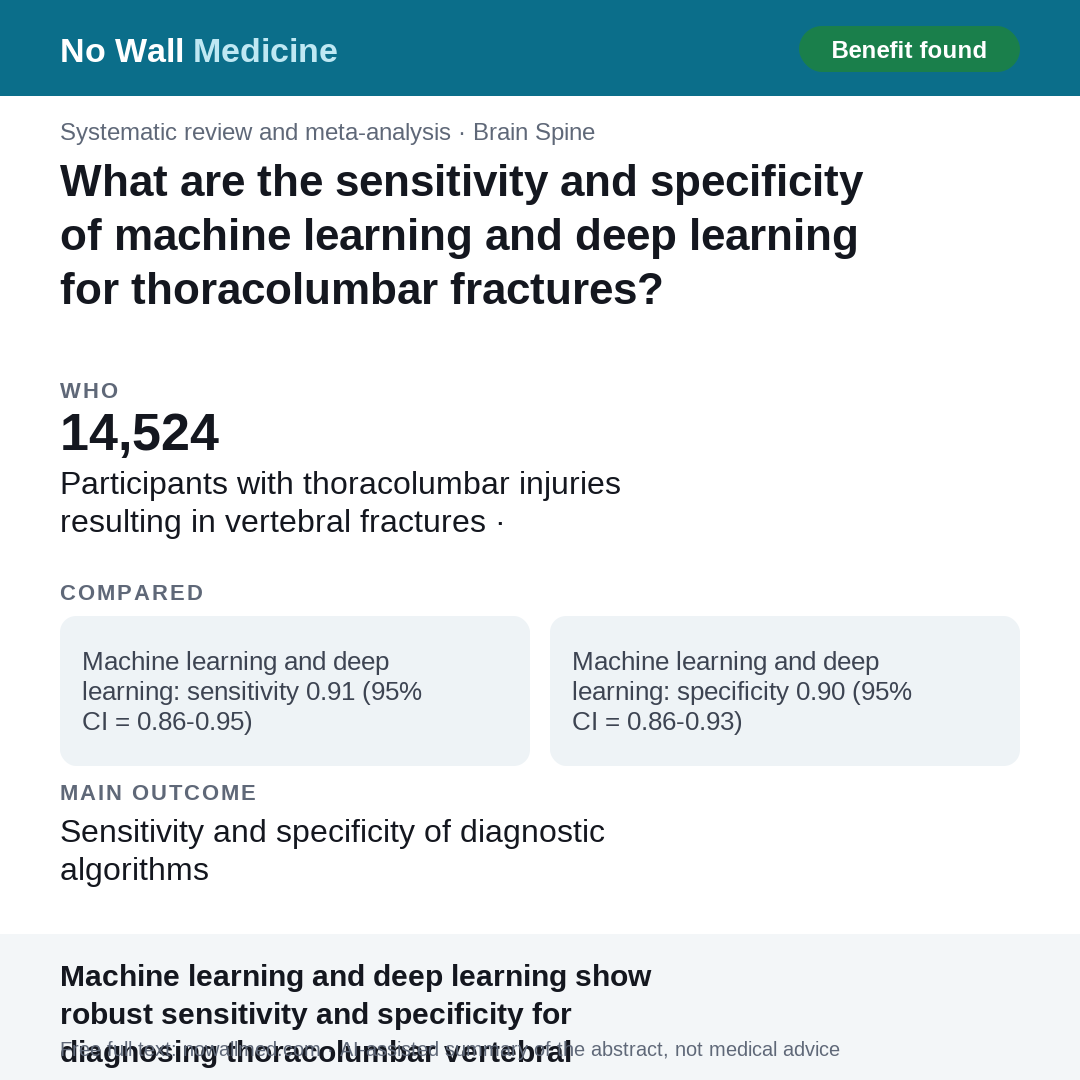
What are the sensitivity and specificity of machine learning and deep learning for thoracolumbar fractures?
Who
14,524
Participants with thoracolumbar injuries resulting in vertebral fractures · Predominantly China
Compared
Machine learning and deep learning: sensitivity 0.91 (95% CI = 0.86-0.95)
Machine learning and deep learning: specificity 0.90 (95% CI = 0.86-0.93)
Main outcome
Sensitivity and specificity of diagnostic algorithms
Result: sensitivity 0.91 (95% CI = 0.86-0.95), specificity 0.90 (95% CI = 0.86-0.93)
Bottom line: Machine learning and deep learning show robust sensitivity and specificity for diagnosing thoracolumbar vertebral fractures.
Limitation: Critical need for standardization in methodologies to enhance clinical utility.
Brain Spine · 2024-04-17Download image
Clinical question: What are the sensitivity and specificity of machine learning and deep learning for thoracolumbar fractures?
Abstract
Introduction
Clinicians encounter challenges in promptly diagnosing thoracolumbar injuries (TLIs) and fractures (VFs), motivating the exploration of Artificial Intelligence (AI) and Machine Learning (ML) and Deep Learning (DL) technologies to enhance diagnostic capabilities. Despite varying evidence, the noteworthy transformative potential of AI in healthcare, leveraging insights from daily healthcare data, persists. Research question
This review investigates the utilization of ML and DL in TLIs causing VFs. Materials and methods
Employing Preferred Reporting Items for Systematic Reviews and Meta-Analyzes (PRISMA) methodology, a systematic review was conducted in PubMed and Scopus databases, identifying 793 studies. Seventeen were included in the systematic review, and 11 in the meta-analysis. Variables considered encompassed publication years, geographical location, study design, total participants (14,524), gender distribution, ML or DL methods, specific pathology, diagnostic modality, test analysis variables, validation details, and key study conclusions. Meta-analysis assessed specificity, sensitivity, and conducted hierarchical summary receiver operating characteristic curve (HSROC) analysis. Results
Predominantly conducted in China (29.41%), the studies involved 14,524 participants. In the analysis, 11.76% (N = 2) focused on ML, while 88.24% (N = 15) were dedicated to deep DL. Meta-analysis revealed a sensitivity of 0.91 (95% CI = 0.86-0.95), consistent specificity of 0.90 (95% CI = 0.86-0.93), with a false positive rate of 0.097 (95% CI = 0.068-0.137). Conclusion
The study underscores consistent specificity and sensitivity estimates, affirming the diagnostic test's robustness. However, the broader context of ML applications in TLIs emphasizes the critical need for standardization in methodologies to enhance clinical utility.
Cite this article
Bečulić H, Begagić E, Džidić-Krivić A, Pugonja R, Softić N, Bašić B. Sensitivity and specificity of machine learning and deep learning algorithms in the diagnosis of thoracolumbar injuries resulting in vertebral fractures: A systematic review and meta-analysis. Brain Spine. 2024. doi:10.1016/j.bas.2024.102809
Spotted a mistake? Suggest a correction
Top studies every Monday
The week’s key trials and guidelines in your specialties, plus any topics you follow. By email, free.
Get the weekly digest