Sensory-adapted dental environments reduced physiological and behavioral distress in autistic children during cleanings
Sensory Adaptations to Improve Physiological and Behavioral Distress During Dental Visits in Autistic Children: A Randomized Crossover Trial
Randomized crossover trialBenefit found
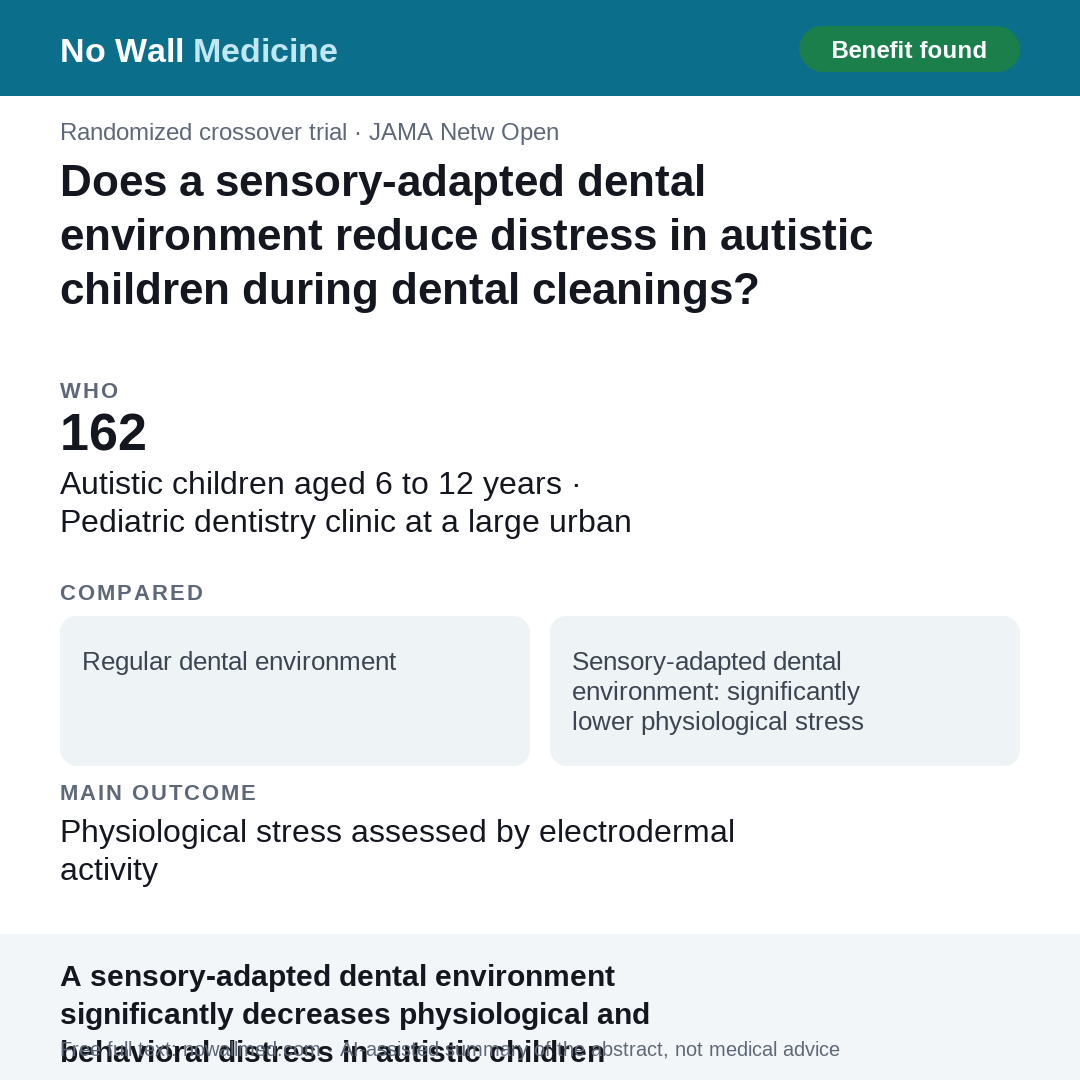
Does a sensory-adapted dental environment reduce distress in autistic children during dental cleanings?
Who
162
Autistic children aged 6 to 12 years · Pediatric dentistry clinic at a large urban children's hospital
Compared
Regular dental environment
Sensory-adapted dental environment: significantly lower physiological stress
Main outcome
Physiological stress assessed by electrodermal activity
Result: mean difference in skin conductance level, -1.22 (95% CI, -2.17 to -0.27) μS
Bottom line: A sensory-adapted dental environment significantly decreases physiological and behavioral distress in autistic children during dental cleanings.
JAMA Netw Open · 2023-06-01Download image
Clinical question: Does a sensory-adapted dental environment reduce distress in autistic children during dental cleanings?
Why it matters: Autistic children often face oral care challenges and sensory overresponsivity, making it difficult for dentists to perform standard clinic-based procedures.
Key points
- Researchers conducted a randomized crossover trial with 162 autistic children aged 6 to 12 years to compare a sensory-adapted dental environment with a regular dental environment.
- The sensory-adapted environment resulted in significantly lower physiological stress, with a mean difference in skin conductance level of -1.22 [95% CI, -2.17 to -0.27] μS.
- Behavioral distress measured from video recordings was also significantly lower in the sensory-adapted environment compared to the regular dental environment.
Headline and key points written with AI from the paper’s abstract, with every number checked against it. Read the paper before relying on them.
Was this summary helpful?
Subject terms
Cite this article
Stein Duker LI, Como DH, Jolette C, Vigen C, Gong CL, Williams ME. Sensory Adaptations to Improve Physiological and Behavioral Distress During Dental Visits in Autistic Children: A Randomized Crossover Trial. JAMA Netw Open. 2023. doi:10.1001/jamanetworkopen.2023.16346
Spotted a mistake? Suggest a correction
Top studies every Monday
The week’s key trials and guidelines in your specialties, plus any topics you follow. By email, free.
Get the weekly digest