Reduced sensory attenuation in schizophrenia is not a sufficient mechanism for auditory hallucinations
Sensory Attenuation Deficit and Auditory Hallucinations in Schizophrenia: A Causal Mechanism or a Risk Factor? Evidence From Meta-Analyses on the N1 Event-Related Potential Component
Meta-analysis of 15 studiesNo clear difference
Does reduced sensory attenuation explain auditory hallucinations in schizophrenia?
Who
Individuals with schizophrenia and healthy controls
Compared
Schizophrenia: reduced magnitude of N1 attenuation
Healthy controls: significant N1 attenuation
Main outcome
N1 component of auditory event-related potential signals
Bottom line: Reduced sensory attenuation occurs in schizophrenia regardless of auditory hallucinations, suggesting it is a risk factor rather than a cause.
Biol Psychiatry · 2024-01-20Download image
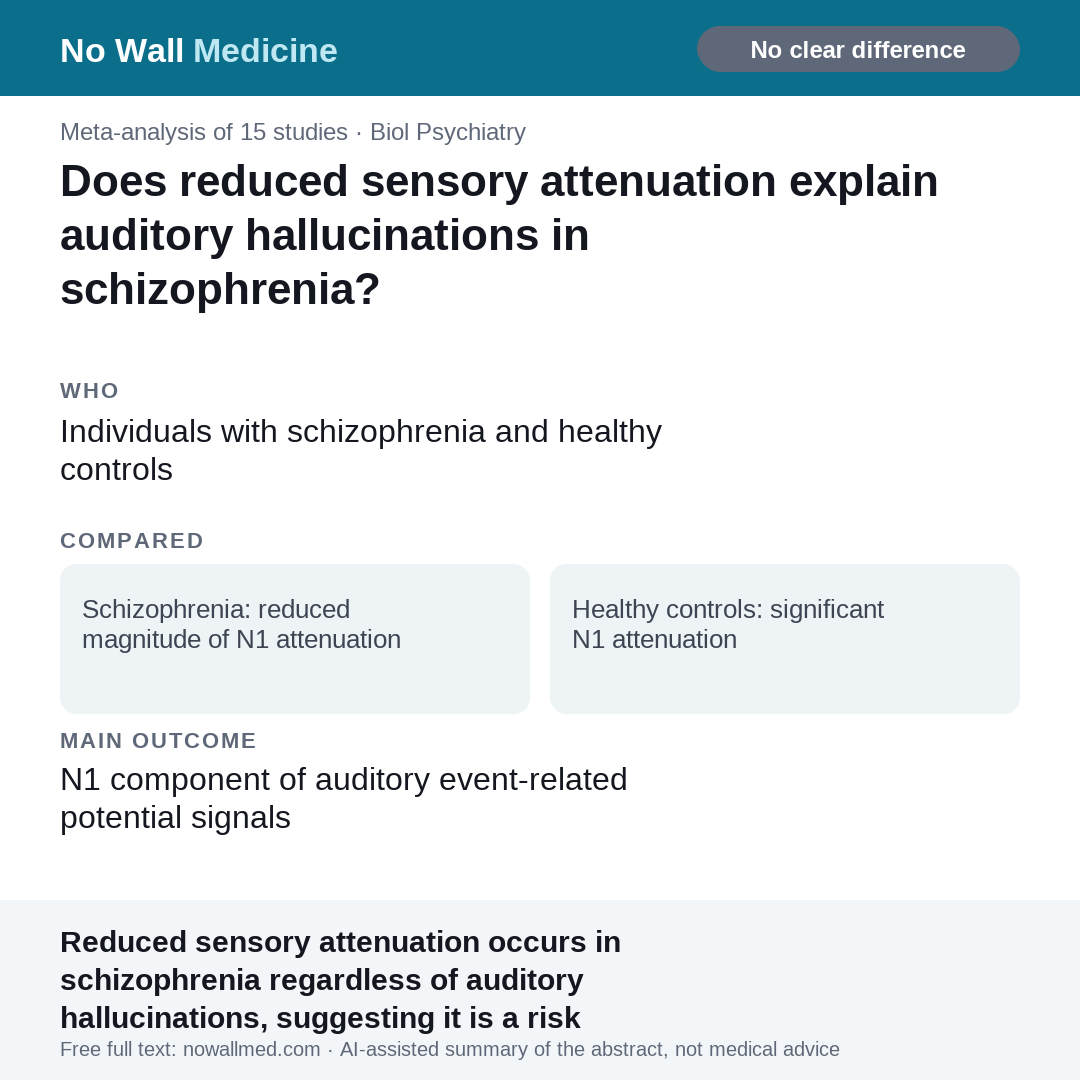
Clinical question: Does reduced sensory attenuation explain auditory hallucinations in schizophrenia?
Why it matters: It is unknown whether a deficiency in sensory attenuation is a sufficient mechanism to explain positive symptoms like auditory hallucinations in schizophrenia.
Key points
- Researchers performed meta-analyses on 15 studies measuring the N1 component, a brain signal measured via electroencephalogram, during self-generated talking and listening to prerecorded voices.
- The magnitude of sensory attenuation, or the dampened perception of self-generated sounds, was reduced in individuals with schizophrenia compared to healthy controls.
- This reduction in sensory attenuation occurred regardless of disease stage, positive symptom severity, or whether patients experienced auditory hallucinations.
Headline and key points written with AI from the paper’s abstract, with every number checked against it. Read the paper before relying on them.
Topics
Cite this article
Mariano M, Rossetti I, Maravita A, Paulesu E, Zapparoli L. Sensory Attenuation Deficit and Auditory Hallucinations in Schizophrenia: A Causal Mechanism or a Risk Factor? Evidence From Meta-Analyses on the N1 Event-Related Potential Component. Biol Psychiatry. 2024. doi:10.1016/j.biopsych.2023.12.026
Spotted a mistake? Suggest a correction
Top studies every Monday
The week’s key trials and guidelines in your specialties, plus any topics you follow. By email, free.
Get the weekly digest