Two different care pathways for veterans with low back pain showed no difference in outcomes
Sequenced Care Pathway vs Pain Navigator Pathway for Veterans With Low Back Pain: The AIM-Back Cluster Randomized Clinical Trial
Embedded cluster randomized clinical trialNo clear difference
Does a sequenced care pathway compare favorably to a pain navigator pathway for low back pain?
Who
1817
Veterans with low back pain · 19 primary care clinics in the Veterans Health Administration
Compared
60.5 pointsSequenced care pathway (97.5% CI, 59.7-61.3 points)
61.1 pointsPain navigator pathway (97.5% CI, 60.4-61.8 points)
Main outcome
Pain interference and physical function
Result: -0.6 points (97.5% CI, -1.6 to 0.4 points) for pain interference
Bottom line: The sequenced care pathway was not superior to the pain navigator pathway for pain interference and physical function.
Limitation: Future research should consider designs that optimize pathway adherence and assess effectiveness in other settings.
JAMA Netw Open · 2026-04-01Download image
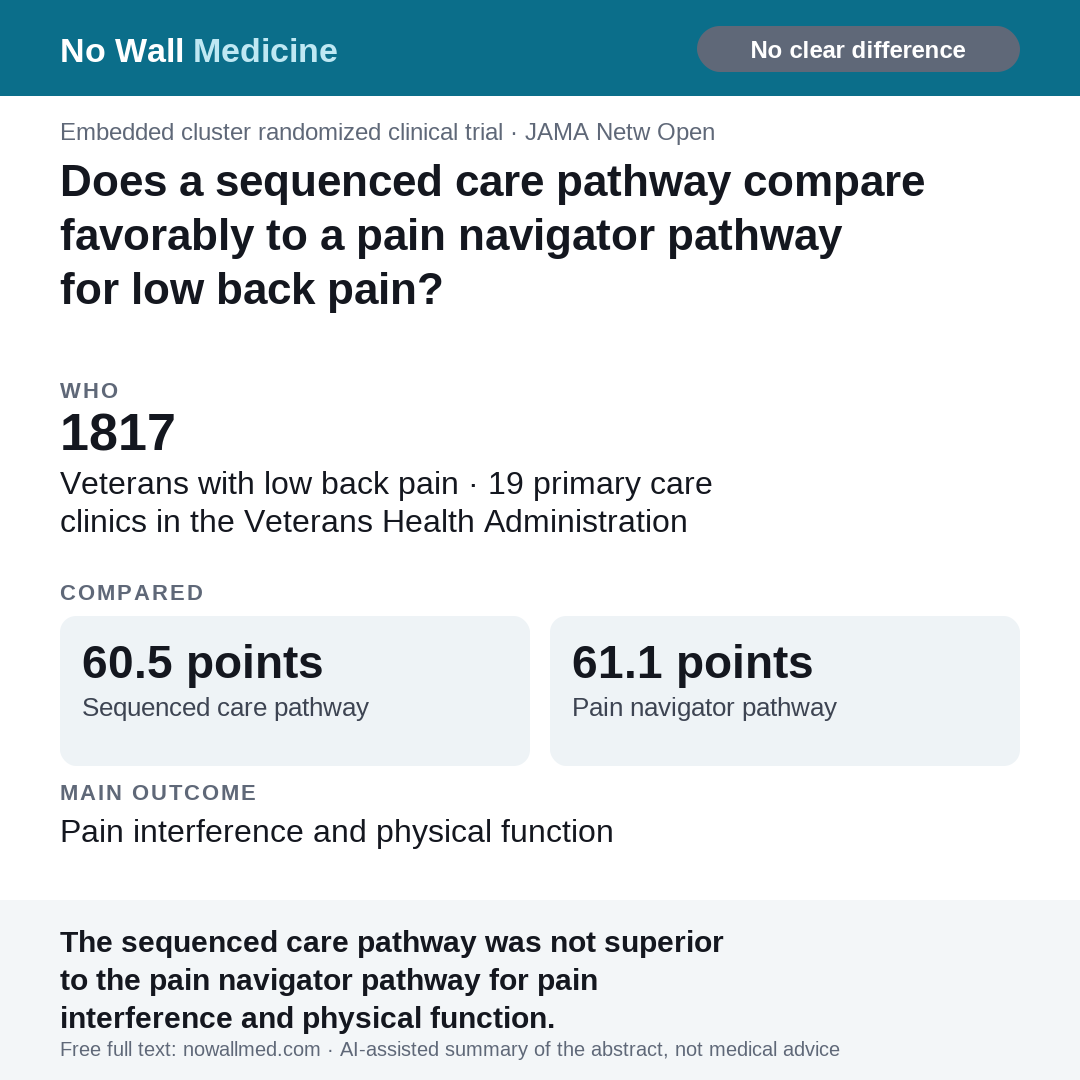
Clinical question: Does a sequenced care pathway compare favorably to a pain navigator pathway for low back pain?
Why it matters: There is limited evidence from clinical practice to support the effectiveness of alternative care models for low back pain.
Key points
- Researchers studied 1817 veterans across 19 clinics to compare a sequenced care pathway with a pain navigator pathway.
- At 3 months, the sequenced care pathway group had a pain interference score of 60.5 and a physical function score of 39.1.
- The pain navigator pathway group had a pain interference score of 61.1 and a physical function score of 38.5, showing no superiority for the sequenced care pathway.
Headline and key points written with AI from the paper’s abstract, with every number checked against it. Read the paper before relying on them.
Topics
Spotted a mistake? Suggest a correction