Sequential motor learning transfers from real to virtual environment
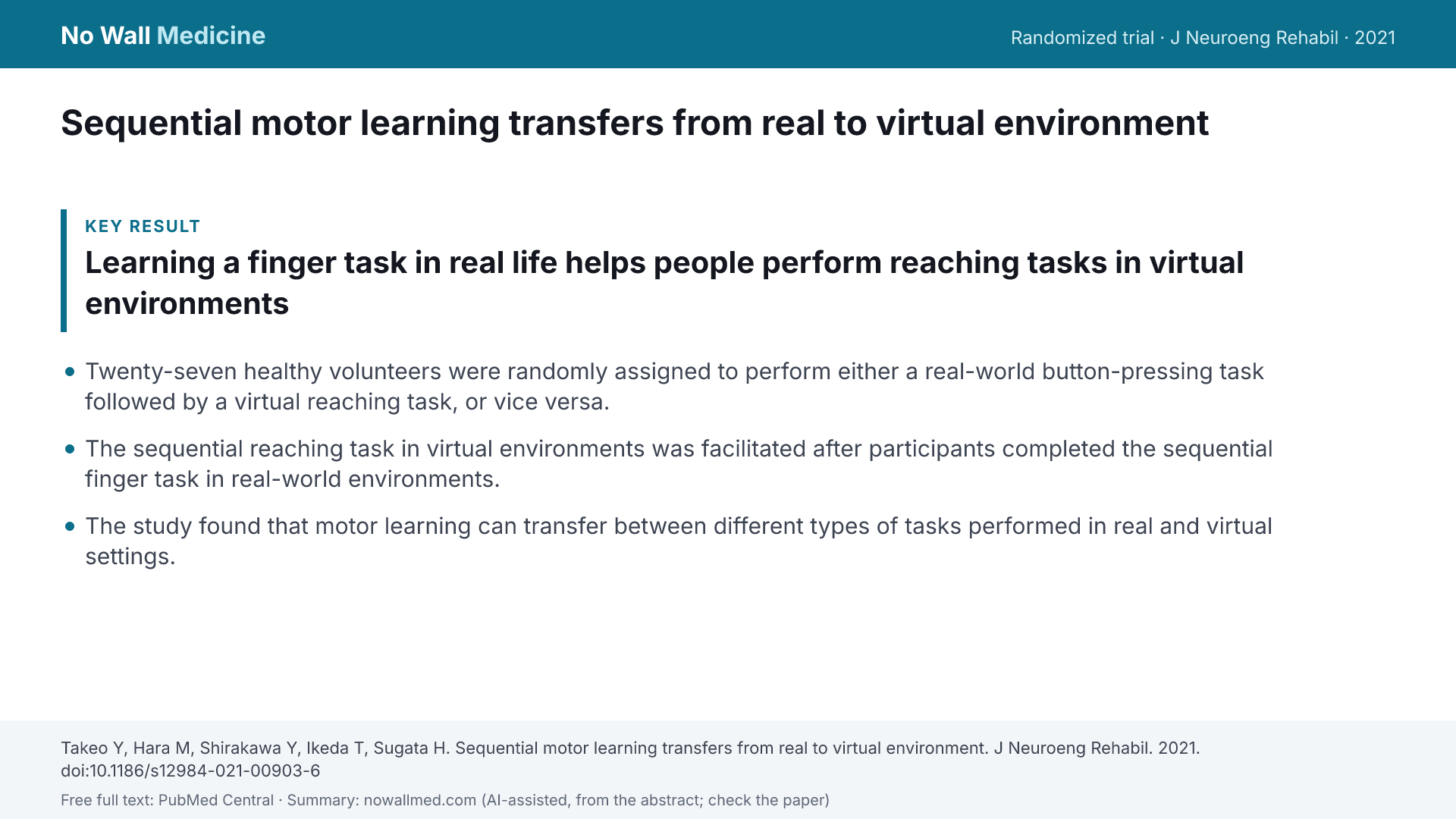
Key result: Learning a finger task in real life helps people perform reaching tasks in virtual environments
Key points
- Twenty-seven healthy volunteers were randomly assigned to perform either a real-world button-pressing task followed by a virtual reaching task, or vice versa.
- The sequential reaching task in virtual environments was facilitated after participants completed the sequential finger task in real-world environments.
- The study found that motor learning can transfer between different types of tasks performed in real and virtual settings.
Discussion prompts
- Would these patients look like yours? Who was left out?
- Is the main outcome one that matters to patients?
- Is the difference large enough to change what you do?
Cite: Takeo Y, Hara M, Shirakawa Y, Ikeda T, Sugata H. Sequential motor learning transfers from real to virtual environment. J Neuroeng Rehabil. 2021. doi:10.1186/s12984-021-00903-6
Free full text: PubMed Central · Summary and visual abstract: nowallmed.com/a/sequential-motor-learning-transfers-from-real-to-virtual-1qyolo2/ (AI-assisted from the abstract; check the paper before relying on it).