Serious Games for Learning Among Older Adults With Cognitive Impairment: Systematic Review and Meta-analysis
Systematic review and meta-analysisBenefit found
Are serious games effective for verbal and nonverbal learning in older adults with cognitive impairment?
Who
Older adults with cognitive impairment
Compared
Serious games
No or sham interventions
Conventional exercises
Conventional cognitive training
Main outcome
Verbal and nonverbal learning
Bottom line: Serious games may enhance verbal and nonverbal learning, but should supplement rather than replace current interventions.
Limitation: Low quality of evidence, small sample sizes, and paucity of studies included in meta-analyses.
J Med Internet Res · 2023-04-12Download image
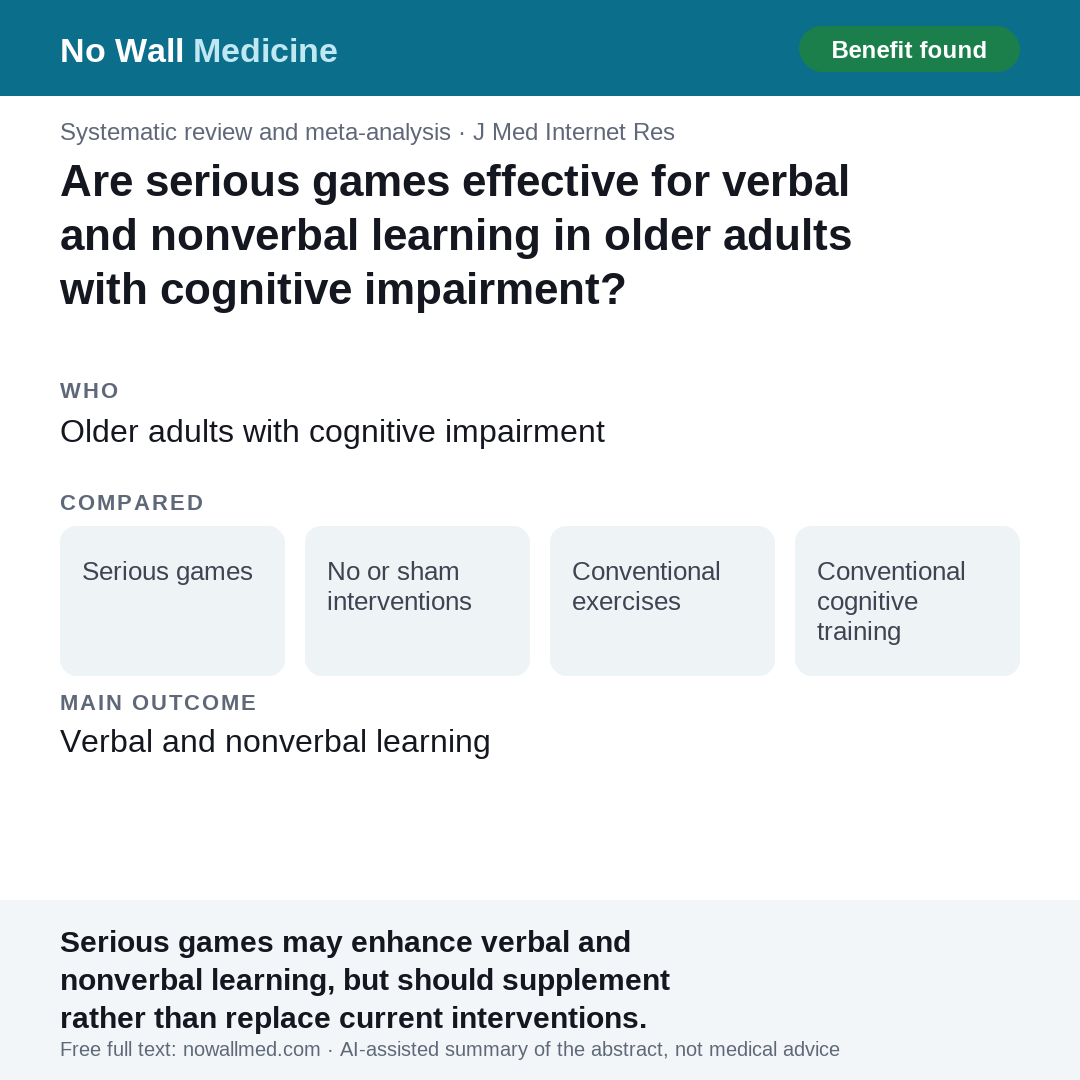
Clinical question: Are serious games effective for verbal and nonverbal learning in older adults with cognitive impairment?
Abstract
Background
Learning disabilities are among the major cognitive impairments caused by aging. Among the interventions used to improve learning among older adults are serious games, which are participative electronic games designed for purposes other than entertainment. Although some systematic reviews have examined the effectiveness of serious games on learning, they are undermined by some limitations, such as focusing on older adults without cognitive impairments, focusing on particular types of serious games, and not considering the comparator type in the analysis. Objective
This review aimed to evaluate the effectiveness of serious games on verbal and nonverbal learning among older adults with cognitive impairment. Methods
Eight electronic databases were searched to retrieve studies relevant to this systematic review and meta-analysis. Furthermore, we went through the studies that cited the included studies and screened the reference lists of the included studies and relevant reviews. Two reviewers independently checked the eligibility of the identified studies, extracted data from the included studies, and appraised their risk of bias and the quality of the evidence. The results of the included studies were summarized using a narrative synthesis or meta-analysis, as appropriate. Results
Of the 559 citations retrieved, 11 (2%) randomized controlled trials (RCTs) ultimately met all eligibility criteria for this review. A meta-analysis of 45% (5/11) of the RCTs revealed that serious games are effective in improving verbal learning among older adults with cognitive impairment in comparison with no or sham interventions (P=.04), and serious games do not have a different effect on verbal learning between patients with mild cognitive impairment and those with Alzheimer disease (P=.89). A meta-analysis of 18% (2/11) of the RCTs revealed that serious games are as effective as conventional exercises in promoting verbal learning (P=.98). We also found that serious games outperformed no or sham interventions (4/11, 36%; P=.03) and conventional cognitive training (2/11, 18%; P<.001) in enhancing nonverbal learning. Conclusions
Serious games have the potential to enhance verbal and nonverbal learning among older adults with cognitive impairment. However, our findings remain inconclusive because of the low quality of evidence, the small sample size in most of the meta-analyzed studies (6/8, 75%), and the paucity of studies included in the meta-analyses. Thus, until further convincing proof of their effectiveness is offered, serious games should be used to supplement current interventions for verbal and nonverbal learning rather than replace them entirely. Further studies are needed to compare serious games with conventional cognitive training and conventional exercises, as well as different types of serious games, different platforms, different intervention periods, and different follow-up periods. Trial registration
PROSPERO CRD42022348849; https://tinyurl.com/y6yewwfa.
Subject terms
Cite this article
Abd-Alrazaq A, Abuelezz I, AlSaad R, Al-Jafar E, Ahmed A, Aziz S. Serious Games for Learning Among Older Adults With Cognitive Impairment: Systematic Review and Meta-analysis. J Med Internet Res. 2023. doi:10.2196/43607
Spotted a mistake? Suggest a correction
Top studies every Monday
The week’s key trials and guidelines in your specialties, plus any topics you follow. By email, free.
Get the weekly digest