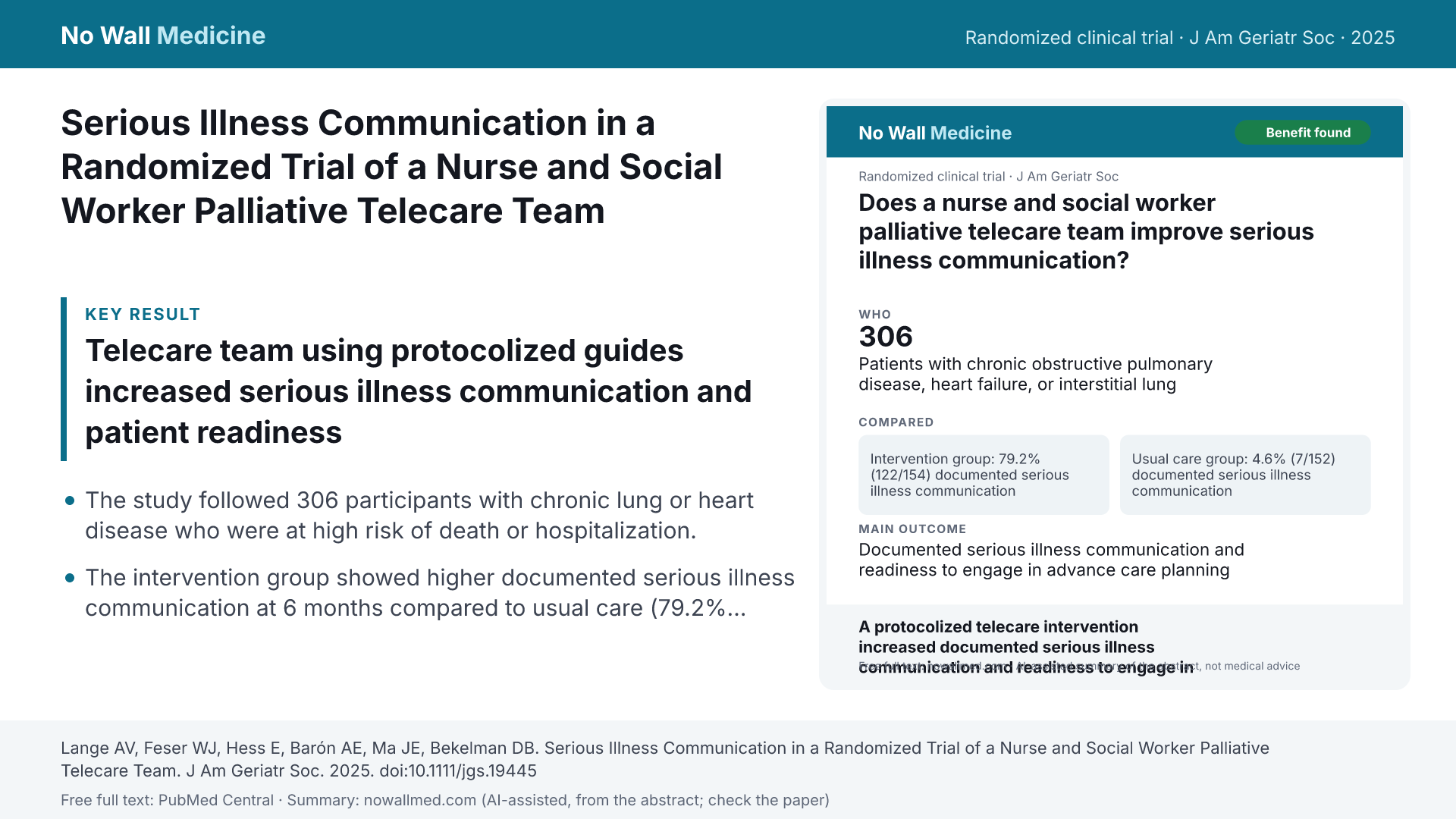
Telecare team using protocolized guides increased serious illness communication and patient readiness
Serious Illness Communication in a Randomized Trial of a Nurse and Social Worker Palliative Telecare Team
Randomized clinical trialBenefit found
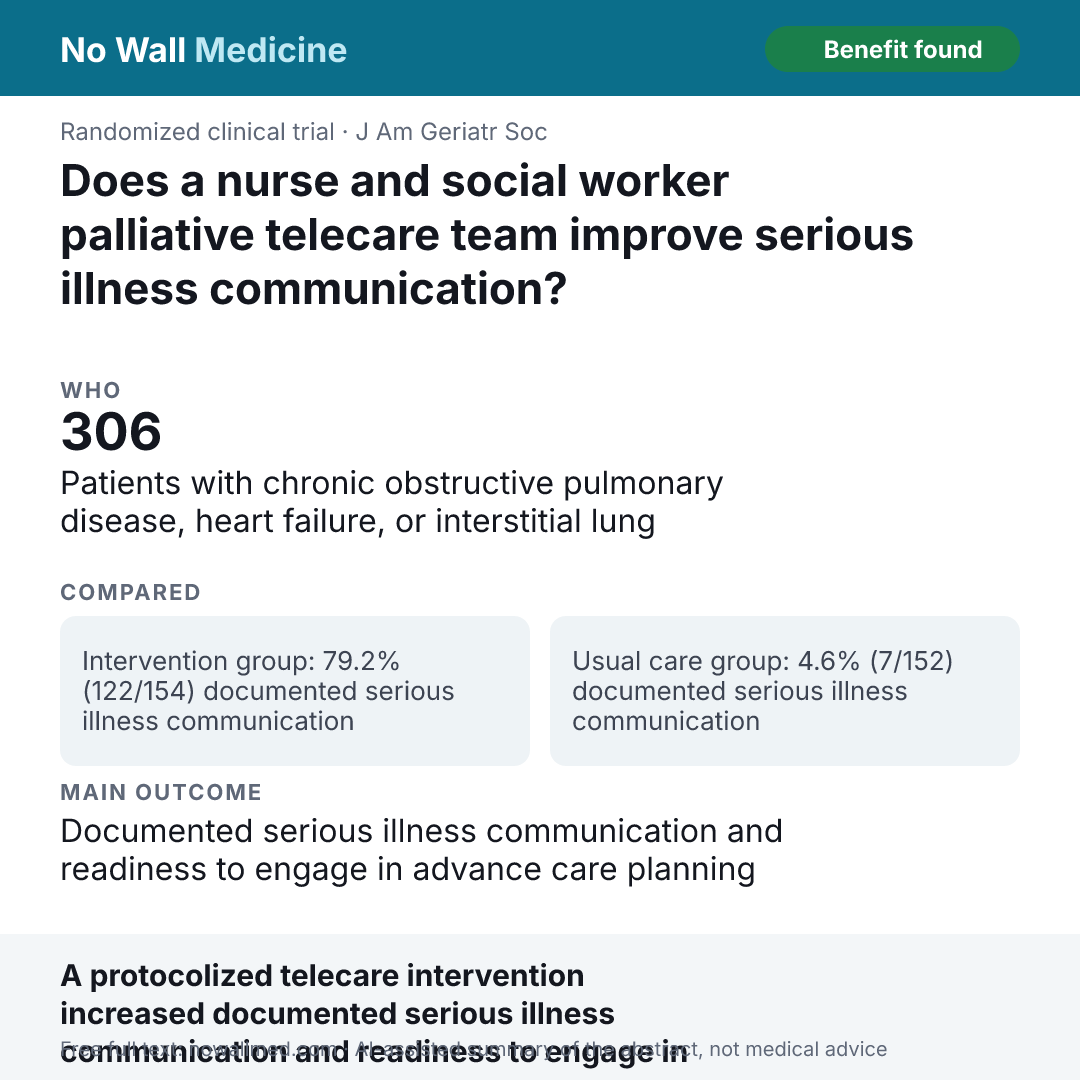
Does a nurse and social worker palliative telecare team improve serious illness communication?
Who
306
Patients with chronic obstructive pulmonary disease, heart failure, or interstitial lung disease
Compared
Intervention group: 79.2% (122/154) documented serious illness communication
Usual care group: 4.6% (7/152) documented serious illness communication
Main outcome
Documented serious illness communication and readiness to engage in advance care planning
Result: adjusted difference in proportions 74.6% (95% CI 67.3-81.9)
Bottom line: A protocolized telecare intervention increased documented serious illness communication and readiness to engage in advance care planning.
Limitation: Future research should evaluate how documented serious illness communication affects downstream healthcare decisions and patient well-being.
J Am Geriatr Soc · 2025-03-22 · Save PNG
Same trial (NCT02713347)
Papers we list that report this registered trial, oldest first. Read a secondary analysis alongside the main results.
- Main results Benefit found
Palliative telecare team improves quality of life for patients with chronic lung or heart disease JAMA 2024-01 - Related analysis Benefit found
This paper J Am Geriatr Soc 2025-03
Clinical question: Does a nurse and social worker palliative telecare team improve serious illness communication?
Why it matters: Clinician time constraints, limited training, and patient readiness make it difficult to engage patients in complex serious illness communication.
In absolute numbers
Intervention group: 79.2% · Usual care group: 4.6% → a difference of 74.6 percentage points, so about 2 people would need the treatment for 1 more to benefit (number needed to treat) over the trial’s follow-up.
Worked out by us from the two group results above, not reported by the authors. Check the paper for the exact outcome and timing.
Key points
- The study followed 306 participants with chronic lung or heart disease who were at high risk of death or hospitalization.
- The intervention group showed higher documented serious illness communication at 6 months compared to usual care (79.2% vs. 4.6%).
- Patient readiness to engage in advance care planning increased more in the intervention group than in the usual care group.
Headline and key points written with AI from the paper’s abstract, with every number checked against it. Read the paper before relying on them.
Was this summary helpful?
Headline, design, result, key points, caveat and citation as plain text.
Cite this article
Lange AV, Feser WJ, Hess E, Barón AE, Ma JE, Bekelman DB. Serious Illness Communication in a Randomized Trial of a Nurse and Social Worker Palliative Telecare Team. J Am Geriatr Soc. 2025. doi:10.1111/jgs.19445
Spotted a mistake? Suggest a correction