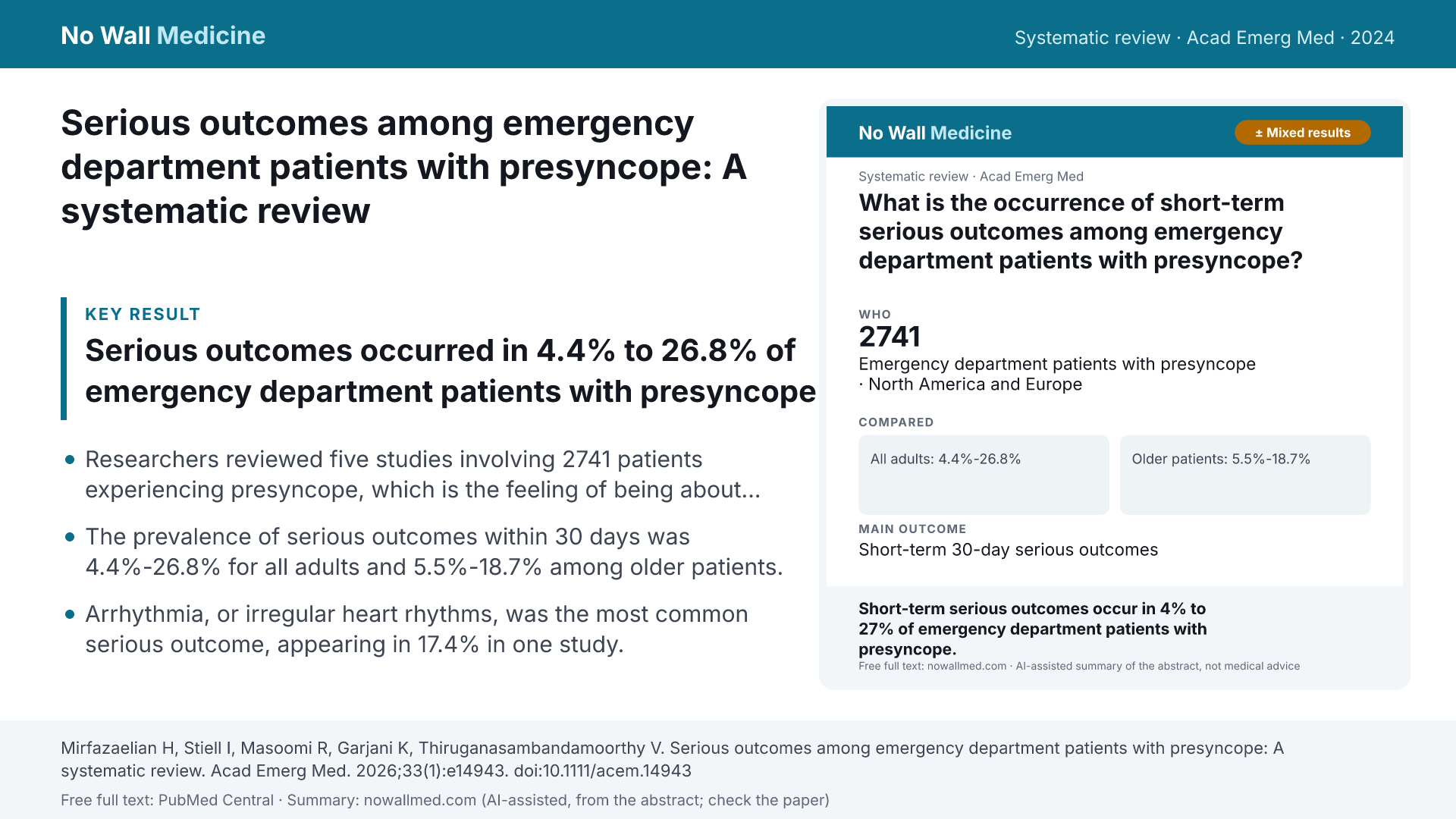
Serious outcomes occurred in 4.4% to 26.8% of emergency department patients with presyncope
Serious outcomes among emergency department patients with presyncope: A systematic review
Systematic reviewMixed results
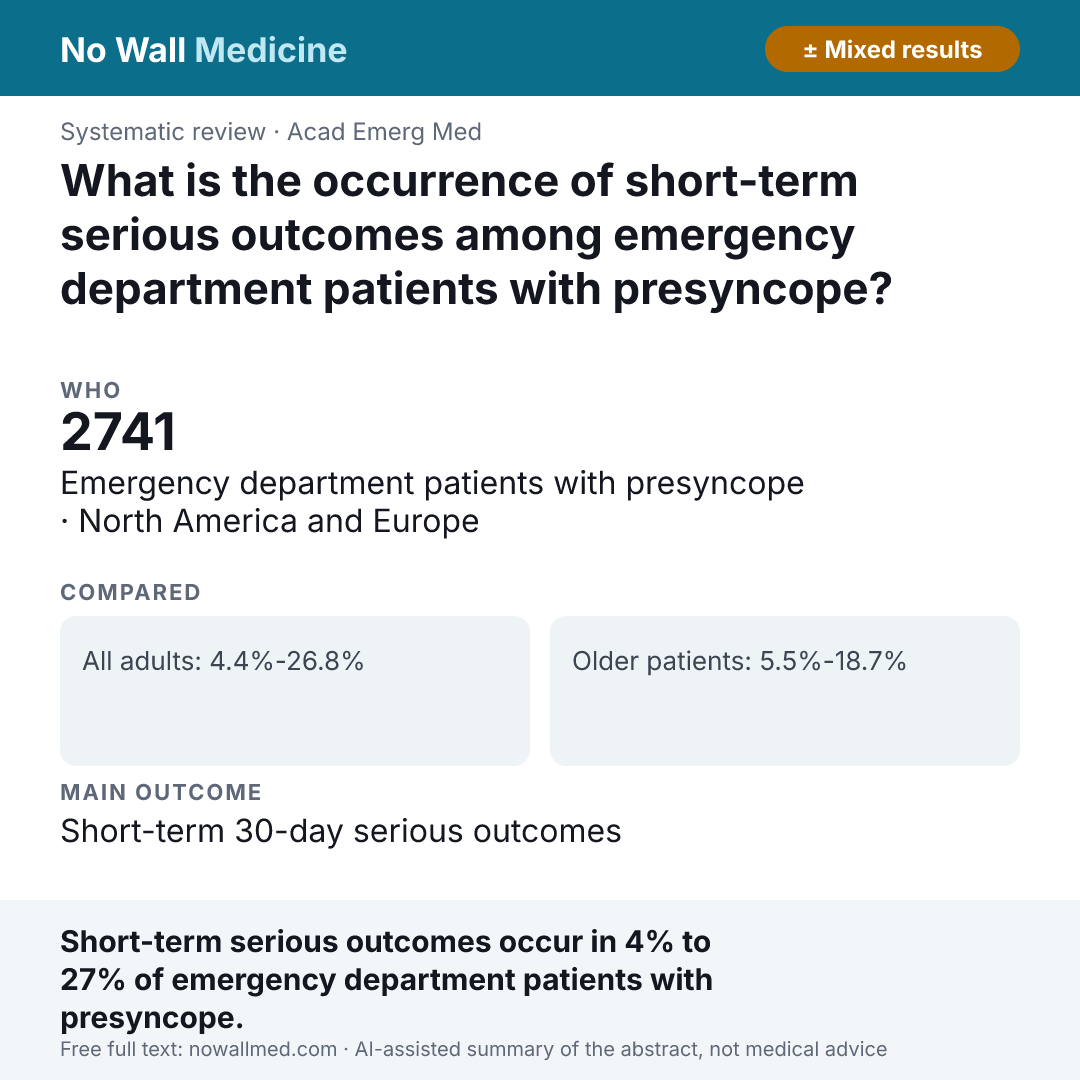
What is the occurrence of short-term serious outcomes among emergency department patients with presyncope?
Who
2741
Emergency department patients with presyncope · North America and Europe
Compared
All adults: 4.4%-26.8%
Older patients: 5.5%-18.7%
Main outcome
Short-term 30-day serious outcomes
Bottom line: Short-term serious outcomes occur in 4% to 27% of emergency department patients with presyncope.
Limitation: Included studies had weaknesses due to risk of bias.
Acad Emerg Med · 2024-06-09 · Save PNG
Clinical question: What is the occurrence of short-term serious outcomes among emergency department patients with presyncope?
Why it matters: The occurrence and management of short-term serious outcomes for patients presenting to the emergency department with presyncope are not well studied.
Key points
- Researchers reviewed five studies involving 2741 patients experiencing presyncope, which is the feeling of being about to faint without actually losing consciousness.
- The prevalence of serious outcomes within 30 days was 4.4%-26.8% for all adults and 5.5%-18.7% among older patients.
- Arrhythmia, or irregular heart rhythms, was the most common serious outcome, appearing in 17.4% in one study.
Limitation the authors note: Included studies had weaknesses due to risk of bias.
Headline and key points written with AI from the paper’s abstract, with every number checked against it. Read the paper before relying on them.
Was this summary helpful?
Subject terms
Headline, design, result, key points, caveat and citation as plain text.
Cite this article
Mirfazaelian H, Stiell I, Masoomi R, Garjani K, Thiruganasambandamoorthy V. Serious outcomes among emergency department patients with presyncope: A systematic review. Acad Emerg Med. 2026;33(1):e14943. doi:10.1111/acem.14943
Spotted a mistake? Suggest a correction