COVID-19 vaccine seroconversion rates are lower or slower in patients with cancer
Seroconversion rate after vaccination against COVID-19 in patients with cancer-a systematic review
Systematic reviewMixed results
What is the immunogenicity of COVID-19 vaccines in patients with cancer?
Who
Patients with cancer
Compared
Patients with cancer: lower or lagged seroconversion rate
General population
Main outcome
Seroconversion rate after vaccination
Bottom line: COVID-19 vaccination is safe but seroconversion rates in cancer patients are lower or lagged compared to the general population.
Ann Oncol · 2021-10-28Download image
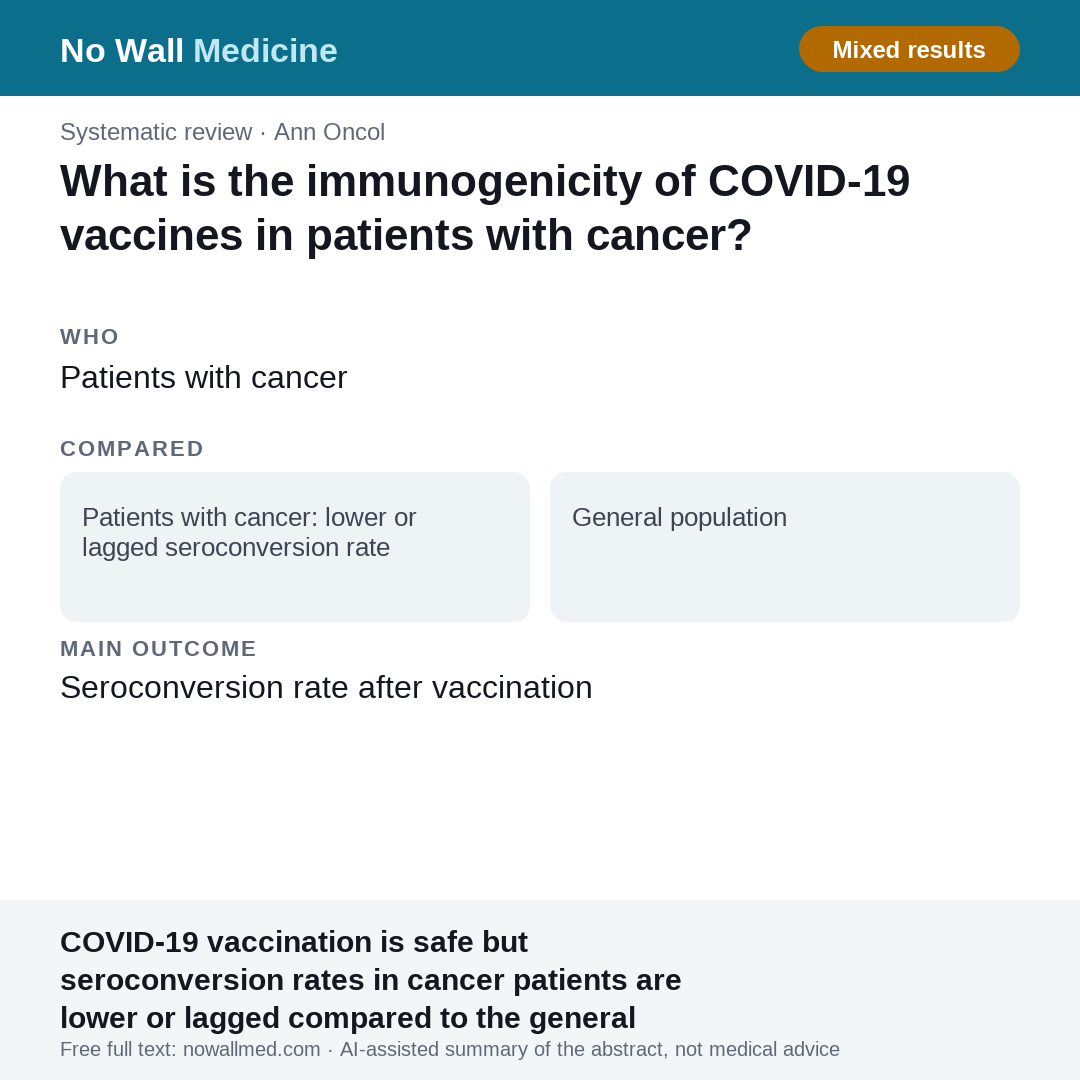
Clinical question: What is the immunogenicity of COVID-19 vaccines in patients with cancer?
Why it matters: It was unknown how COVID-19 vaccines affect the immune response in patients with cancer because these individuals were mostly excluded from clinical trials.
Key points
- Researchers conducted a systematic review of prospective studies evaluating the safety and immune response to COVID-19 vaccines in patients with cancer.
- The review found that seroconversion, or the development of detectable antibodies, was lower or lagged in cancer patients compared to the general population.
- Patients with blood cancers, particularly those who received B-cell-depleting agents in the previous 12 months, were associated with the highest risk of poor antibody response.
Headline and key points written with AI from the paper’s abstract, with every number checked against it. Read the paper before relying on them.
Was this summary helpful?
Subject terms
Cite this article
Corti C, Antonarelli G, Scotté F, Spano JP, Barrière J, Michot JM. Seroconversion rate after vaccination against COVID-19 in patients with cancer-a systematic review. Ann Oncol. 2021. doi:10.1016/j.annonc.2021.10.014
Spotted a mistake? Suggest a correction
Top studies every Monday
The week’s key trials and guidelines in your specialties, plus any topics you follow. By email, free.
Get the weekly digest