Serum CA19.9 shows poor accuracy for detecting high-grade dysplasia or invasive carcinoma in IPMN patients
Serum CA19.9 for Detecting High-Grade Dysplasia and Invasive Carcinoma in Patients With Intraductal Papillary Mucinous Neoplasm: A Systematic Review and Meta-Analysis
Systematic review and meta-analysisMixed results
What is the diagnostic accuracy of serum CA19.9 for detecting high-grade dysplasia and invasive carcinoma in IPMN?
Who
5281
Patients with resected intraductal papillary mucinous neoplasm
Compared
High-grade dysplasia or invasive carcinoma present: 0.35 (95% CI, 0.29-0.43) sensitivity
High-grade dysplasia or invasive carcinoma absent: 0.90 (95% CI, 0.87-0.92) specificity
Main outcome
Diagnostic accuracy of serum carbohydrate antigen 19.9
Result: area under the curve 0.78 (95% CI 0.74 to 0.82)
Bottom line: Serum CA19.9 has poor performance for excluding high-grade dysplasia or invasive carcinoma and only modest value for ruling them in.
Limitation: Future studies should investigate whether different cutoffs and dynamic trends could improve diagnostic accuracy.
JAMA Netw Open · 2026-06-01Download image
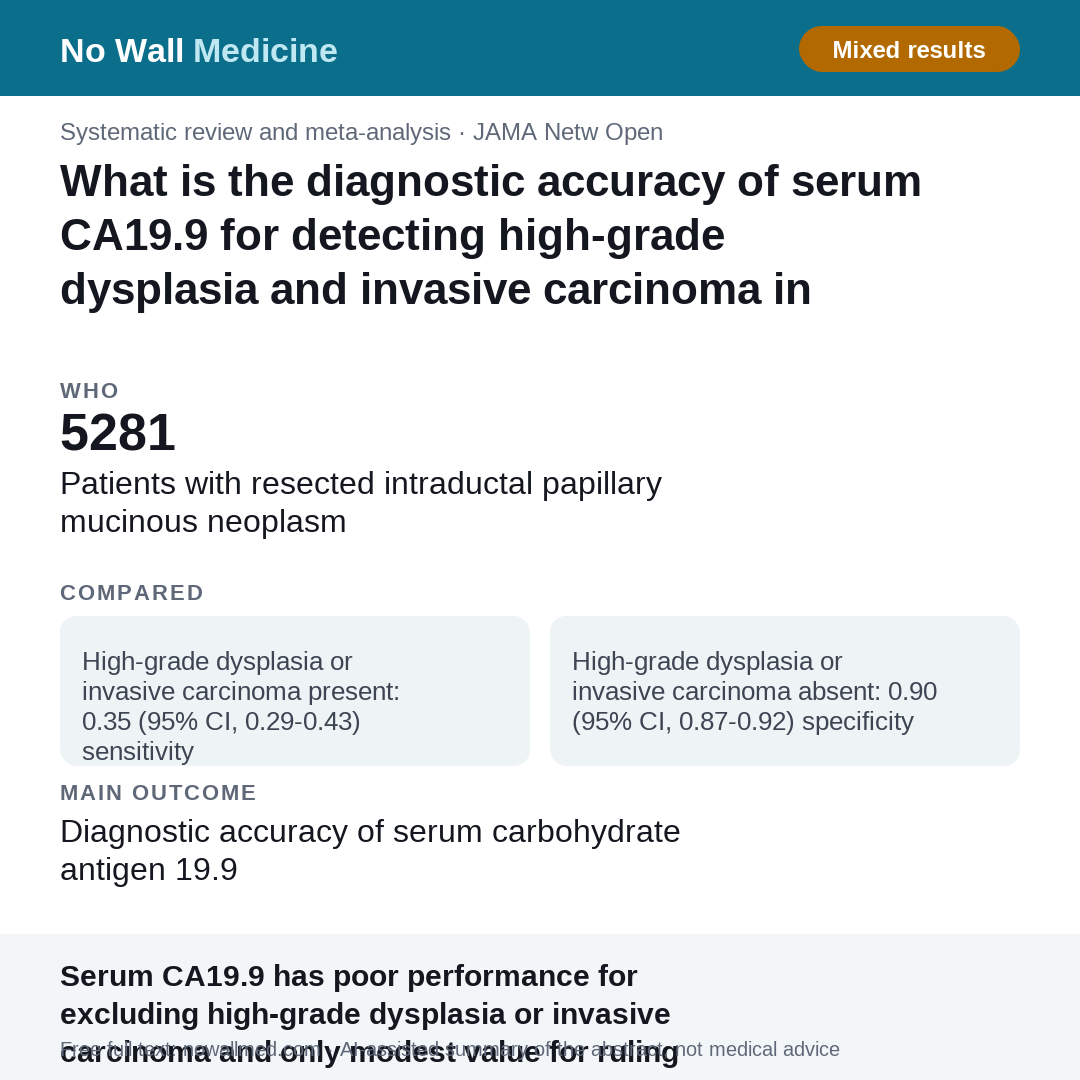
Clinical question: What is the diagnostic accuracy of serum CA19.9 for detecting high-grade dysplasia and invasive carcinoma in IPMN?
Why it matters: Current guidelines recommend using the CA19.9 blood test to detect high-grade dysplasia or invasive carcinoma in patients with intraductal papillary mucinous neoplasm.
Key points
- Researchers analyzed 24 studies involving 5281 patients with intraductal papillary mucinous neoplasm to evaluate the diagnostic accuracy of the CA19.9 blood test.
- The test showed a sensitivity of 0.35 and a specificity of 0.90 for identifying high-grade dysplasia or invasive carcinoma among 1939 patients.
- The overall area under the curve for test performance was 0.78, suggesting the test is poor at excluding disease and only modestly useful for ruling it in.
Headline and key points written with AI from the paper’s abstract, with every number checked against it. Read the paper before relying on them.
Topics
Cite this article
Leseman CA, Bonomi AM, Schuitema J, Granieri S, Sällberg Chen M, Maker AV. Serum CA19.9 for Detecting High-Grade Dysplasia and Invasive Carcinoma in Patients With Intraductal Papillary Mucinous Neoplasm: A Systematic Review and Meta-Analysis. JAMA Netw Open. 2026. doi:10.1001/jamanetworkopen.2026.17587
Spotted a mistake? Suggest a correction