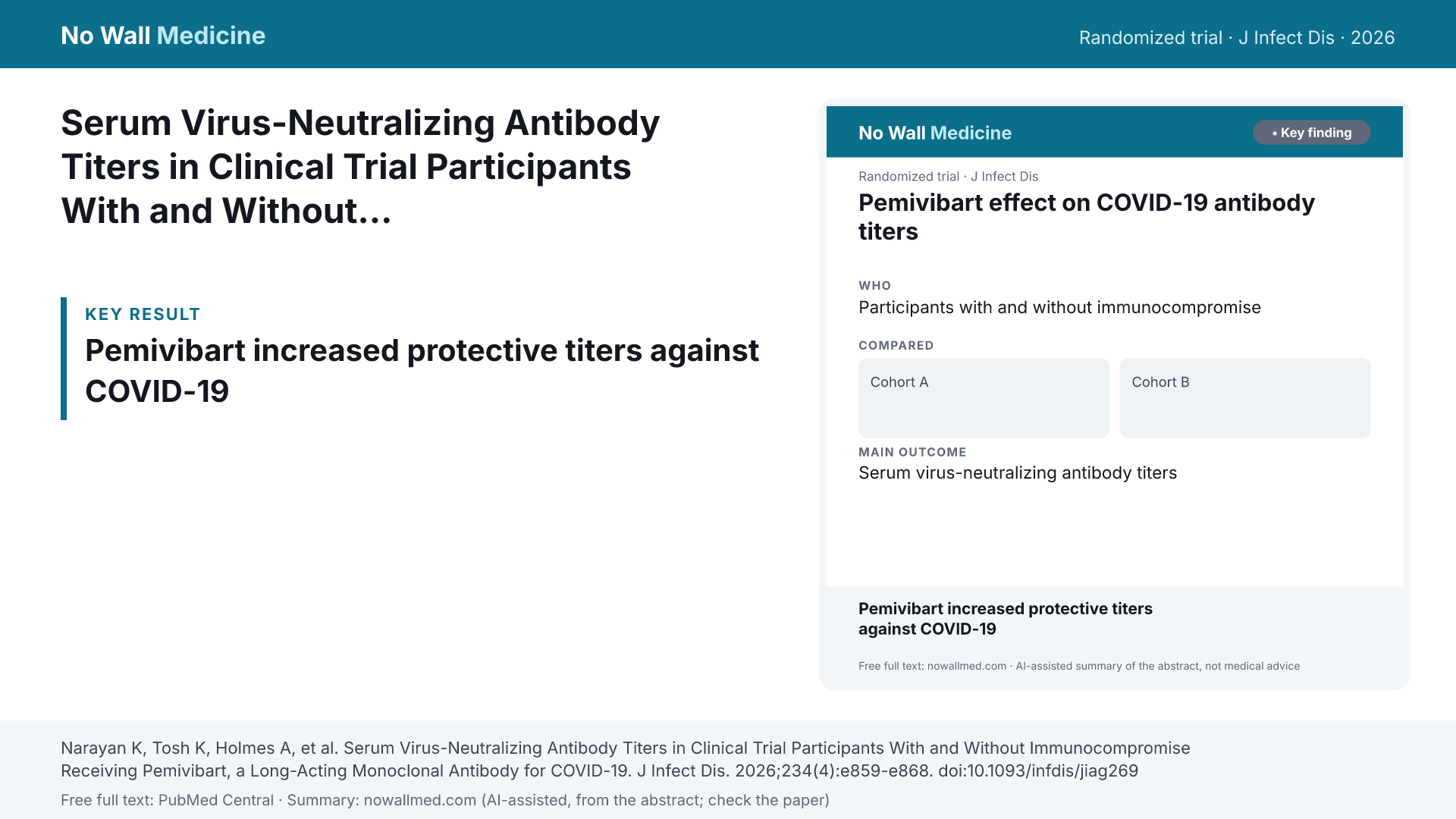
Serum Virus-Neutralizing Antibody Titers in Clinical Trial Participants With and Without Immunocompromise Receiving Pemivibart, a Long-Acting Monoclonal Antibody for COVID-19
Randomized trialKey finding
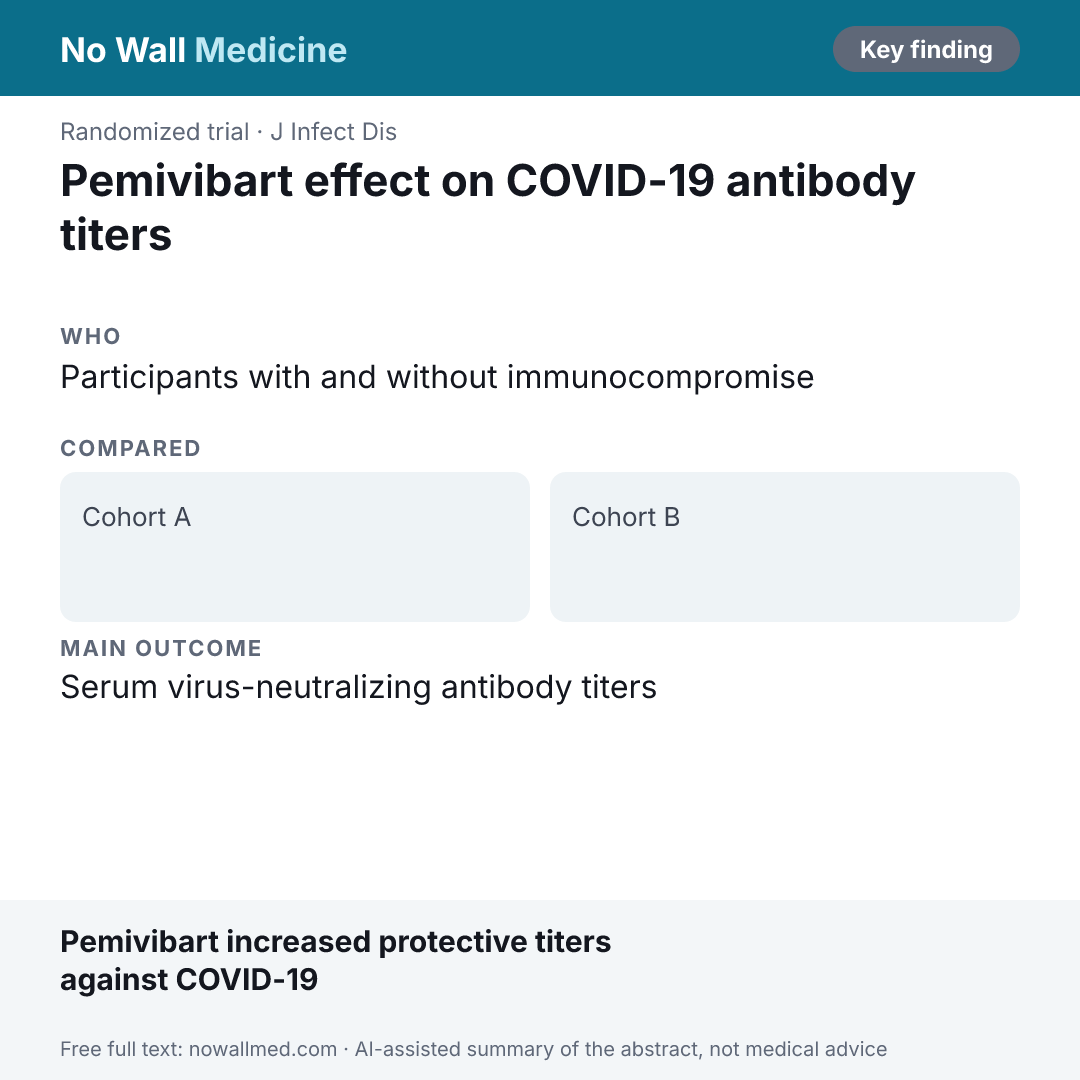
Pemivibart effect on COVID-19 antibody titers
Who
Participants with and without immunocompromise
Compared
Cohort A
Cohort B
Main outcome
Serum virus-neutralizing antibody titers
Bottom line: Pemivibart increased protective titers against COVID-19
J Infect Dis · 2026-05-21 · Save PNG
Same trial (NCT06039449, NCT05791318)
Papers we list that report this registered trial, oldest first. Read a secondary analysis alongside the main results.
- Main results
Pemivibart reduced symptomatic COVID-19 cases in immunocompetent adults in phase 3 trial Clin Infect Dis 2025-05 - Related analysis Key finding
This paper J Infect Dis 2026-05
Abstract
Background
Pemivibart received emergency use authorization for COVID-19 prevention in certain individuals with immunocompromise based on immunobridging calculated serum virus-neutralizing antibody (csVNA) titers. We report an analysis of measured (msVNA) titers against severe acute respiratory syndrome coronavirus 2 (SARS-CoV-2) variants before and after receipt of pemivibart in a SARS-CoV-2 immune-experienced population (CANOPY) and compare the relationship between csVNA and msVNA titers in 2 clinical trials. Methods
The trials were conducted during 2023-2024. In the phase 3 CANOPY trial, participants with (cohort A) or without (cohort B) significant immunocompromise received 2 intravenous 4500-mg pemivibart or placebo infusions 90 days apart. In the phase 1 trial, healthy adults received a single intravenous dose of pemivibart (1500, 2500, or 4500 mg). msVNA titers were determined using a SARS-CoV-2 spike pseudotyped assay; csVNA titers were calculated as serum pemivibart concentrations divided by variant-specific IC50 values from in vitro neutralization assays. Results
In CANOPY, predose msVNA geometric mean titers (GMTs) to the dominant circulating XBB.1.5 lineage were low across cohorts (range, 78.6-119.8), suggesting inadequate protection. msVNA titers were substantially higher against earlier Delta (B.1.617.2) and BA.4/5 variants. Pemivibart increased the day-28 msVNA GMT >55-fold against XBB.1.5, with similar levels in both cohorts. Across trials, csVNA titers were significantly correlated with msVNA titers (all Spearman correlation coefficients ≥0.73, P < .0001). Conclusions
These data show that previous immune experience to earlier pandemic variants provided limited cross-protection and demonstrate that pemivibart increased protective titers against newly circulating SARS-CoV-2 in individuals with and without immunocompromise. Notably, csVNA titers effectively predicted pemivibart's neutralization potential. Clinical Trials Registration. NCT06039449 and NCT05791318.
Subject terms
Headline, design, result, key points, caveat and citation as plain text.
Cite this article
Narayan K, Tosh K, Holmes A, et al. Serum Virus-Neutralizing Antibody Titers in Clinical Trial Participants With and Without Immunocompromise Receiving Pemivibart, a Long-Acting Monoclonal Antibody for COVID-19. J Infect Dis. 2026;234(4):e859-e868. doi:10.1093/infdis/jiag269
Spotted a mistake? Suggest a correction