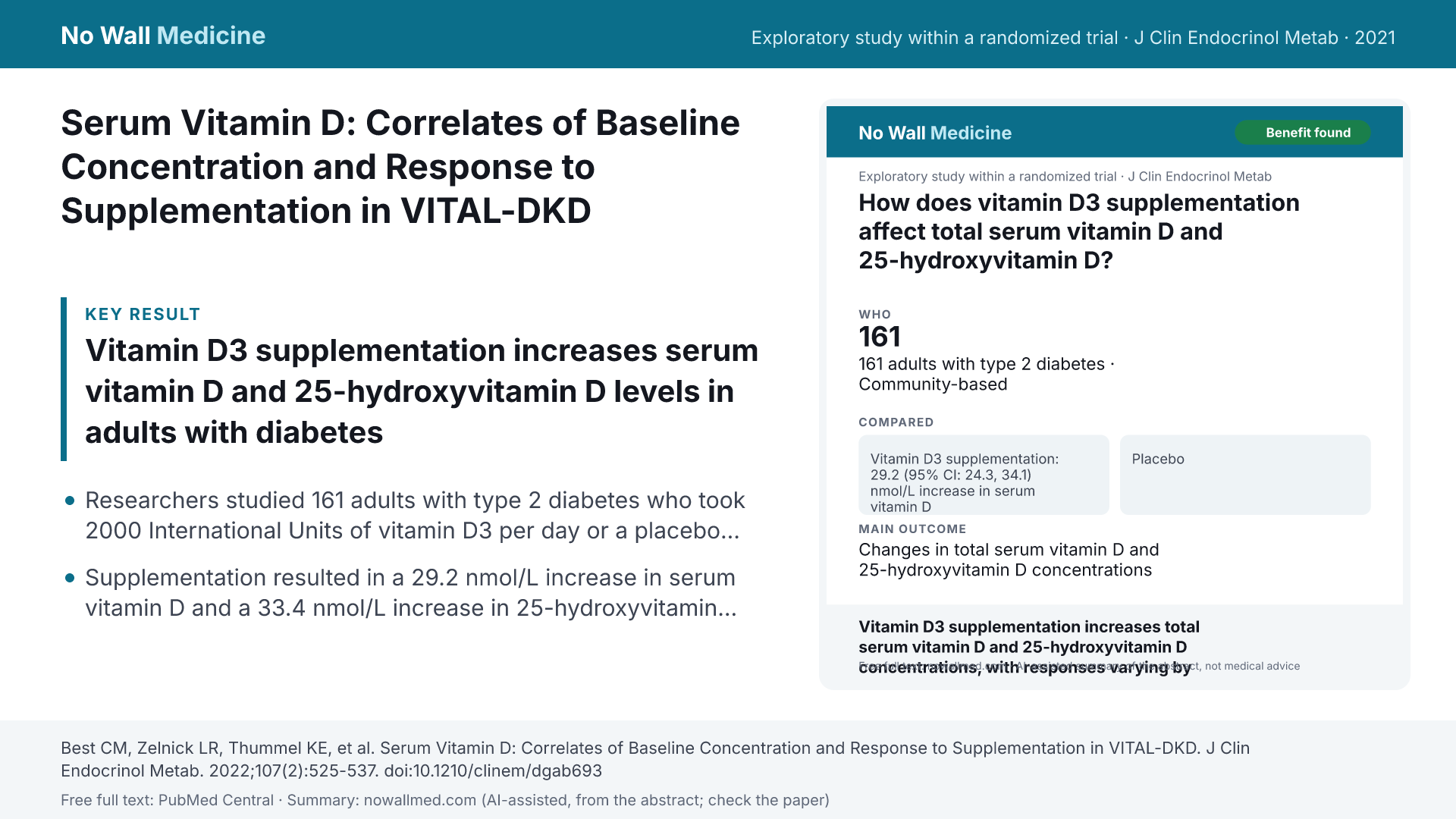
Vitamin D3 supplementation increases serum vitamin D and 25-hydroxyvitamin D levels in adults with diabetes
Serum Vitamin D: Correlates of Baseline Concentration and Response to Supplementation in VITAL-DKD
Exploratory study within a randomized trialBenefit found
How does vitamin D3 supplementation affect total serum vitamin D and 25-hydroxyvitamin D?
Who
161
161 adults with type 2 diabetes · Community-based
Compared
Vitamin D3 supplementation: 29.2 (95% CI: 24.3, 34.1) nmol/L increase in serum vitamin D
Placebo
Main outcome
Changes in total serum vitamin D and 25-hydroxyvitamin D concentrations
Result: 29.2 (95% CI: 24.3, 34.1) nmol/L increase in serum vitamin D
Bottom line: Vitamin D3 supplementation increases total serum vitamin D and 25-hydroxyvitamin D concentrations, with responses varying by baseline levels.
J Clin Endocrinol Metab · 2021-09-21 · Save PNG
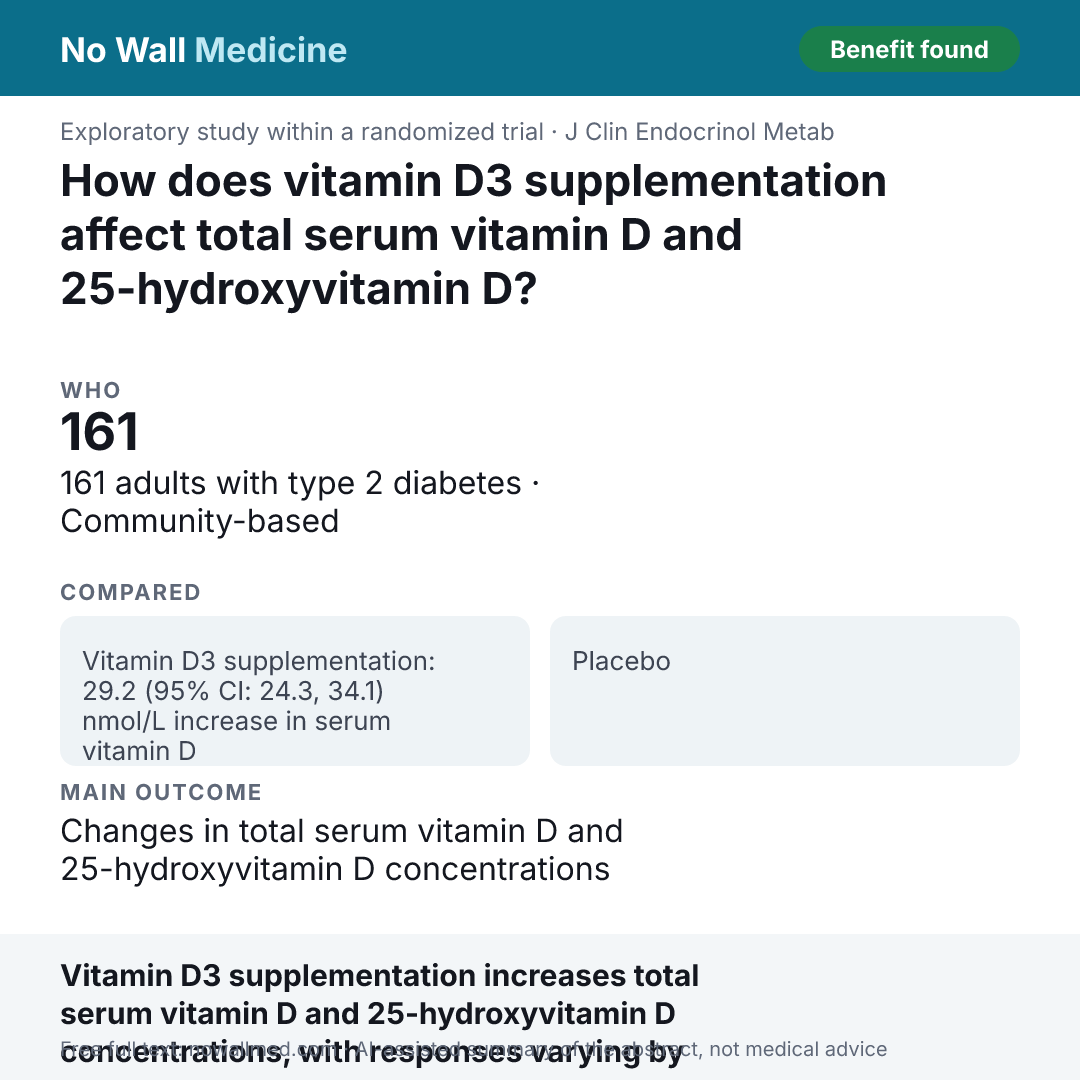
Clinical question: How does vitamin D3 supplementation affect total serum vitamin D and 25-hydroxyvitamin D?
Key points
- Researchers studied 161 adults with type 2 diabetes who took 2000 International Units of vitamin D3 per day or a placebo for 2 years.
- Supplementation resulted in a 29.2 nmol/L increase in serum vitamin D and a 33.4 nmol/L increase in 25-hydroxyvitamin D, the form used clinically.
- The response to supplementation varied by baseline levels, with a 15.7 nmol/L increase in serum vitamin D for those starting below 50 nmol/L.
Headline and key points written with AI from the paper’s abstract, with every number checked against it. Read the paper before relying on them.
Was this summary helpful?
Subject terms
Headline, design, result, key points, caveat and citation as plain text.
Cite this article
Best CM, Zelnick LR, Thummel KE, et al. Serum Vitamin D: Correlates of Baseline Concentration and Response to Supplementation in VITAL-DKD. J Clin Endocrinol Metab. 2022;107(2):525-537. doi:10.1210/clinem/dgab693
Spotted a mistake? Suggest a correction