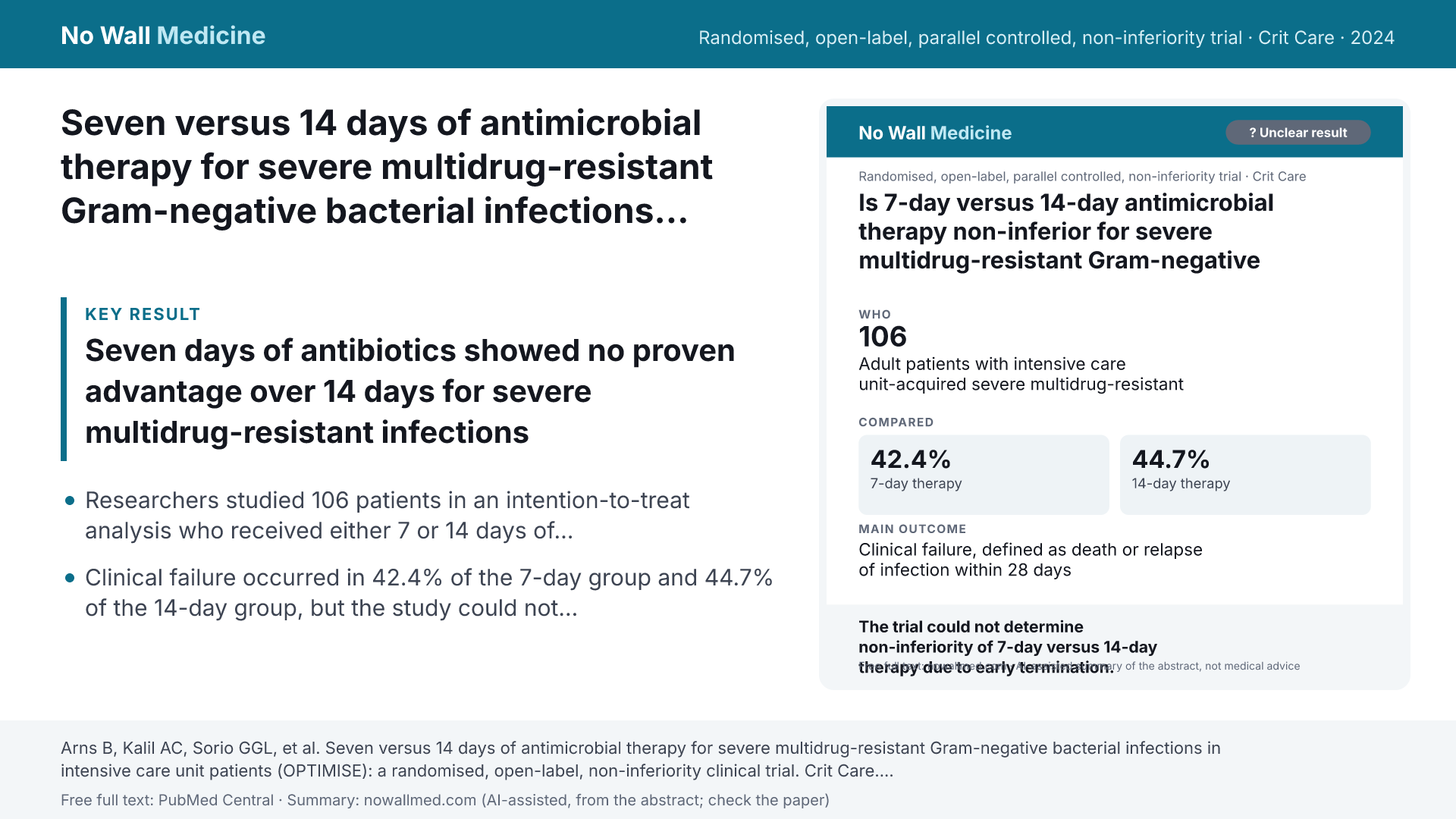
Seven days of antibiotics showed no proven advantage over 14 days for severe multidrug-resistant infections
Seven versus 14 days of antimicrobial therapy for severe multidrug-resistant Gram-negative bacterial infections in intensive care unit patients (OPTIMISE): a randomised, open-label, non-inferiority clinical trial
Randomised, open-label, parallel controlled, non-inferiority trialUnclear result
Is 7-day versus 14-day antimicrobial therapy non-inferior for severe multidrug-resistant Gram-negative bacterial infections?
Who
106
Adult patients with intensive care unit-acquired severe multidrug-resistant Gram-negative bacterial infections · Multicenter
Compared
42.4%7-day therapy
44.7%14-day therapy
Main outcome
Clinical failure, defined as death or relapse of infection within 28 days
Result: risk difference -2.3, 95%CI -21.3 to 16.7
Bottom line: The trial could not determine non-inferiority of 7-day versus 14-day therapy due to early termination.
Limitation: The study was interrupted before reaching planned sample size due to low recruitment rate.
Crit Care · 2024-12-18 · Save PNG
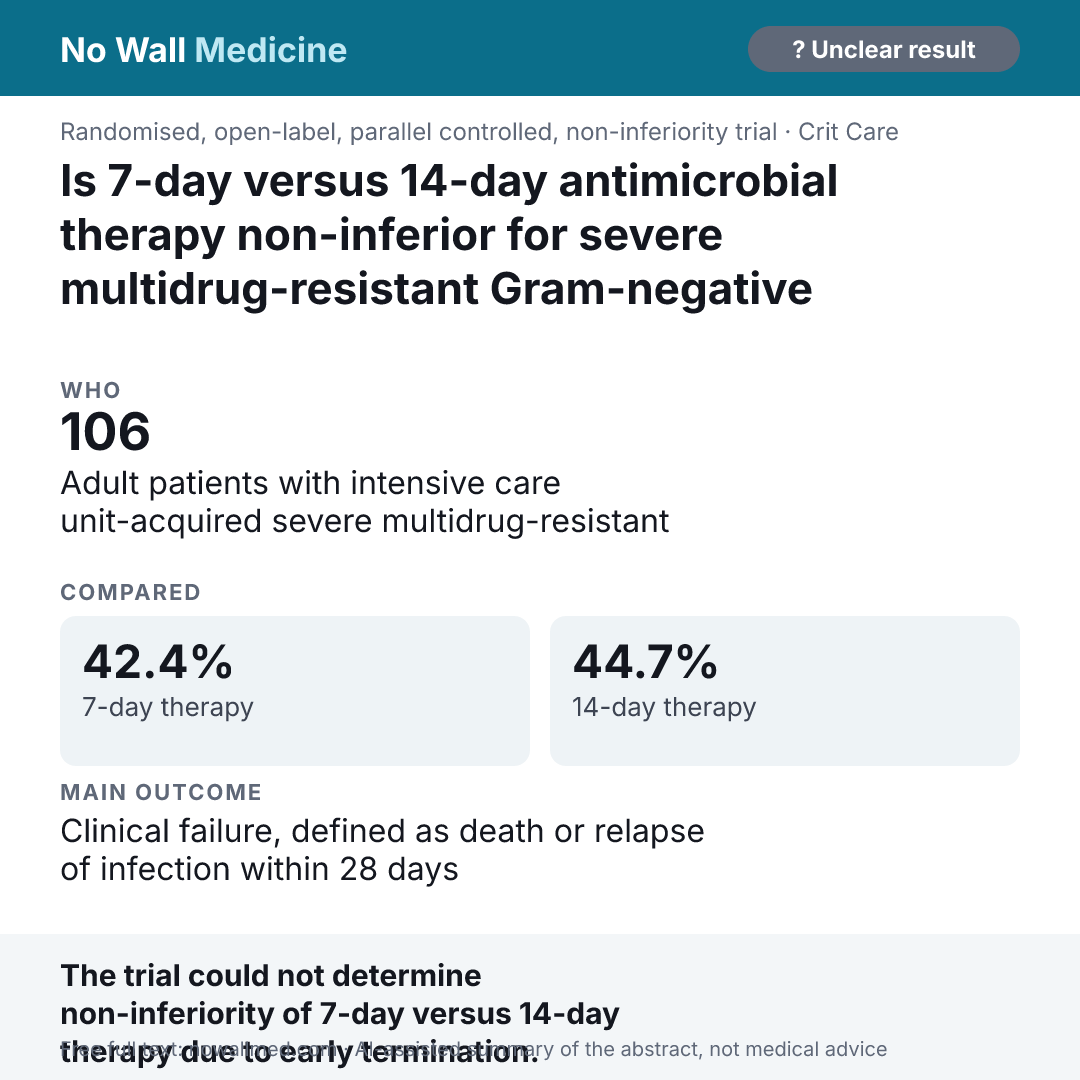
Clinical question: Is 7-day versus 14-day antimicrobial therapy non-inferior for severe multidrug-resistant Gram-negative bacterial infections?
Key points
- Researchers studied 106 patients in an intention-to-treat analysis who received either 7 or 14 days of antimicrobial therapy for severe multidrug-resistant Gram-negative bacterial infections.
- Clinical failure occurred in 42.4% of the 7-day group and 44.7% of the 14-day group, but the study could not determine non-inferiority.
- Most infections were respiratory tract infections and were caused by carbapenem-resistant Enterobacterales, which are bacteria resistant to a specific class of antibiotics.
Headline and key points written with AI from the paper’s abstract, with every number checked against it. Read the paper before relying on them.
Was this summary helpful?
Subject terms
Headline, design, result, key points, caveat and citation as plain text.
Cite this article
Arns B, Kalil AC, Sorio GGL, et al. Seven versus 14 days of antimicrobial therapy for severe multidrug-resistant Gram-negative bacterial infections in intensive care unit patients (OPTIMISE): a randomised, open-label, non-inferiority clinical trial. Crit Care. 2024;28(1):412. doi:10.1186/s13054-024-05178-6
Spotted a mistake? Suggest a correction